On this page
Top picks at a glance
As an Amazon Associate I earn from qualifying purchases.
- 1
 EAGLE PEAK 10x10 Walk in Pop Up GreenhouseView on Amazon
- 2
 VIVOSUN S108 10x10 Extra Large Grow Tent 120"x120"x80" IndoorView on Amazon
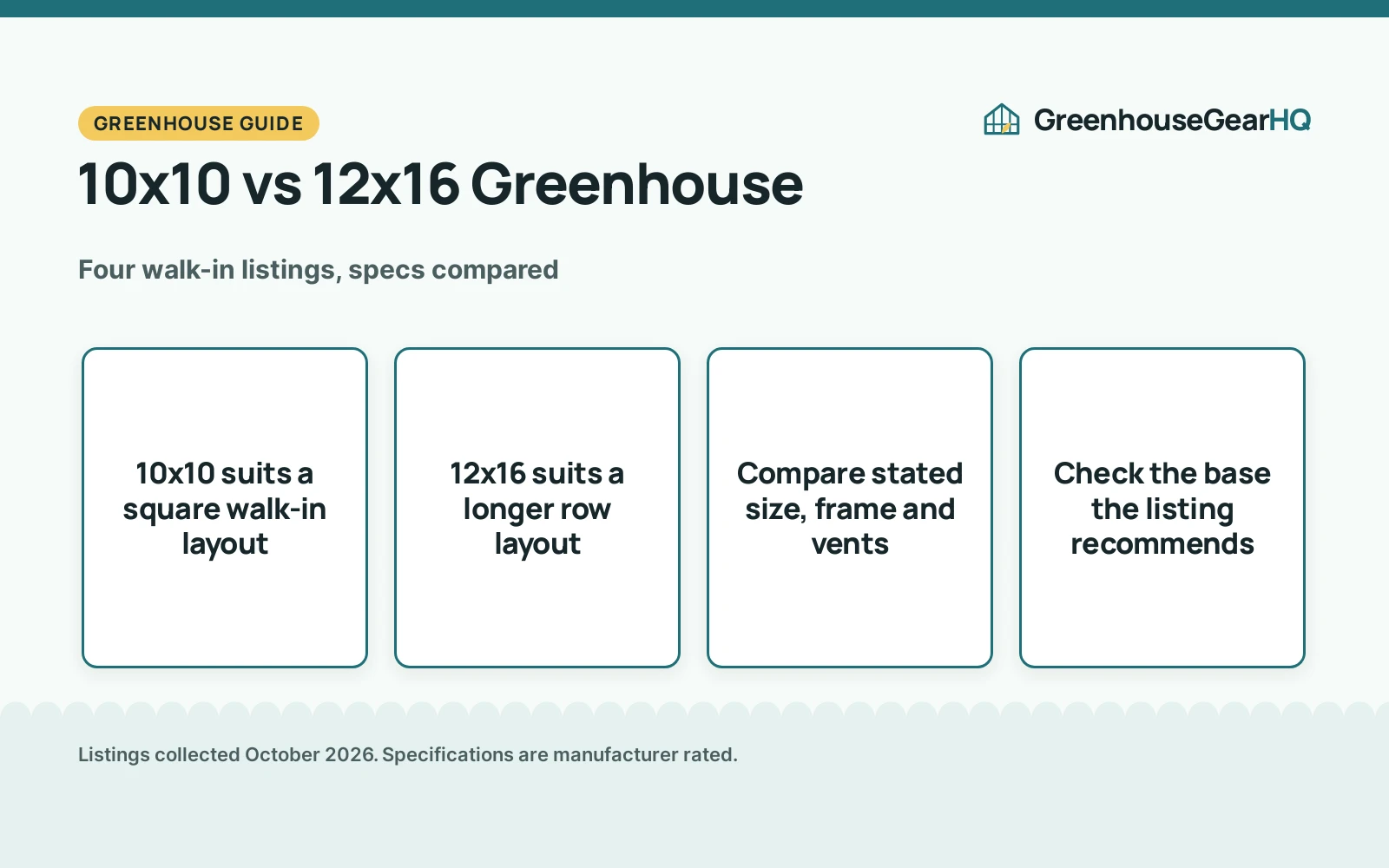
For a first walk-in greenhouse, the 10×10 vs 12×16 greenhouse question comes down to shape, not just size: pick the 10×10 when a square walk-in with a center bench fits the plot, and pick the 12×16 when you want a longer house with an aisle layout for rows or stands down the length. This guide compares four walk-in listings by stated size, frame, cover and ventilation, so you can match the footprint to the beds, benches and paths you plan to keep inside.
Other options worth a look
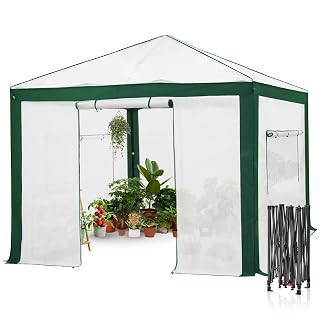 EAGLE PEAK 10x10 Walk in Pop Up GreenhouseCheck price on Amazon
 VIVOSUN S108 10x10 Extra Large Grow Tent 120"x120"x80" IndoorCheck price on Amazon
GreenhouseGearHQ earns a commission when you buy through links on this page, at no extra cost to you. As an Amazon Associate I earn from qualifying purchases. Affiliate disclosure.
What the two sizes give you
A 10×10 house is close to square, so the middle stays open: the Benass 10×10 listing describes wide open space for potted trees and center potting benches, and the Porayhut hexagon pop-up lists 120 x 103.5 x 90.6 inches, a broad walk-in shape with front and back doors. A longer house trades some of that open middle for aisle length: Benass lists an 8×12 FT size for long aisle layouts for multi-tier plant stands, which shows how extra length becomes standing room and shelf rows rather than one open floor. When the plot is narrow, the longer shape can also be easier to place along a fence or wall, while a square house needs clear space on more sides for its doors and windows.
Height matters as much as footprint. The Jocisland 8×10 lists an 8x10x6.7 FT size, and the Porayhut lists 120 x 103.5 x 90.6 inches, so always check the listed height against the tallest plant or shelf you plan to keep inside, and check the door style, since a roll-up door, a swing door and a zippered door change how you move a wheelbarrow or a potting bench in and out. Check the listed height against the tallest plant or shelf you plan to keep inside, and check the door style, since a roll-up door, a swing door and a zippered door change how you move a wheelbarrow or a potting bench in and out.
Four listings to compare
The four listings below cover the two builds most buyers weigh: pop-up houses with soft covers, and polycarbonate houses with aluminum frames. None of them is a 12×16 model, so use them to judge what each size class offers, then check the stated size on any 12×16 listing before ordering.
| Listing | Stated size | Frame and cover | Ventilation and doors |
|---|---|---|---|
| Porayhut hexagon pop-up | 120 x 103.5 x 90.6 in | 600D Oxford, double-layer PVC and mesh | 4 screen windows, front and back doors |
| Benass 10×10 pop-up | 10×10 FT | Powder-coated steel frame, PE cover | Roll-up zipper door, dual mesh side windows |
| Garvee 8×10 polycarbonate | 8×10 FT | Aluminum frame, polycarbonate panels | Roof vent, lockable swing door |
| Jocisland 8×10 polycarbonate | 8×10 FT | Aluminum frame, 4mm PC panels | 2 top windows, swing doors |
The Porayhut pop-up lists 4 screen windows and front and back doors: 6 camping ropes and 12 U-shape ground stakes hold it down, 3 glass poles support an arched roof, and a detachable PE mat sits underfoot for watering and drainage. Its bullets list 120 x 103.5 x 90.6 inches while its spec table lists a different third figure, so this guide uses the bullet figures and you should confirm the size on the listing before ordering. The Benass 10×10 is the other pop-up: a pre-assembled accordion frame that sets up in minutes with two people and zero tools, folds into a carry bag, and lets you bury an extended cover skirt with soil, bricks or gravel for a seal.
The two polycarbonate houses trade the pop-up’s fast setup for a fixed frame. The Garvee lists 1.58 lb per sq ft panels, a snow load of over 110 lbs per sq ft, an adjustable roof vent, a lockable swing door, a UV-blocking coating, a built-in rain gutter and 4 ground anchor kits, and it ships in 2 boxes. The Jocisland lists 4mm PC panels that block 99.99% of UV rays, cross beams, top braces and corner supports, a gable roof with built-in roof channels, and assembly in 2 to 3 hours with two people. Its listing also gives recommended bases of 8.62 x 10.4 ft and 8.62 x 12.4 ft, so check which base matches the spot you have.
How to choose a 10×10 vs 12×16 greenhouse
Measure the plot, the path and the base
Start with the ground, not the catalog size. A 10×10 house needs a square patch plus room to open its doors, while a 12×16 house needs a longer run and a path down the middle, so walk the plot and picture where benches, pots and a watering can will go. Where a listing gives a recommended base, as the Jocisland does with 8.62 x 10.4 ft and 8.62 x 12.4 ft, use that figure for the foundation rather than the headline size. If the ground is soft, check the anchoring the listing states: the Porayhut lists 12 U-shape stakes, the Benass lists ground stakes and guy ropes, and the Garvee lists 4 ground anchor kits.
Match the cover and frame to the season
Soft-cover pop-ups suit a seasonal house you put up and take down: the Benass folds into a carry bag, and the Porayhut folds down to 30.7 x 30.7 x 5.12 inches. Polycarbonate houses with aluminum frames suit a house that stays up through winter: the Garvee lists a snow load of over 110 lbs per sq ft, and the Jocisland lists 4mm panels that block 99.99% of UV rays and retain warmth. Our pop-up greenhouse vs polycarbonate greenhouse comparison weighs the two builds in more detail.
Plan ventilation and doors before you buy
Heat builds fast under a cover, so count the openings, not just the size. The Porayhut lists 4 screen windows with roll-up curtains, the Benass lists dual roll-up mesh side windows, the Garvee lists one adjustable roof vent, and the Jocisland lists 2 top windows. Doors matter too: the Benass roll-up zipper door suits passage with a wheelbarrow, the Garvee lockable swing door suits a house left closed, and the Porayhut front and back doors suit through-access. If you plan to grow through summer heat, pick the house whose openings you can open and close easily.
What this guide does not cover
This guide does not cover heaters, fans, watering or shading, and it gives no planting dates, since those depend on the crop and the local climate. It also does not review a 12×16 model directly, because none of the four listings above is a 12×16: use the size, frame and ventilation figures here to judge any 12×16 listing on its own stated specs. For a size comparison at a larger scale, see our 12×12 vs 12×20 greenhouse guide.
FAQ for growers
Can a 10×10 greenhouse hold a potting bench?
Yes, on the listings here. The Benass 10×10 listing describes wide open space for potted trees and center potting benches, so a center bench fits the square layout.
What changes with a longer greenhouse?
Length becomes aisle room. Benass lists an 8×12 FT size for long aisle layouts for multi-tier plant stands, so a longer house suits rows of stands down the length rather than one open floor.
Do these listings state a snow load?
Only the Garvee listing in this guide states one: over 110 lbs per sq ft of snow load, with 1.58 lb per sq ft panels and an aluminum frame. The other three listings state no snow load figure.
How long does assembly take on these listings?
It differs by build. The Benass pop-up sets up in minutes with two people and zero tools, while the Jocisland polycarbonate house lists assembly in 2 to 3 hours with two people.
Keep reading
See every walk-in greenhouses guide and all greenhouses guides.
More picks: pop-up greenhouse for small spaces, aluminum vs polycarbonate greenhouse, greenhouse shelving for shed and pop-up vs polycarbonate greenhouse.