On this page
Top picks at a glance
As an Amazon Associate I earn from qualifying purchases.
- 1
 OWLHAUS U Channel 8mm Polycarbonate Panel End Caps9.6/10View on Amazon
- 2
 HOWE 14x9.5x9 FT Polycarbonate Greenhouse for Outdoors9.7/10View on Amazon
- 3
 OWLHAUS H Channel 4mm Polycarbonate Panel Connectors9.6/10View on Amazon
- 4OWLHAUS Polycarbonate Greenhouse Panel H-ConnectorsView on Amazon
- 5
 KASTLITE Polycarbonate Greenhouse PanelsView on Amazon
- 6KASTLITE 1×1' Twin Wall Polycarbonate Greenhouse PanelView on Amazon
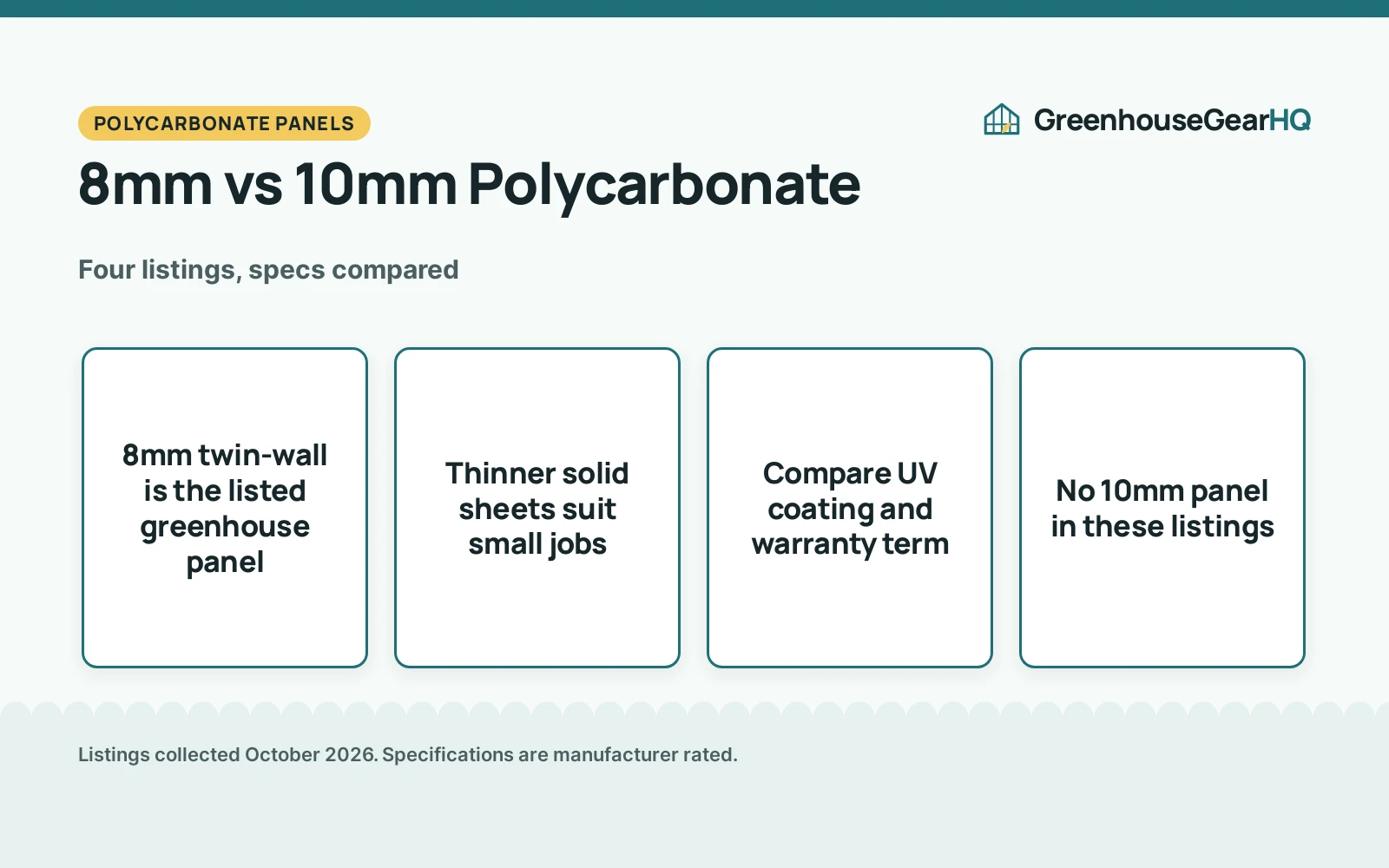
A cold snap is coming and the glazing has to earn its keep, which is when growers ask about 8mm vs 10mm polycarbonate. From the four listings we compared, 8mm twin-wall is the standard greenhouse panel: the UMIG and Silk Road listings both state 8mm twin-wall panels, and none of the four lists a 10mm panel. Thinner solid sheets, about 6mm and 3mm, appear only as small 12 x 12 in hobby sheets, not greenhouse glazing.
Other options worth a look
 OWLHAUS Polycarbonate Greenhouse Panel H-ConnectorsCheck price on Amazon
 KASTLITE Polycarbonate Greenhouse PanelsCheck price on Amazon
- KASTLITE 1×1' Twin Wall Polycarbonate Greenhouse PanelCheck price on Amazon
GreenhouseGearHQ earns a commission when you buy through links on this page, at no extra cost to you. As an Amazon Associate I earn from qualifying purchases. Affiliate disclosure.
What the 8mm twin-wall listings state
The two panel listings agree on thickness and form. The UMIG set lists 8 pieces at 70.9 x 23.6 in (5.9 x 1.97 ft) with a single-layer thickness of 0.32 in (8mm); the Silk Road lists 2 pieces at 72 x 24 x 0.32 in and 8mm thick. The UMIG coats both sides with UV protection, so there is no front or back to distinguish during installation, and states 80% light transmission. The Silk Road states a 10-year warranty and a withstanding range of -40℃ to 105℃, keeping the greenhouse cooler in summer and warmer in winter per the listing. Both state a 1.2 kg per square meter density and impact resistance; the UMIG adds crack resistance, and its 8 panels weigh 9.07 kg in total. The UMIG listing says one piece covers a 6 ft frame with fewer seams, which reduces the chance of leaks in the rainy season, and that the lightweight panels suit curved and arched framing. The Silk Road listing says to peel the protective film from both sides after installation.
Where the thinner solid sheets fit
The Robosource listings are a different product: solid 12 x 12 in sheets, not twin-wall panels. The 1/4 in sheet lists 0.236 in (about 6mm) and the 1/8 in sheet lists 0.118 in (about 3mm); both state UV stabilization, an ASTM specification, shatter resistance and an EasyRuler protective film. The maker says they cut with snips or a hacksaw, drill with standard bits and bend with a heat gun, which suits small jobs: a cold-frame lid, a vent cover, a patch panel. They are not greenhouse-scale glazing, and neither states a warranty term.
How to compare 8mm vs 10mm polycarbonate listings
Compare the same four lines on every listing: stated thickness in millimeters, twin-wall versus solid form, UV coating (both sides, one side or just stabilized), and warranty term. Light transmission and temperature range are bonus lines when stated.
| Panel listing | Stated thickness | Form | UV stated | Warranty |
|---|---|---|---|---|
| UMIG 8-piece set | 8mm (0.32 in) | Twin-wall | Double-sided coating | Not stated |
| Silk Road 2-piece | 8mm (0.32 in) | Twin-wall | Not stated | 10 years |
| Robosource 1/4 in sheet | 0.236 in (approx 6mm) | Solid sheet | UV stabilized | Not stated |
| Robosource 1/8 in sheet | 0.118 in (approx 3mm) | Solid sheet | UV stabilized | Not stated |
For the plastic-versus-polycarbonate decision, see our pvc vs polycarbonate roof panels comparison; for UV questions, see uv plastic vs clear greenhouse plastic.
Which thickness for which job
Match the panel to the job size. For glazing a greenhouse, the 8mm twin-wall listings are the fit: the UMIG set covers larger frames with 8 pieces at 70.9 x 23.6 in each, and the Silk Road 2-piece set lists greenhouses, pool roofs, aisle roofs, garden fences and outdoor canopies as uses. For small repairs, the Robosource solid sheets at 12 x 12 in are the fit: the 1/4 in (about 6mm) sheet for sturdier patches and the 1/8 in (about 3mm) sheet for lighter ones. Do not glaze a full roof with 12 in hobby sheets; the seam count alone argues against it.
What this guide does not cover
We do not compare 10mm panels because none of the four listings states a 10mm thickness. We do not give insulation values, snow-load ratings or install spans, because the listings do not state them; check the panel maker’s specs and your local building code before glazing a roof. We also do not cover cutting tools beyond what the listings state.
FAQ for growers
Is 8mm twin-wall the standard greenhouse panel?
In these four listings, yes: both panel listings state 8mm twin-wall. No 10mm panel is listed here.
What does double-sided UV coating change?
The UMIG listing states UV coating on both sides, so there is no front or back to distinguish during installation, with less yellowing and cracking over time per the listing.
Which listings state a warranty?
The Silk Road states a 10-year warranty. The other three listings state no warranty term.
Can I cut these panels myself?
The Silk Road states a hobby knife cuts the 8mm panels; the Robosource sheets state snips, a hacksaw or a heat gun. Peel the protective film after installation per the listings.
Keep reading
See every polycarbonate greenhouse guide and all greenhouse guides.
More picks: pvc vs polycarbonate roof panels, uv plastic vs clear greenhouse plastic and 4×6 vs 6×8 greenhouse.