On this page
Top picks at a glance
As an Amazon Associate I earn from qualifying purchases.
- 1
 OWLHAUS Polycarbonate Greenhouse Panel H-ConnectorsView on Amazon
- 2
 OWLHAUS Polycarbonate Greenhouse Panel ConnectorsView on Amazon
- 3
 KASTLITE Polycarbonate Greenhouse PanelsView on Amazon
- 4KASTLITE 1×1' Twin Wall Polycarbonate Greenhouse PanelView on Amazon
When the greenhouse glazing needs replacing and the choice is between thin and thick panels, the 8mm vs 16mm polycarbonate question comes down to insulation versus light and cost. The short answer: 16mm multiwall insulates far better and suits cold climates, while 8mm twinwall costs less, transmits more light and suits mild climates or seasonal use. This guide explains how thickness affects insulation, strength and light, then looks at four listings: two 8mm panel sets, a connector set and an acrylic sheet.
Other options worth a look
 OWLHAUS Polycarbonate Greenhouse Panel H-ConnectorsCheck price on Amazon
 OWLHAUS Polycarbonate Greenhouse Panel ConnectorsCheck price on Amazon
 KASTLITE Polycarbonate Greenhouse PanelsCheck price on Amazon
- KASTLITE 1×1' Twin Wall Polycarbonate Greenhouse PanelCheck price on Amazon
GreenhouseGearHQ earns a commission when you buy through links on this page, at no extra cost to you. As an Amazon Associate I earn from qualifying purchases. Affiliate disclosure.
What the millimeters mean: 8mm vs 16mm polycarbonate
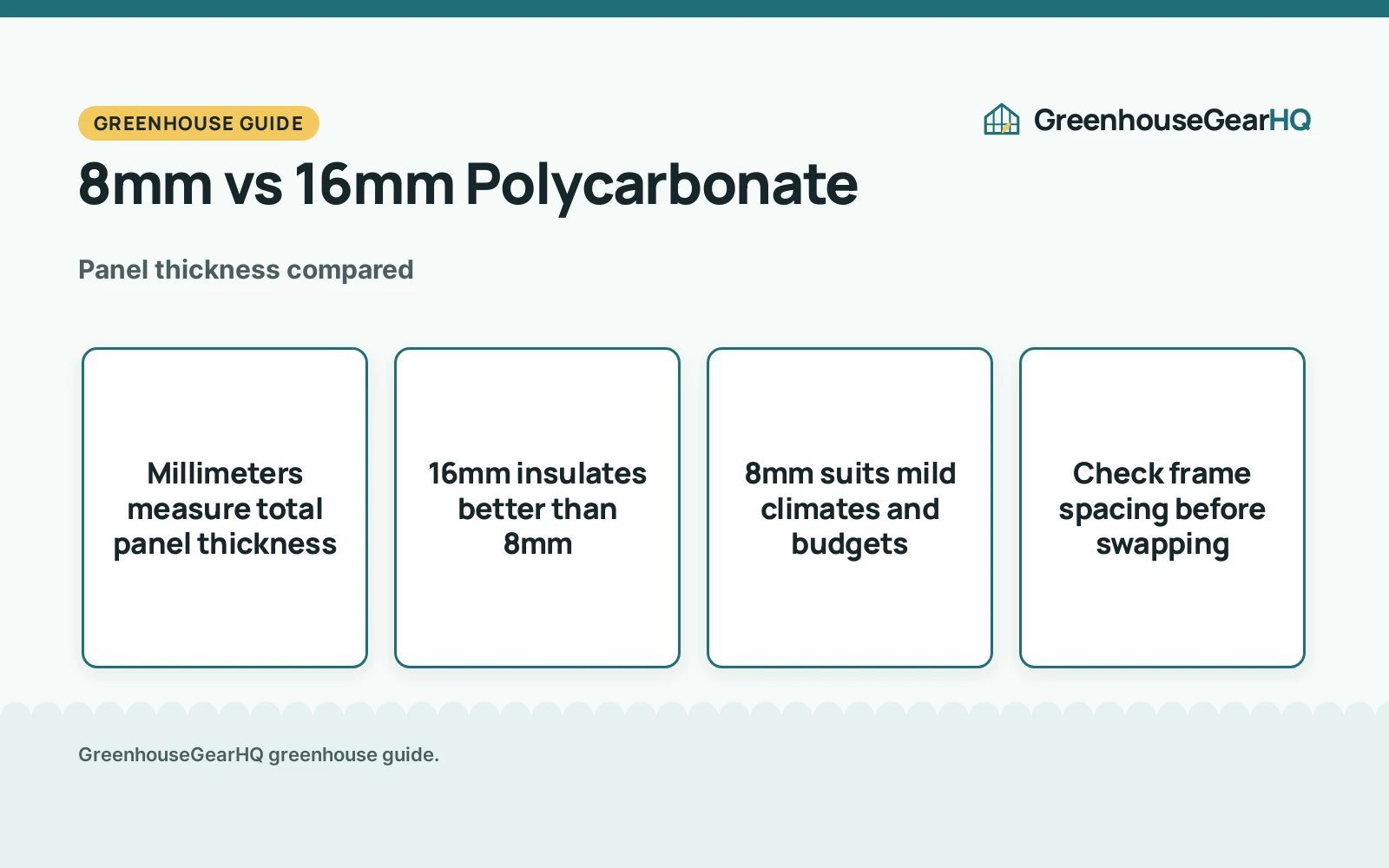
Polycarbonate greenhouse panels are multiwall: two or more sheets joined by internal ribs, with air trapped between. The millimeter rating is the total panel thickness. An 8mm panel is usually twinwall (two sheets, one air gap), while 16mm is often triple or multiwall with more air chambers. More chambers mean better insulation, because still air slows heat transfer.
Thickness also adds stiffness. A 16mm panel spans wider purlin gaps without sagging and resists hail better than 8mm. But it also costs more, weighs more and transmits slightly less light, since each wall and air gap absorbs a little. For a small hobby greenhouse in a mild climate, 8mm is often enough; for winter growing or heavy snow, 16mm earns its price.
8mm: the practical default
Two of the listings below are 8mm panels. The UMIG set gives 8 pieces at 6 by 2 feet and 0.32 inch thick, clear, for greenhouse roofs. The Sinimaka set gives 10 pieces at 4 by 2 feet and 0.32 inch thick. Both are the classic 8mm twinwall: light, easy to cut and enough insulation for three-season growing.
8mm panels need closer purlin spacing than 16mm, so check the greenhouse frame before swapping thicknesses. The panels cut with a fine-tooth saw, and the flutes should be sealed top and bottom against insects and moisture. For more panel options, see our polycarbonate greenhouse guide.
16mm: when to step up
No 16mm panels are in the listings here, but the tradeoff is worth understanding before buying. A 16mm multiwall panel holds more air chambers than 8mm twinwall, so it insulates better, spans wider purlin gaps and resists hail better. It also costs more, weighs more and transmits slightly less light. For a greenhouse that runs through winter or sits in a snowy region, 16mm earns its price. For a mild-climate hobby house used spring to fall, 8mm does the job for less.
Swapping from 8mm to 16mm is not just a panel change. The frame’s glazing channels, connectors and seals are sized for one thickness. The OWLHAUS connectors here fit 6 to 8mm panels only, at 0.3 inches thick and 4 feet long, so a move to 16mm needs different connectors and possibly different glazing bars. Measure the existing channels before ordering.
The gear: four listings compared
The UMIG 8-piece set and the Sinimaka 10-piece set are the 8mm panels here: 0.32 inch thick, clear, in 6 by 2 foot and 4 by 2 foot sizes. Either one reglazes a small roof or wall; the Sinimaka gives two more pieces in a smaller size, which suits patching or a cold frame.
The other two are accessories, not panels. The OWLHAUS set is H-connectors for 6 to 8mm panels, 4 feet long, 10 pieces: they join panel edges, which is exactly what a reglazing job needs. The YMYKLB is a black cast acrylic sheet, 1/8 inch thick and 8 by 8 inches: acrylic, not polycarbonate, and far too small for glazing, but useful for small custom windows or vents.
The UMIG panels list a double-sided UV coating, so there is no front or back to track during installation. Panels with a single-sided coating must face the coated side outward, or the uncoated side yellows in the sun. If a listing does not state double-sided coating, confirm the orientation before installing, since flipping a single-sided panel shortens its life.
FAQ for growers
Is 16mm always better than 8mm?
For insulation and strength, yes. But 16mm costs more, weighs more and passes slightly less light. In a mild climate, 8mm is the better value.
Can I mix 8mm and 16mm panels?
Not in the same frame bay, since the thicknesses need different glazing bars and connectors. The OWLHAUS connectors here fit 6 to 8mm panels only.
How do I cut polycarbonate panels?
With a fine-tooth saw and the protective film left on. Seal the flutes after cutting to keep out insects and moisture.
Do I need new connectors when replacing panels?
If the new panels match the old thickness, the existing connectors may work. The OWLHAUS connectors here fit 6 to 8mm panels, 4 feet long in a 10-pack. For a different thickness, buy connectors sized to the new panels, since a loose fit leaks and a tight fit will not close.
Keep reading
See every greenhouses guide. Also see our greenhouse for winter picks and our polycarbonate vs glass greenhouse comparison.
More picks: see polycarbonate greenhouses and polycarbonate panels.