On this page
Top picks at a glance
As an Amazon Associate I earn from qualifying purchases.
- 1
 EAGLE PEAK 8x8 Pop Up Greenhouse9.8/10View on Amazon
- 2
 INTER HUT 8x8 Pop Up Greenhouse9.6/10View on Amazon
- 3
 Oneofics 8x8 FT Pop Up Greenhouse9.6/10View on Amazon
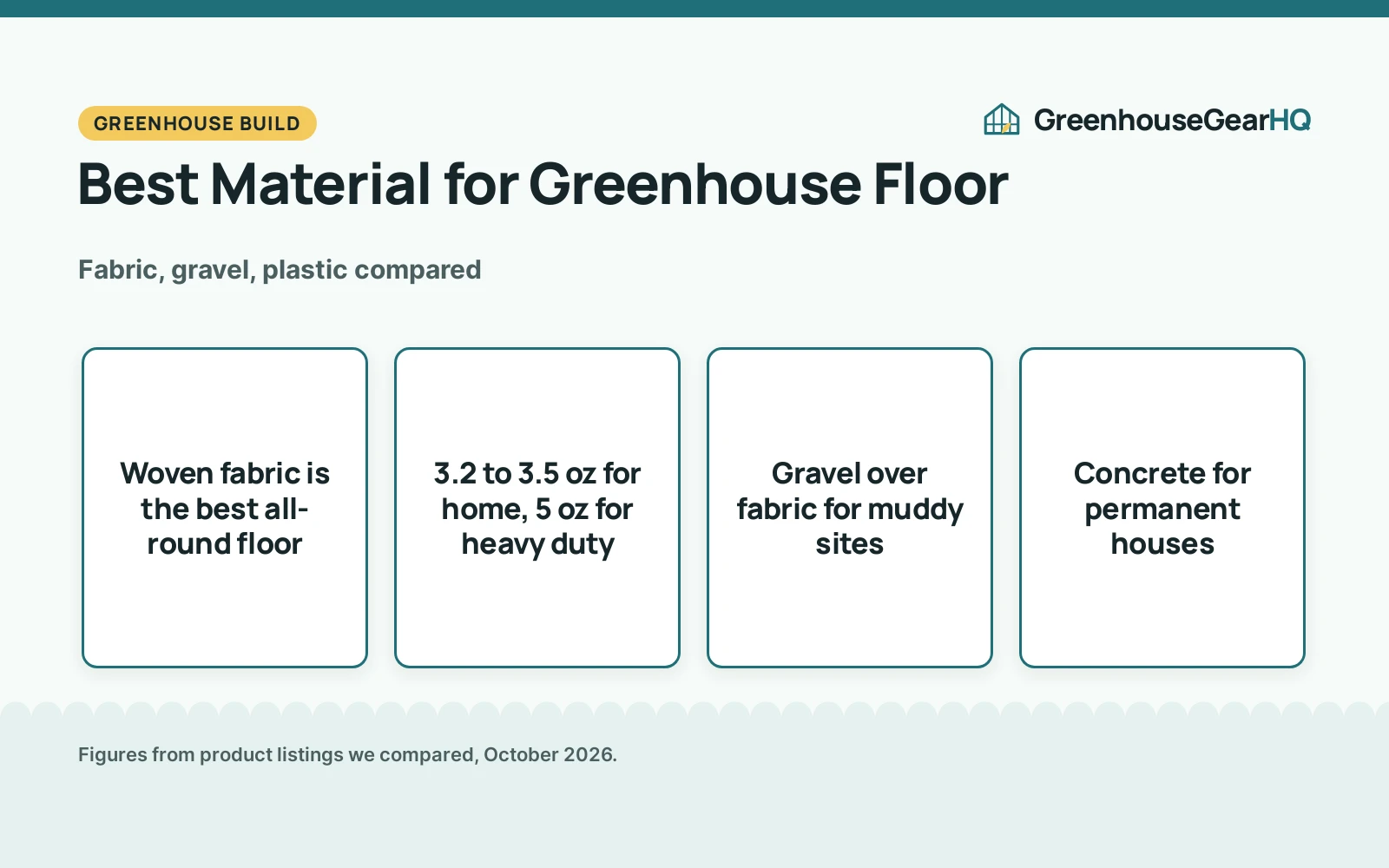
The best material for a greenhouse floor is woven weed-barrier fabric: it blocks weeds, lets water drain through, and stands up to foot traffic. Gravel over fabric is the upgrade for muddy sites, concrete suits permanent commercial houses, and plastic sheeting or reflective film serve special cases. This guide compares each option step by step. Where a number appears, it comes from a product listing we compared, and we name the listing so you can check it.
GreenhouseGearHQ earns a commission when you buy through links on this page, at no extra cost to you. As an Amazon Associate I earn from qualifying purchases. Affiliate disclosure.
What is the best material for greenhouse floor use?
The short answer: woven weed-barrier fabric for most growers, gravel over fabric for muddy sites, and concrete for permanent commercial houses. Plastic sheeting and reflective film suit special cases like temporary covers and light-hungry corners. The sections below compare each option in detail.
Why woven fabric wins
Woven polypropylene ground cover is the default greenhouse floor for a reason. The DeWitt Sunbelt 3.2 oz fabric at 3 by 300 feet blocks weed growth while letting air, water and nutrients move through, and it is UV-stabilized for outdoor use. The DeWitt Pro-5 at 5 oz and 3 by 250 feet is the heavier commercial grade for high-traffic zones. Both carry golden alignment stripes every 12 inches for straight plant rows. Fabric keeps the floor clean and weed-free without the cost or permanence of concrete.
Pick the right weight
Fabric weight is measured in ounces per square yard. For home greenhouses, 3.2 to 3.5 oz is plenty: the GDNaid 3.2 oz at 4 by 100 feet and the mychoiii 3.5 oz at 3 by 100 feet, which lists 600 lbs tensile strength, both handle foot traffic. For commercial or high-traffic floors, step up to 3.7 or 5 oz: the TUFFIOM 3.7 oz at 3 by 300 feet, the DeWitt Pro-5 at 5 oz, and the Kdgarden 5 oz at 142gsm, which offers a limited 1-year warranty. Heavier fabric resists tears from tools and carts.
Gravel over fabric for muddy sites
Where drainage is poor, lay fabric first and spread gravel on top. The fabric blocks weeds while the gravel carries water away and gives a firm walking surface. This is the standard commercial setup: fabric for weed control, gravel for drainage and footing. Rinse the gravel now and then; silt eventually clogs the fabric below.
Plastic sheeting and reflective film
Solid plastic has its place but is not the best general floor. The PureSpace Armor 10 by 25 foot 6 mil sheeting works as a temporary floor covering or moisture barrier, and the Poly-Tex 12 by 14 foot ground cover kit with 24 included pins is sized for a small house. But solid plastic traps water on top, so it suits dry storage areas better than planted floors. Reflective mylar is a different tool: the VIVOSUN 4 by 100 foot 2 mil film claims 95% reflectivity to bounce light back onto plants. Use it on walls and benches, not underfoot.
Concrete and bare soil
Concrete is the permanent answer: easy to hose clean, strong enough for carts, and the best thermal mass for winter. It costs the most and is forever. Bare soil is free and drains naturally, but it grows weeds and turns to mud. Fabric over soil splits the difference for most home growers. For small houses, see our mini greenhouses guide, and for larger ones, walk-in greenhouses.
Installing fabric the right way
Level the ground, unroll the fabric, and pin it down: the Poly-Tex kit (on Amazon) includes 24 pins for its 12 by 14 foot cover. Overlap seams by several inches and cut slits only where plants go through. The mychoiii listing notes its 3-foot width fits standard bed widths without cutting. Secure the edges well; wind gets under loose fabric and turns it into a sail.
FAQ for growers
How do I clean a greenhouse floor?
Sweep fabric floors and hose them down; the woven material lets water through. For gravel, rake and rinse. Concrete hoses clean easiest of all.
Where can I buy greenhouse floor material?
Weed-barrier fabric, gravel and plastic sheeting are stocked by garden suppliers and farm stores, in rolls from 3 by 100 feet up to 3 by 300 feet like the DeWitt listings.
Can I put gravel directly on soil?
You can, but weeds will come through. Lay woven fabric first, then gravel on top, for a floor that drains and stays weed-free.
How long does weed-barrier fabric last?
UV-stabilized woven polypropylene lasts for years; the Kdgarden 5 oz listing offers a limited 1-year warranty. Heavier weights outlast lighter ones in sun and traffic.
Keep reading
See every greenhouses guide and all growing guides.
More picks: browse walk-in greenhouses, mini greenhouses and polycarbonate greenhouses.