On this page
Top picks at a glance
As an Amazon Associate I earn from qualifying purchases.
- 1
 JOJOLEE 70% Shade Cloth 6.5x10 FT9.6/10View on Amazon
- 2
 FONUNO Bubble Insulation Sheet9.5/10View on Amazon
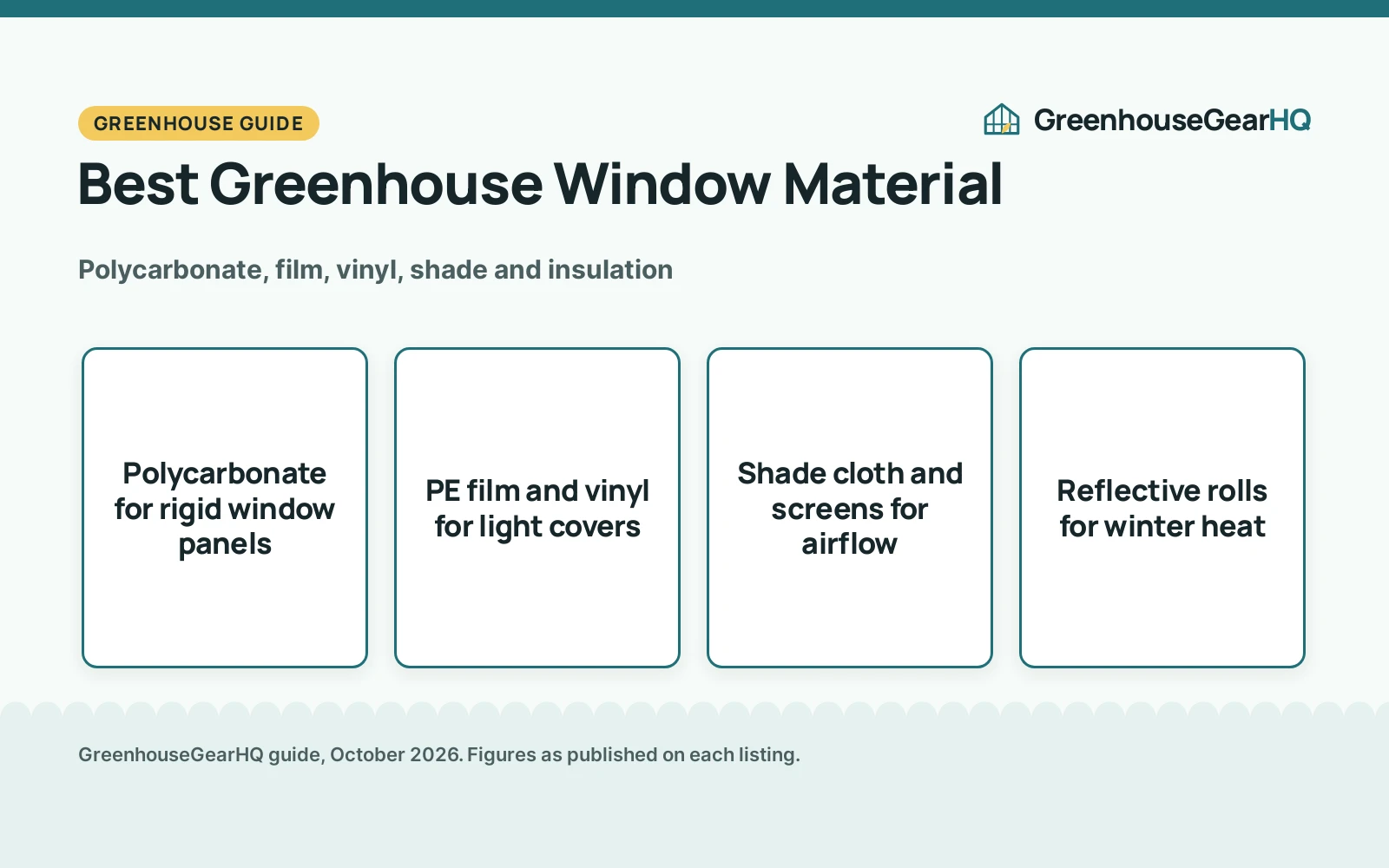
The best greenhouse window material is polycarbonate for most growers: it resists impact, the sheets we checked carry a UV coating on both sides, and it cuts with simple tools like scissors or a hacksaw. Glass gives the clearest view but is heavy and can break; PE film and vinyl are the light covers for mini greenhouses and temporary panels; shade cloth and screen mesh trade covering for airflow; and reflective bubble insulation is for holding heat in winter, not for letting light through. Below is how each material compares, with the brand named every time a figure is cited.
GreenhouseGearHQ earns a commission when you buy through links on this page, at no extra cost to you. As an Amazon Associate I earn from qualifying purchases. Affiliate disclosure.
Which is the best greenhouse window material?
| Material listing | Stated build | Stated figure | Best fit |
|---|---|---|---|
| Beeveer polycarbonate sheets | 6 pcs, 8 x 10 in, 0.04 in thick | Dual-sided UV coating | Window replacement panels |
| Outsunny mini greenhouse | 2-layer 140 GSM PE cover | 85% sunlight through | Small portable greenhouse |
| Marine Vinyl Fabric | 8 gauge clear vinyl, 54 in, 5 yards | 500 hours UV resistance, -40F cold crack | Porch and greenhouse enclosures |
| LCYFBE clear tarp | 14 mil PVC vinyl, 3 x 6 ft | 500 g/m2, grommets every 50 cm | Temporary greenhouse cover |
| JOJOLEE shade cloth | HDPE, 6.5 x 10 ft | 70% shade rate | Summer shading |
| FONUNO insulation roll | Double aluminum bubble, 23.6 in x 10 ft, 3mm | 2832 square inches coverage | Winter window insulation |
| VUAOHIY insulation roll | Double aluminum bubble, 23.6 in x 10 ft, 2mm | 10 to 30 F car temp reduction claimed | Winter window insulation |
| fowong insulation roll | Aluminum bubble, 48 in x 10 ft, 3mm | 1.3 pounds | Wide window insulation |
| Gecork screen mesh | Fiberglass, 48 x 102 in, 110 g/m2 | 5 years of service stated | Ventilation screens |
| FLYZZZ screen mesh | 100% polyester, 100x150cm | 39.37×59.05 inches | Window screens |
Polycarbonate: the all-rounder
Polycarbonate is the closest thing to a default answer. The Beeveer package lists 6 clear polycarbonate sheets at 8 x 10 inches and 0.04 inches thick, with a dual-sided UV coating that resists yellowing, and the listing describes the material as impact-resistant. It cuts with scissors, a hacksaw or a drill, and bends with a heat gun without cracking, which makes it practical for replacing a broken pane or glazing a small cold frame. For roof-scale panels, see our best polycarbonate roof panels for greenhouse picks, and for the glass-versus-plastic decision, our polycarbonate vs glass greenhouse comparison.
PE film and vinyl: light covers
Polyethylene film and vinyl cover more area per dollar of material and roll up for storage, which suits mini greenhouses and seasonal covers. The Outsunny mini greenhouse (on Amazon) lists a 2-layer 140 GSM PE cover that lets 85% of sunlight through while blocking UV scorching, on an 11.8 ft L x 3 ft W x 3 ft H frame. The Marine Vinyl Fabric roll (on Amazon) lists 8 gauge clear vinyl in a 54 in width by 5 yards, double-polished for clarity, with 500 hours of UV resistance and a -40F cold crack rating, made for porch enclosures and greenhouses. The LCYFBE clear tarp (on Amazon) lists 14 mil PVC vinyl at 3 x 6 ft and 500 g/m2, with metal grommets every 50 cm for tying down as a temporary cover. For sheeting comparisons, see our best greenhouse plastic sheeting picks and our clear vs diffused greenhouse plastic guide.
Shade cloth and screens: airflow first
When heat is the problem, covering less is the answer. The JOJOLEE shade cloth (on Amazon) lists a 70% shade rate in high-density polyethylene at 6.5 x 10 ft, filtering UV while letting air move through. For vents and doors, screen mesh keeps insects out without sealing the opening: the Gecork listing gives a 48 x 102 in fiberglass mesh at 110 g/m2 with at least 5 years of service stated, and the FLYZZZ listing gives a 100x150cm self-adhesive polyester mesh, about 39.37×59.05 inches, that cuts to fit the frame. Use shade cloth over the roof in summer and screens on every vent you leave open.
Reflective insulation: winter heat
Double-sided aluminum bubble rolls reflect heat back inside, but they block light, so they belong on north walls, doors, or windows at night rather than over growing areas. The FONUNO roll (on Amazon) lists 23.6 in x 10 ft at 3mm thick with 2832 square inches of coverage. The VUAOHIY roll lists 23.6 in x 10 ft at 2mm thick and makes strong claims: cooling a garage door area by 3 C in 30 minutes, cutting car window temperatures by 10 to 30 F, and keeping pipes unfrozen at -7 C. The fowong roll is the widest of the three at 48 in x 10 ft and 3mm, weighing 1.3 pounds, and its listing names greenhouses among its uses. Treat the temperature claims as the listings’ own figures and compare the stated thickness and width when choosing.
What to check before you buy
Match the form to the job: rigid sheets like the Beeveer 8 x 10 in panels for flat window frames, rolls like the 10 ft insulation and vinyl listings for wrapping curves and large areas, and tarps with grommets where you need tie-downs. Check the UV language: dual-sided UV coating on the Beeveer, 500 hours UV resistance on the Marine Vinyl Fabric, and UV protection stated on the Outsunny cover. Check thickness in the listing’s own units, 8 gauge vinyl, 14 mil tarp, 0.04 in polycarbonate, 3mm bubble roll, without converting between systems. Finally, check light transmission where it matters: 85% sunlight through on the Outsunny PE cover and a 70% shade rate on the JOJOLEE cloth tell you exactly how much light each one passes or blocks. Browse all greenhouses guides for the wider shelf.
FAQ for growers
How does a greenhouse work?
Glazing lets sunlight in and slows heat escaping, so the inside stays warmer than the outside. Ventilation through doors, vents and screens keeps the temperature from climbing too high on sunny days.
How do I clean greenhouse glass?
Wash panels with mild soap and water and a soft cloth or sponge, then rinse. Avoid abrasive pads that scratch glazing, and clean on an overcast day so the soap does not dry on the surface.
What size greenhouse do I need?
Start from the space you have and the plants you grow. As a small example, the Outsunny mini greenhouse lists 11.8 ft L x 3 ft W x 3 ft H, which suits a few rows of pots. Measure the site before choosing a structure.
How do I fix an automatic greenhouse window opener?
Most automatic openers use a wax cylinder that expands with heat. Check that the cylinder is seated, the arm moves freely, and nothing blocks the vent. If the vent stays shut on a hot day, the cylinder is the usual suspect; follow the opener maker’s instructions for replacement.
Keep reading
See all greenhouse guides. Also see our polycarbonate vs glass greenhouse comparison. Also see our best greenhouse plastic sheeting picks. Also see our best polycarbonate roof panels for greenhouse.
More picks: polycarbonate vs polyethylene greenhouse and glass vs twin wall polycarbonate greenhouse.