On this page
Top picks at a glance
As an Amazon Associate I earn from qualifying purchases.
- 1
 Abbott Collection 27-Carolyn Bell Shaped Glass Cloche9.6/10View on Amazon
- 2
 OWLHAUS Polycarbonate Greenhouse Panel H-ConnectorsView on Amazon
- 3
 OWLHAUS Polycarbonate Greenhouse Panel ConnectorsView on Amazon
- 4
 Sinimaka 8-Pack Polycarbonate Greenhouse PanelsView on Amazon
- 5
 6 Pack Polycarbonate Greenhouse PanelsView on Amazon
- 6
 VEIKOU 6’x12’ Greenhouse for OutdoorsView on Amazon
- 7
 Bezseller 6 Pcs 5'x2' Polycarbonate Greenhouse PanelsView on Amazon
When you glaze a greenhouse, the oldest choice is glass and the newest is twin-wall polycarbonate. The glass vs twin wall polycarbonate greenhouse debate comes down to this: glass is a single rigid pane with maximum clarity, while twin-wall polycarbonate is a hollow, honeycomb sheet that trades a little light for insulation and impact resistance. We compared twin-wall panel listings to explain what each glazing is and which growers each suits. Every number below comes from a product listing; where a listing gives no figure, we say so.
Other options worth a look
 OWLHAUS Polycarbonate Greenhouse Panel H-ConnectorsCheck price on Amazon
 OWLHAUS Polycarbonate Greenhouse Panel ConnectorsCheck price on Amazon
 Sinimaka 8-Pack Polycarbonate Greenhouse PanelsCheck price on Amazon
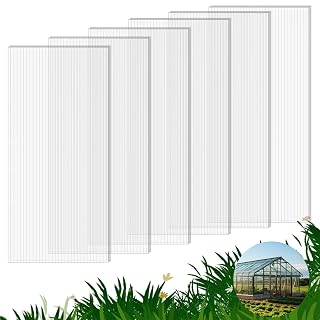 6 Pack Polycarbonate Greenhouse PanelsCheck price on Amazon
 VEIKOU 6’x12’ Greenhouse for OutdoorsCheck price on Amazon
 Bezseller 6 Pcs 5'x2' Polycarbonate Greenhouse PanelsCheck price on Amazon
GreenhouseGearHQ earns a commission when you buy through links on this page, at no extra cost to you. As an Amazon Associate I earn from qualifying purchases. Affiliate disclosure.
Glass vs twin wall polycarbonate greenhouse: the short answer
Choose twin-wall polycarbonate when you want insulation and toughness: the Sinimaka 8 by 4 foot panels list 89% light transmission at 0.24 inches thick with a minus 40 to 120 C range. Choose glass when you want maximum clarity and a traditional look, and you accept fragile, heavy panes. If you want a full kit rather than panels, our polycarbonate greenhouses guide compares those.
What twin-wall polycarbonate is
Twin-wall polycarbonate is a hollow plastic sheet with two faces joined by ribs: the Tatuo 12-pack lists 2 by 8 foot panels at 0.16 inches thick with a honeycomb design, UV resistant on both sides. The UMIG 8-pack lists 6 by 2 foot panels at 0.32 inches (8mm) with 80% light transmission and double-sided UV coating. The EVERECO 8-pack lists 6 by 2 foot panels at 0.24 inches with 90% light transmission. Panels are sold by thickness and pack size: 0.16 to 0.32 inches across these listings, in packs of 3 to 14.
What a glass greenhouse is
A glass greenhouse is glazed with single panes of glass in an aluminum or wood frame: maximum light, classic looks, and panes that shatter on impact. None of these listings is a glass greenhouse; they are polycarbonate panels and kits, so we give no glass figures here. The tradeoffs are qualitative: glass gives the clearest view and the longest unchanged life, while polycarbonate gives insulation from its hollow core and impact resistance the listings describe as shatterproof. For a classic look on a sheltered patio, glass wins; for hail country or a DIY build, twin-wall wins.
Glass vs twin wall polycarbonate at a glance
| Glazing | What it is | Suits | Watch for |
|---|---|---|---|
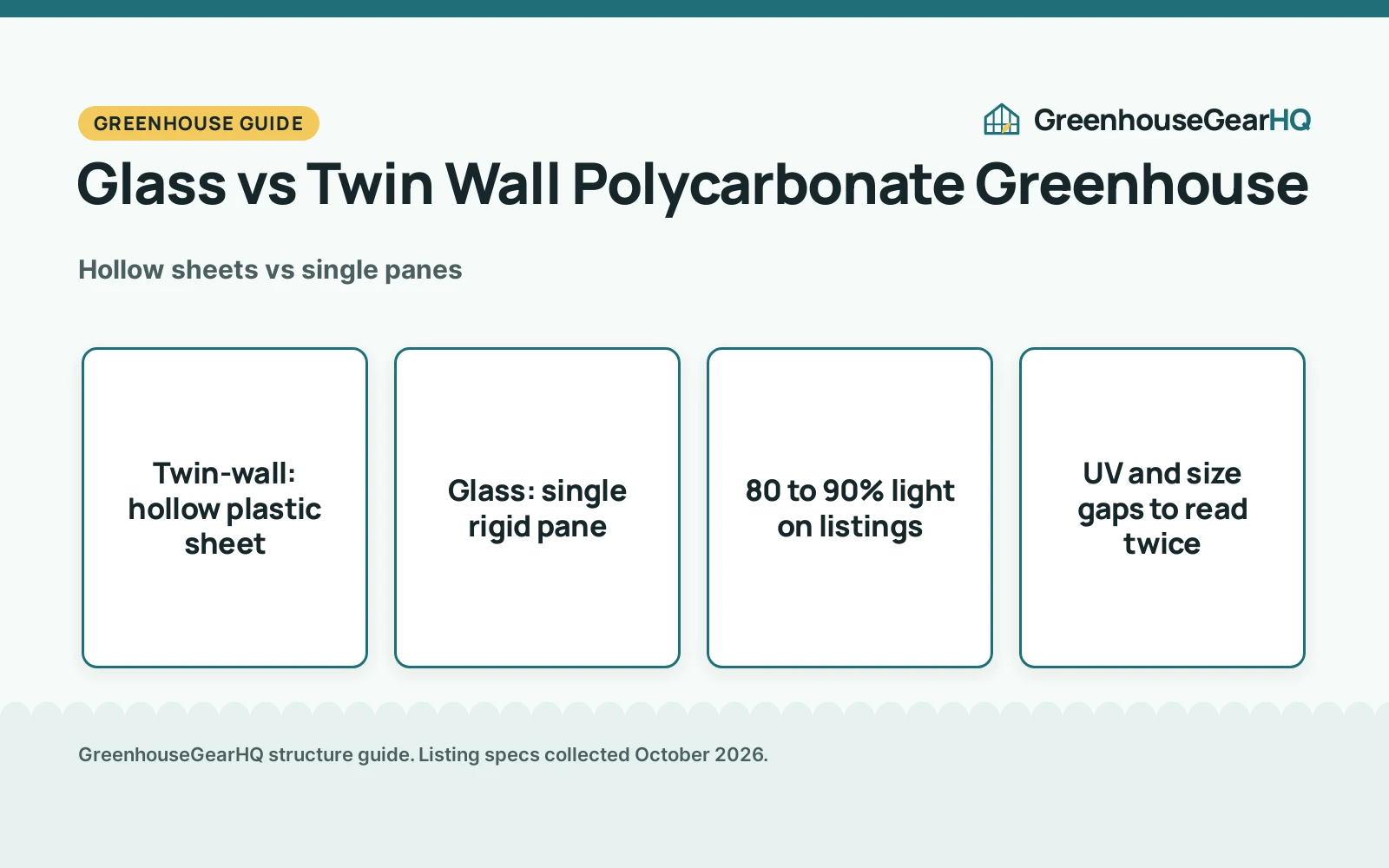
| Twin-wall polycarbonate | Hollow plastic sheet, 0.16 to 0.32 in | Insulation, hail, DIY builds | 80 to 90% light on these listings |
| Glass | Single rigid pane | Clarity, classic looks | No glass figures in these listings |
Which should you buy?
Match the glazing to the weather. Hail, kids, and low heating bills point to twin-wall: the 0.32-inch UMIG or the 0.24-inch Sinimaka at 89% light. Maximum clarity and tradition point to glass. For complete kits with panels included, see our greenhouse guides.
Read the listing twice
Panel listings mix up UV claims and sizes:
- XISOCO: the bullets tout UV protection, but the fine print says the panels are only UV protected on one side.
- Kingdura: the bullets claim the greenhouse withstands all kinds of wind, rain, and snow, but the stated ratings are 50 mph and 160 pounds per square meter.
- GFaoaengra: the title says panels, but the listing says the product ships in roll form and bends 180 degrees.
Trust the spec table over the title, and read the UV fine print: one-sided coating must face outward.
What this guide does not cover
This guide covers glazing types only. It does not cover frames, foundations or heating, which depend on your site and kit. Your local extension office can advise on siting for your area.
FAQ for growers
How much light does twin-wall polycarbonate let through?
These listings state 80% (UMIG), 89% (Sinimaka and VOYAR) and 90% (EVERECO). The GFaoaengra roll claims 90% or more, comparable to glass per the listing.
Which twin-wall thickness should I choose?
These listings range from 0.16 inches (Tatuo) to 0.32 inches (UMIG, VOYAR). Thicker panels insulate better; the Kingdura kit uses 4.6mm panels and claims superior heat retention over glass.
Do polycarbonate panels yellow?
The listings credit UV coatings: UMIG lists double-sided UV coating to reduce yellowing, while XISOCO warns its panels are UV protected on one side only. Install the coated side outward.
Can I cut twin-wall panels myself?
Tatuo says cut with a utility knife, Sinimaka says cut without cracking, and XISOCO notes an industry cutting tolerance of plus or minus 0.19 inch. Measure twice.
Keep reading
See every polycarbonate greenhouse guide and all greenhouse guides.
More picks: polycarbonate vs glass, mini greenhouses and light and heat.