On this page
Top picks at a glance
As an Amazon Associate I earn from qualifying purchases.
- 1
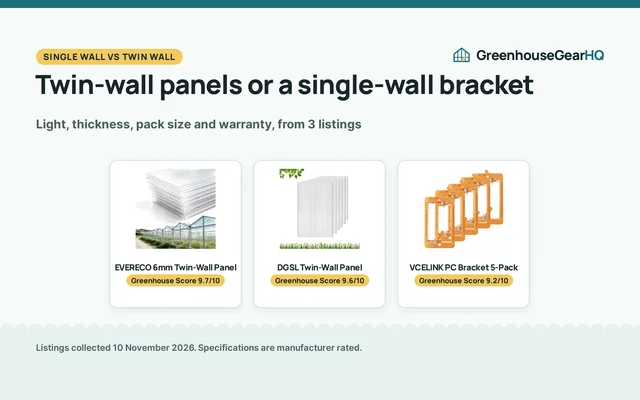
 EVERECO Twin-Wall Polycarbonate Panels9.7/10View on Amazon
- 2
 DGSL Twin-Wall Polycarbonate Greenhouse Panels9.6/10View on Amazon
- 3
 VCELINK Low Voltage Mounting Bracket 5-Pack9.2/10View on Amazon
- 4
 Storystore Twin-Wall Polycarbonate PanelsView on Amazon
- 5
 KASTLITE 1×1' Twin Wall Polycarbonate Greenhouse PanelView on Amazon
- 6
 Domi 10x12FT SunroomView on Amazon
- 7
 Domi 12x16FT SunroomView on Amazon
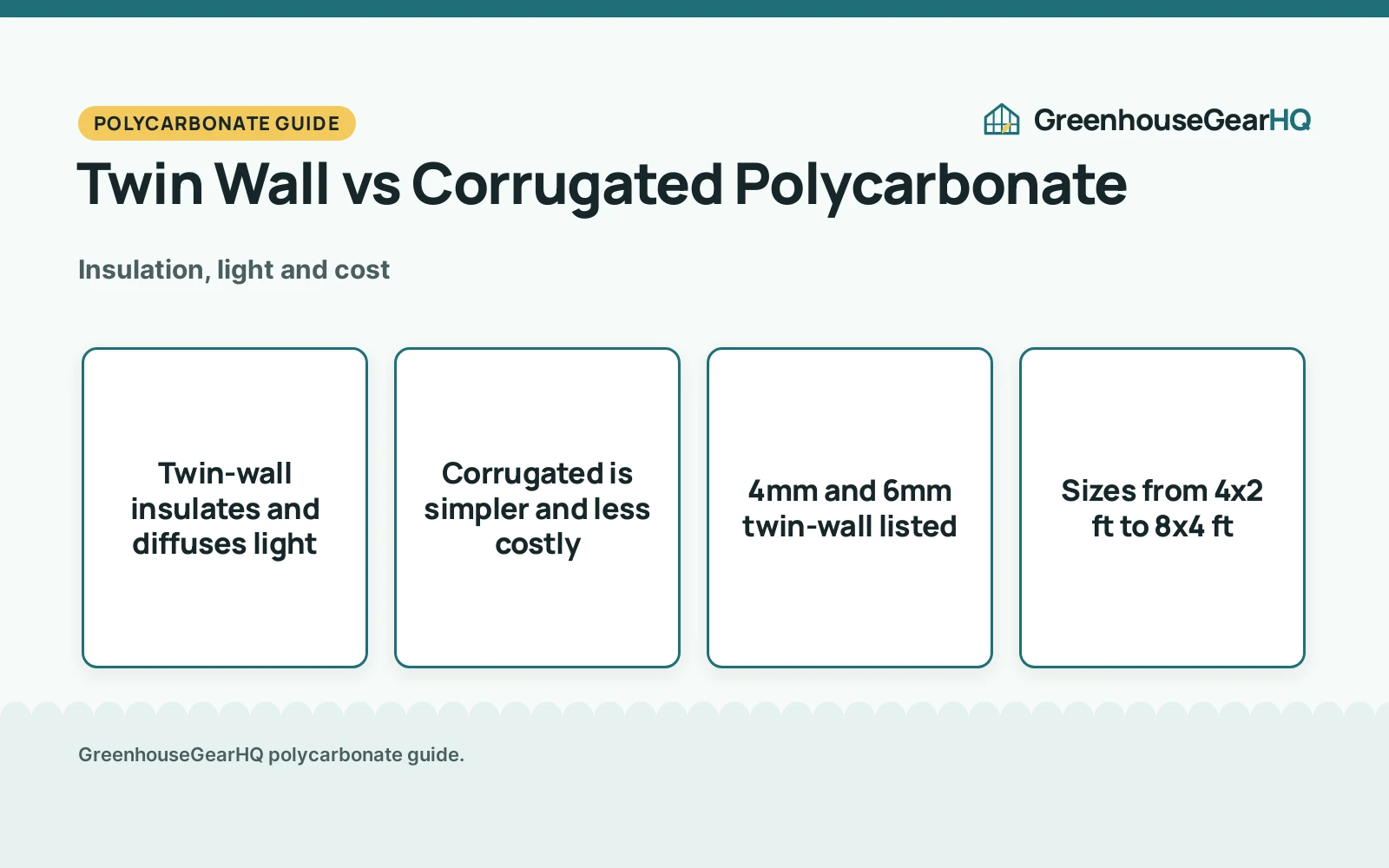
Twin wall vs corrugated polycarbonate comes down to insulation: twin-wall panels have two walls joined by air channels that insulate and diffuse light, while corrugated panels are a single wavy sheet that is simpler and usually less costly. If the greenhouse runs through winter, twin-wall wins; if the structure is a seasonal shelter, carport or shed, corrugated wins. The listings here are all twin-wall, so the twin-wall figures are real and the corrugated side is explained from general practice.
Other options worth a look
 Storystore Twin-Wall Polycarbonate PanelsCheck price on Amazon
 KASTLITE 1×1' Twin Wall Polycarbonate Greenhouse PanelCheck price on Amazon
 Domi 10x12FT SunroomCheck price on Amazon
 Domi 12x16FT SunroomCheck price on Amazon
GreenhouseGearHQ earns a commission when you buy through links on this page, at no extra cost to you. As an Amazon Associate I earn from qualifying purchases. Affiliate disclosure.
Choosing twin wall vs corrugated polycarbonate: the short answer
Choose twin-wall for growing: the air channels add insulation, the panels diffuse light so plants get even coverage, and the sheets cut and cold-bend for curved roofs. Choose corrugated for simple covering: the wave profile adds stiffness to a thin sheet, it installs fast on carports, sheds and chicken coops, and it costs less per square foot. Glass-greenhouse growers and winter growers should default to twin-wall.
What twin-wall panels do
The twin-wall listings give solid figures. The Sinimaka 10-pack lists 4 x 2 ft panels at 0.24 in (6mm) thick, each covering 8 sq ft for 80 sq ft of total coverage, and states the 6mm sheet is 50% thicker than the 4mm version for greater rigidity and insulation. The VOYAR 6-pack lists 4 x 2 ft panels at 0.16 in (4mm), with a UV-resistant coating that blocks 99% of UV rays while allowing 89% light transmission, and a temperature range of -40°C to 120°C. The EVERECO 8-pack lists 8 x 4 ft sheets at 0.24 in (6mm) with 90% light transmission.
Twin-wall’s hollow structure is its signature: the EVERECO listing states the air channels reduce heat buildup in summer and retain warmth in cold weather. The Sinimaka listing notes one-side UV protection with the marked side facing the sun, and ASTM E84 Class A flame-resistant material performance. All three describe cutting and drilling with common tools, and the Sinimaka and VOYAR note cold-bending along the channels for gently curved roofs. The Sinimaka pack weighs 15.5 lb for 10 panels, so handling is a one-person job.
What corrugated panels do
Corrugated polycarbonate is a single sheet pressed into waves. The waves give a thin sheet its stiffness, so it spans rafters without a solid backing. Light passes straight through rather than being diffused, which is fine for sheds, carports, patio covers and chicken coops but harsher for plants than twin-wall’s softened light. Because it is a single wall, corrugated insulates far less: heat moves straight through it, so a corrugated greenhouse swings hotter by day and colder by night than a twin-wall one.
Corrugated wins on simplicity and price. It cuts with basic tools, fastens with standard roofing screws and washers, and replaces one sheet at a time. For a structure that only needs weather cover, not a growing climate, corrugated is the practical choice. It also handles curved or uneven frames more forgivingly than rigid twin-wall sheets.
Choosing: insulation, light and cost
Start with the season. A greenhouse that holds plants through cold months needs the insulation and diffused light of twin-wall: the 6mm listings here give the stiffness and thermal performance for year-round use. A three-season structure or a non-growing cover can take corrugated. Next, the light: seedlings and leafy crops prefer the softened, even light the twin-wall listings describe; mature sun-loving plants tolerate direct transmission. Then the cost: corrugated costs less per square foot and installs with simpler framing, while twin-wall needs proper channels and end caps to keep the air cells clean. For thickness within twin-wall, see 4mm vs 6mm polycarbonate, and for full builds see the polycarbonate greenhouse for peppers roundup.
What this guide does not cover
This guide does not cover greenhouse film, fiberglass panels or glass glazing. It does not cover greenhouse frames, heaters or ventilation. For film, see the film and tape guides linked below. Match the panel to the structure first, then to the season.
FAQ for growers
What sizes do twin-wall panels come in?
The listings show 4 x 2 ft panels (Sinimaka 10-pack, VOYAR 6-pack) and 8 x 4 ft sheets (EVERECO 8-pack).
How thick are the twin-wall listings?
The Sinimaka and EVERECO list 0.24 in (6mm); the VOYAR lists 0.16 in (4mm). The Sinimaka states 6mm is 50% thicker than 4mm.
What light transmission do they state?
The VOYAR states 89% light transmission with 99% of UV rays blocked; the EVERECO states 90% light transmission.
Keep reading
See every polycarbonate greenhouses guide and all greenhouses guides.
More picks: 4mm vs 6mm polycarbonate, fiberglass vs polycarbonate greenhouse, polytunnel vs polycarbonate greenhouse and polycarbonate roof panels.