On this page
Top picks at a glance
As an Amazon Associate I earn from qualifying purchases.
- 1
 EVERECO Twin-Wall Polycarbonate Panels9.7/10View on Amazon
- 2
 XISOCO 3-Pack 4x2 ft 0.24 in Twin-Wall Polycarbonate9.7/10View on Amazon
- 3
 DGSL Twin-Wall Polycarbonate Greenhouse Panels9.6/10View on Amazon
- 4
 Storystore Twin-Wall Polycarbonate PanelsView on Amazon
- 5
 KASTLITE 1×1' Twin Wall Polycarbonate Greenhouse PanelView on Amazon
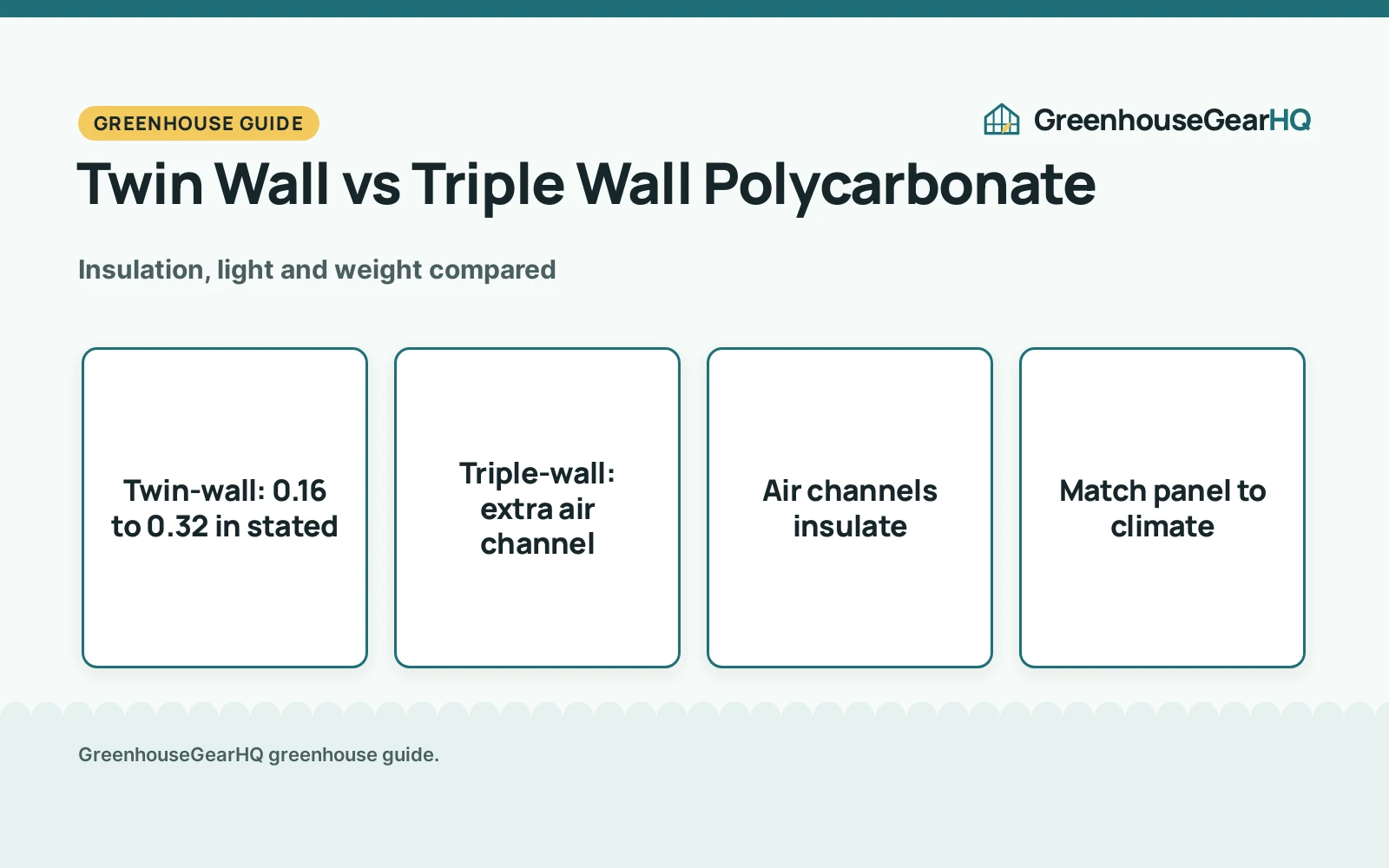
Twin wall vs triple wall polycarbonate: the short answer is that twin-wall panels trap air in channels between the walls for solid insulation at a light weight, while triple-wall panels add a middle wall and an extra air channel for stronger insulation in cold climates. Twin-wall is lighter and brighter; triple-wall is warmer and sturdier. The right choice depends on winter temperatures and how much light the plants need.
Other options worth a look
 Storystore Twin-Wall Polycarbonate PanelsCheck price on Amazon
 KASTLITE 1×1' Twin Wall Polycarbonate Greenhouse PanelCheck price on Amazon
GreenhouseGearHQ earns a commission when you buy through links on this page, at no extra cost to you. As an Amazon Associate I earn from qualifying purchases. Affiliate disclosure.
Twin wall vs triple wall polycarbonate: how each is built
Both are rigid polycarbonate sheets with hollow air channels that insulate better than a solid sheet. Twin-wall has walls on both faces with air channels running between them; triple-wall adds a middle wall, dividing the space into more channels. The figures below are stated in each listing; explanations without figures come from how the panels work.
Twin-wall: the standard greenhouse panel
Twin-wall is the panel every listing here sells. The DGSL listing states 4 by 2 foot sheets at 0.16 inch thick in a 6-pack; the Storystore listing states 47.2 by 23.6 by 0.16 inch sheets, noting that twin-wall construction creates insulating air channels. Thicker options are stated too: the UMIG listing states 6 by 2 foot panels at 0.32 inch (8mm), and the Sinimaka listing describes its 0.32-inch (8mm) panel as twice as thick as the 0.16-inch option. For small repairs, the KASTLITE listing states 1 by 1 foot 8mm panels in a 2-pack.
Twin-wall suits most hobby greenhouses because it balances insulation, light transmission and weight. The 0.16-inch panels are lighter and easier to cut; the 0.32-inch panels add insulation for colder nights.
Choose twin-wall when the greenhouse runs seasonally or in a mild climate, and match the stated thickness to how cold the nights get.
Panel sizes, packs and thickness
Listings sell twin-wall in set sheet sizes, so plan the frame around them. The DGSL, XISOCO, Sinimaka, FAHKNS and VOYAR listings all state 4 by 2 foot sheets, in packs of 3, 6, 10 or 15; the Sinimaka 15-pack and the 10-pack both state 4 by 2 foot sheets at 0.24 inch. For bigger roofs, the Sinimaka listing states 8 by 4 foot sheets at 0.24 inch in a 10-pack, and the UMIG listing states 6 by 2 foot panels at 0.32 inch (8mm) measuring 70.9 by 23.6 inches. The Storystore listing states 47.2 by 23.6 by 0.16 inch sheets in a 6-pack.
Thickness steps up with cold. The listings state 0.16, 0.24 and 0.32 inch panels; the Sinimaka listing describes its 0.32-inch (8mm) sheet as twice as thick as the 0.16-inch option, which is the simplest way to think about the upgrade. More packs suit bigger builds: a 15-pack of 4 by 2 foot sheets covers far more wall than a 3-pack, so count sheets against the frame before ordering.
Triple-wall: more insulation for cold climates
Triple-wall adds a middle wall inside the panel, creating an extra air channel that slows heat loss further. No triple-wall panels appear in these listings, so no thickness or size figures are stated here. Expect a heavier, stiffer sheet that insulates better than twin-wall of similar thickness but transmits somewhat less light, since each added wall filters the sun a little more.
Choose triple-wall when winter growing matters more than maximum light: year-round greenhouses in cold regions, or any structure heated through frost nights.
Which should you buy?
| Panel type | How it is built | Stated thicknesses | Character | Suits |
|---|---|---|---|---|
| Twin-wall | Walls on both faces, air channels between | 0.16, 0.24, 0.32 in | Lighter, brighter | Hobby greenhouses, mild winters |
| Triple-wall | Middle wall, extra air channel | Not stated in these listings | Warmer, heavier | Cold climates, winter growing |
Match the panel to the climate. A seasonal hobby greenhouse in a mild region does well with twin-wall, like the 0.16-inch or 0.24-inch panels the listings state. A year-round greenhouse facing hard frosts leans triple-wall for its extra insulation. Either way, check the stated panel dimensions against the frame; see our greenhouse plastic for cold climates picks.
FAQ for growers
What thickness of twin-wall polycarbonate do I need?
The listings state 0.16, 0.24 and 0.32 inch (8mm) panels. Thicker panels insulate better; the Sinimaka listing describes 0.32 inch as twice as thick as 0.16 inch. Match thickness to winter cold.
Is triple-wall stronger than twin-wall?
The extra middle wall makes triple-wall stiffer, which helps under snow load. No load figures are stated in these listings, so compare the maker’s ratings before buying for snow country.
Do these panels block UV?
Several listings state UV protection, including the UMIG twin-wall with double-sided UV protection. Check each listing for which faces carry the coating.
What sheet size should I order?
The listings state 4 by 2 foot, 6 by 2 foot and 8 by 4 foot sheets, plus 47.2 by 23.6 inch and 1 by 1 foot panels. Measure the frame bays first, then pick the sheet size that covers each bay with the fewest cuts; fewer seams mean fewer leaks.
Keep reading
See every walk-in greenhouse guide and all greenhouse guides.
More picks: greenhouse plastic for cold climates.