On this page
Top picks at a glance
As an Amazon Associate I earn from qualifying purchases.
- 1
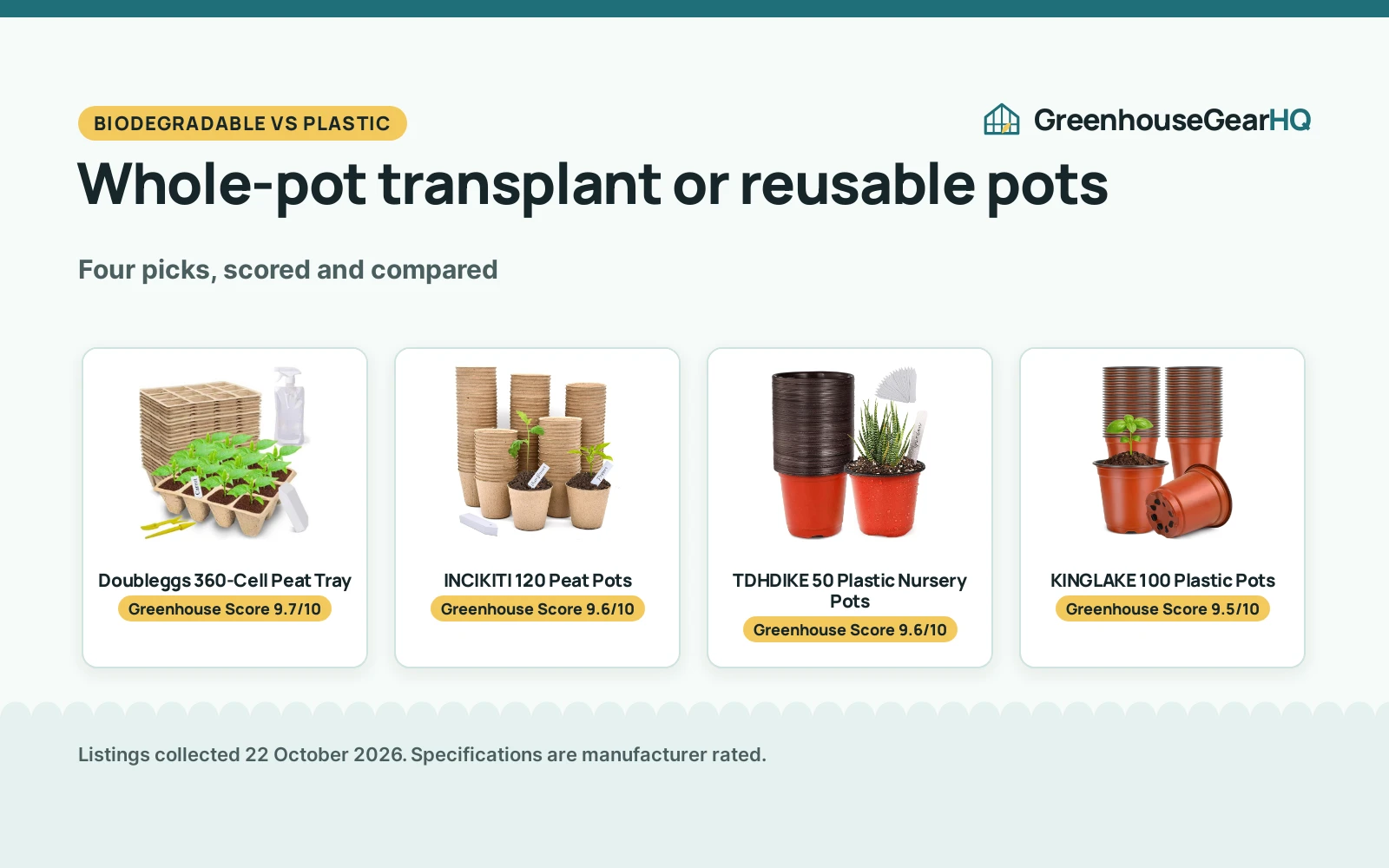
 Doubleggs 360-Cell Peat Tray9.7/10View on Amazon
- 2
 INCIKITI 120 Peat Pots9.6/10View on Amazon
- 3
 TDHDIKE 50 Plastic Nursery Pots9.6/10View on Amazon
- 4
 KINGLAKE 100 Plastic Pots9.5/10View on Amazon
The biodegradable vs plastic seed starting pots choice shows up in late winter, when the first seed trays go in. We read the listings for peat, wood pulp and plastic options and compared them on material, size, drainage and what each listing states.
GreenhouseGearHQ earns a commission when you buy through links on this page, at no extra cost to you. As an Amazon Associate I earn from qualifying purchases. Affiliate disclosure.
Quick verdict: pick biodegradable pots (the INCIKITI or Doubleggs listings) if you want to set the whole pot into the soil. Pick plastic pots (the TDHDIKE or KINGLAKE listings) if you want pots you can reuse across seasons, with stated drainage holes. Neither side wins on every spec; the listings below show where each side is clear and where a figure is missing.
Four examples
| # | Product | Greenhouse Score | Buy |
|---|---|---|---|
| 1 | Doubleggs 360-Cell Peat Tray | 9.7/10 | Buy on Amazon |
| 2 | INCIKITI 120 Peat Pots | 9.6/10 | Buy on Amazon |
| 3 | TDHDIKE 50 Plastic Nursery Pots | 9.6/10 | Buy on Amazon |
| 4 | KINGLAKE 100 Plastic Pots | 9.5/10 | Buy on Amazon |

Doubleggs 360-Cell Peat Tray
A 360-cell wood pulp seed starter tray set with stated cell dimensions, 200 labels and transplanting tools, suited to growers who want biodegradable cells they can cut apart.
Pros
- 360 cells across 30 trays, the most starting cells of the four
- Cell dimensions are stated: 1.6 x 1.6 x 2 inches
- Wood pulp that the maker says lets roots penetrate and degrades into fertilizers in the soil
- 200 labels, 2 transplanting tools and a foldable sprayer are included
Cons
- No drainage holes are stated
- Wood pulp cells soften in use and are not stated as reusable like the plastic pots
- No warranty term is stated
- Full trays must be cut into 12 small cells by hand for partial sowings

INCIKITI 120 Peat Pots
A 120-pack of 3.15 inch biodegradable peat pots with 30 plant labels, suited to growers who want to transplant seedlings pot and all.
Pros
- 120 peat pots with 30 plant labels
- Pots go straight into the soil, which the maker says avoids transplant shock
- Stated to decompose in the soil and become organic fertilizers
- 3.15 inch round pots suit flowers, vegetables, herbs and strawberries
Cons
- No drainage holes are stated
- Spec table lists indoor use only
- No warranty term is stated
- Single-season pots; the listing does not state they can be reused

TDHDIKE 50 Plastic Nursery Pots
A 50-pack of 4 inch PP plastic nursery pots with 50 labels and 8 drainage holes, suited to growers who want reusable pots for cuttings and seedlings.
Pros
- 8 small drainage holes, upgraded from 6
- PP material stated as reusable, break-resistant and wear resistant
- 50 pots with 50 matching labels
- Sized for indoor and outdoor planting, per the bullets
Cons
- No warranty term is stated
- No soil capacity figure is stated
- Only the 4 inch size is stated

KINGLAKE 100 Plastic Pots
A 100-pack of 4 inch thin plastic nursery pots with drainage holes, suited to growers who want the most pots per pack for propagation and transplanting.
Pros
- 100 pots, the largest pack of the four
- 6g per pot stated, light for handling large batches
- Multiple drainage holes stated in the bottom
- Thin plastic stated as flexible, lightweight and reusable
Cons
- No plant labels are included
- No warranty term is stated
As an Amazon Associate I earn from qualifying purchases.
Other options worth a look
 RooTrimmer 4 Inch Plastic Plant Pots 60 Pcs and 12 CellCheck price on Amazon
 Peat PotsCheck price on Amazon
 3 Inch Coconut Coir Biodegradable PotsCheck price on Amazon
 Karenhi 16 Pcs Peat Pots 6 Inch Biodegradable Organic SeedCheck price on Amazon
 60-Pack 4” Biodegradable Peat Pots with 60 Plant LabelsCheck price on Amazon
 130 Pcs 6 Inches Plastic Plant Nursery PotsCheck price on Amazon
Biodegradable vs plastic seed starting pots: side by side
| Seed starting pot | Greenhouse Score | Side | Material | Pot size | Pack size | Extras | Amazon |
|---|---|---|---|---|---|---|---|
| Doubleggs 360-Cell Peat Tray | 9.7/10 | Biodegradable | Wood pulp | 1.6 x 1.6 x 2 inch cells | 30 trays, 360 cells | 200 labels, 2 tools, sprayer | View on Amazon |
| INCIKITI 120 Peat Pots | 9.6/10 | Biodegradable | Biodegradable paper and peat | 3.15 inch diameter | 120 pots | 30 labels | View on Amazon |
| TDHDIKE 50 Plastic Nursery Pots | 9.6/10 | Plastic | PP plastic | 4 inch top, 3.2 inch high | 50 pots | 50 labels, 8 drain holes | View on Amazon |
| KINGLAKE 100 Plastic Pots | 9.5/10 | Plastic | Plastic | 4 inch top, 3.34 inch high | 100 pots | Drain holes, 6g per pot | View on Amazon |
These specifications come from the listings and are rated by each manufacturer, current to 22 October 2026.
Material and transplant shock
The material is the real divide. The INCIKITI pots are made of biodegradable paper and peat, and the listing states they decompose in the soil and become organic fertilizers. The Doubleggs cells are wood pulp, stated to naturally degrade into fertilizers; the maker says the soft pulp lets roots penetrate. Both listings are built around one idea: the pot goes into the soil with the seedling, with less transplant shock.
The plastic listings take the other route. The TDHDIKE pots are PP plastic the maker calls reusable, break-resistant and wear resistant. The KINGLAKE pots are soft thin plastic, also described as reusable. Nothing decomposes; you empty the pot, wash it and use it again. That reusability is the plastic side’s main argument.
Size and cell count
The INCIKITI listing gives 120 peat pots at 3.15 inch diameter, with 30 plant labels. The Doubleggs listing gives 30 trays holding 360 cells, each 1.6 by 1.6 by 2 inches, plus 200 labels, 2 transplanting tools and a foldable sprayer.
The plastic listings are individual pots. The KINGLAKE listing states 100 pots at 4 inches outside diameter at the top, 3.34 inch height and 6.5 cm/2.55 inch bottom diameter, with 320 cubic centimeters capacity. The TDHDIKE listing states 50 pots at 4 inch opening, 2.5 inch bottom and 3.2 inch height, with 50 labels. Cell count is a biodegradable-side figure here: only the Doubleggs listing gives one.
Drainage and indoor or outdoor use
Drainage is stated on the plastic side only. The KINGLAKE listing states multiple drainage holes per pot. The TDHDIKE listing states 8 small drainage holes, upgraded from 6, linked to soil drainage and ventilation that keep roots from rotting. Neither biodegradable listing states drainage holes; the peat and pulp listings describe moisture moving through the pot walls instead.
The Doubleggs listing states indoor and outdoor use, and the TDHDIKE bullets state indoor and outdoor planting, though its spec table lists indoor only. The INCIKITI spec table lists indoor use, and the KINGLAKE spec table lists outdoor use. Where spec table and bullets disagree, the bullets and title carry more weight.
Listing gaps to check
The KINGLAKE spec table lists two dimension sets, 3.93 x 3.93 x 3.34 inches and 3.5 x 3.5 x 3.54 inches, while the title and bullets say 4 inches at the top and 3.34 inch height; trust the title and bullets. Its bullets say 6g per pot while the spec table says 4.54 g item weight; trust the bullets. The TDHDIKE bullets say indoor and outdoor planting while the spec table says indoor; trust the bullets. No listing states a warranty with a concrete term.
Which should you choose?
Choose biodegradable seed starting pots if you want to move seedlings into the ground or bigger pots without pulling them out. The INCIKITI listing states the pots decompose in the soil and become organic fertilizers, and the Doubleggs listing states its pots naturally degrade into fertilizers. Our seed starter kit for beginners picks cover full kits if you want more than pots.
Choose plastic seed starting pots if you want pots that last more than one season. The TDHDIKE listing states PP material that is reusable and restored after being compressed, and the KINGLAKE listing calls its thin plastic pots reusable. Pair either with a humidity dome for seedlings during germination.
For a different material comparison on trays, see our aluminum vs plastic seed starting trays guide.
In the Greenhouse
- Set peat pots like the INCIKITI directly into the soil or a larger pot, as the listing describes, so roots stay undisturbed.
- Cut a Doubleggs tray into 12 small cells when only part of the tray is sown, as the listing allows.
- Water plastic pots through their stated drainage holes and let excess water leave, since the TDHDIKE listing warns that poor drainage can rot roots.
- Wash and dry the TDHDIKE or KINGLAKE pots before storing them; neither plastic listing states a reuse limit.
Scoring notes
| Product | Greenhouse Score | Perf. /35 | Build /25 | Value /25 | Safety /10 | Warranty /5 |
|---|---|---|---|---|---|---|
| Doubleggs 360-Cell Peat Tray | 9.7 | 32 | 21 | 21 | n/a | 0 |
| INCIKITI 120 Peat Pots | 9.6 | 29 | 20 | 21 | n/a | 0 |
| TDHDIKE 50 Plastic Nursery Pots | 9.6 | 29 | 20 | 20 | n/a | 0 |
| KINGLAKE 100 Plastic Pots | 9.5 | 28 | 19 | 20 | n/a | 0 |
Weighted points are mapped straight onto the 9.2 through 9.8 range, so the order of the totals is the order of the scores. Safety counts for heaters, fans, lights and other powered gear and for listings stating safety features; anything else is scored on 90 points.
The Greenhouse Score weighs performance, build, value, safety and warranty, as explained on our How we pick page. No listing states safety-relevant features or a warranty with a concrete term, so none earns safety or warranty points. The Doubleggs tray scores highest for its 360 stated cells with dimensions and kit extras, the INCIKITI follows with 120 peat pots and 30 labels, and the TDHDIKE ranks above the KINGLAKE on its stated 8 drainage holes while the KINGLAKE loses points for spec-table contradictions.
FAQ for growers
Do biodegradable seed starting pots break down in the soil?
The INCIKITI listing states its pots are biodegradable paper and peat and will decompose in the soil and become organic fertilizers. The Doubleggs listing states its pots naturally degrade into fertilizers in the soil.
Can I reuse plastic seed starting pots?
The TDHDIKE listing states its PP pots are reusable, and the KINGLAKE listing calls its thin plastic pots reusable.
What size are these seed starting pots?
The INCIKITI pots are 3.15 inch in diameter, and the KINGLAKE and TDHDIKE pots are 4 inch at the top. The Doubleggs cells are 1.6 by 1.6 by 2 inches.
Which of these pots come with plant labels?
The INCIKITI 120 pack includes 30 plant labels, the Doubleggs set includes 200 labels, and the TDHDIKE 50 pack includes 50 labels. The KINGLAKE listing states no labels.
Keep reading
See every seed starting tray guide and all seed starting guides.
More picks: seed starter kits for beginners, humidity domes for seedlings, grow lights for seed starting and aluminum vs plastic seed starting trays.