On this page
Top picks at a glance
As an Amazon Associate I earn from qualifying purchases.
- 1
 RooTrimmer 3.15 Inch Peat Pots9.5/10View on Amazon
- 2
 VUWEZ 6 Pack Plastic Plant Tray Saucer RectangularView on Amazon
- 3
 1020 Seed Starting TraysView on Amazon
- 4
 Rectangle Plant Tray 13 InchView on Amazon
- 5
 Handy Pantry Black Plastic Garden Tray InsertsView on Amazon
- 6
 10-Pack Heavy-Duty 1020 Seed Trays No HolesView on Amazon
- 7
 Burpee SuperSeed 36-Cell Reusable Seed Starting Tray forView on Amazon
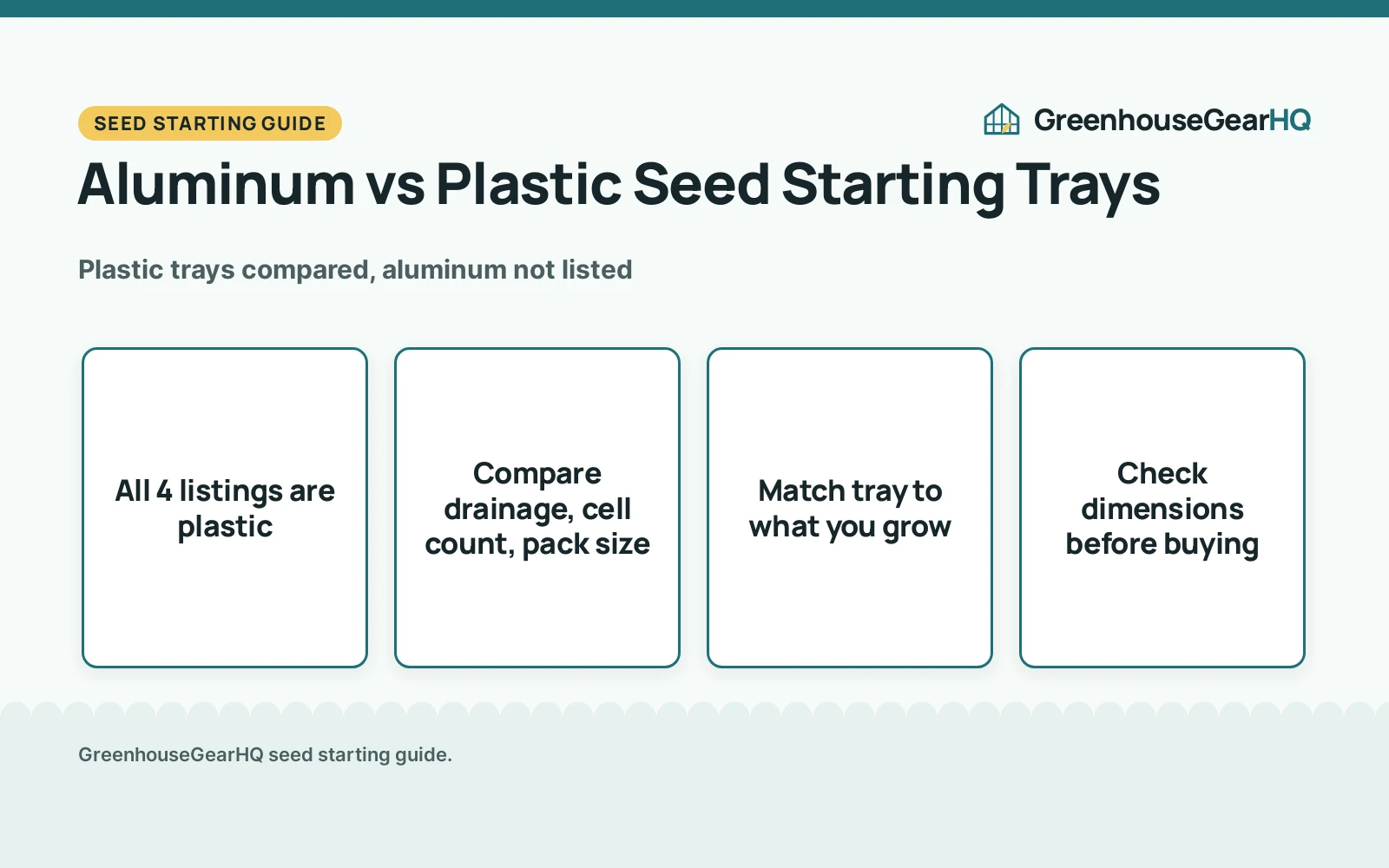
Aluminum vs plastic seed starting trays: the 4 listings we compared are all plastic, and none lists an aluminum tray. If you came looking for an aluminum option, these listings do not have one. Plastic trays are what the listings offer, in cell counts from 36 to 72 and flat sizes around 21 by 11 inches, with and without drainage holes. Where a number appears below, it comes from a listing we compared, and we name the listing so you can check it.
Other options worth a look
 VUWEZ 6 Pack Plastic Plant Tray Saucer RectangularCheck price on Amazon
 1020 Seed Starting TraysCheck price on Amazon
 Rectangle Plant Tray 13 InchCheck price on Amazon
 Handy Pantry Black Plastic Garden Tray InsertsCheck price on Amazon
 10-Pack Heavy-Duty 1020 Seed Trays No HolesCheck price on Amazon
 Burpee SuperSeed 36-Cell Reusable Seed Starting Tray forCheck price on Amazon
GreenhouseGearHQ earns a commission when you buy through links on this page, at no extra cost to you. As an Amazon Associate I earn from qualifying purchases. Affiliate disclosure.
The 4 plastic trays, ranked: aluminum vs plastic seed starting trays
1. RooTrimmer 72-cell trays (10-pack). The listing describes thickened plastic 72-cell trays, 21 by 11 inches, with drainage holes and a 1.81-inch height. It states the trays do not warp easily in sun and can be cleaned and reused. The cells provide space for water and nutrients, with top drip ports and bottom holes to prevent saturation. The 10-pack suits sowing many varieties at once. Best for: starting many seedlings in cells.
2. Living Whole Foods 5-pack trays. The listing describes 5 durable black plastic trays, 21 by 11 by 2 inches, without drain holes. It states they work as drip trays and for hydroponic growing, and accommodate 20 by 10 inch grow pads and micro-mats. The 5-gallon capacity suits holding water under pots. Reusable for greenhouse, seedlings, wheatgrass and microgreens. Best for: drip trays and microgreens.
3. RooTrimmer 1020 flat trays (5-pack). The listing describes 5 BPA-free plastic flat trays, 21.3 by 10.9 by 2.1 inches, without drainage holes. It states they hold soil for seeds and microgreens, work as wheatgrass and bonsai trays, and move without leaking. The 8.22-liter capacity holds a large amount of soil. BPA-free matters for food crops. Best for: carrying pots and soil.
4. Burpee SuperSeed 36-cell tray. The listing names a 36-cell seed starting tray with silicone cells. Few specs are stated. Best for: growers who want silicone cells.
Drainage holes or solid
2 listings state drainage holes: the RooTrimmer 72-cell has bottom drip holes to prevent root saturation, and the Burpee is a cell tray. 2 state no drain holes: the Living Whole Foods and the RooTrimmer 1020 flat, which suit holding water. Solid trays suit drip trays, microgreens and wheatgrass; cell trays with holes suit seedlings that need drainage and air. The RooTrimmer 72-cell pairs with a 1020 flat tray. Match the tray to what you grow, not the other way around.
What to look for in the listing
Cell count matters: 72 cells (RooTrimmer) vs 36 cells (Burpee) vs flat trays with no cells. Pack size matters: 10-pack vs 5-pack. Material notes: the RooTrimmer 1020 states BPA-free plastic; the RooTrimmer 72-cell states thickened plastic that resists warping. Reusability is stated for the 72-cell and the Living Whole Foods trays. None of the 4 lists an aluminum tray, so compare plastic on these points.
Plastic features worth comparing
Thickness is stated for the RooTrimmer 72-cell: thickened plastic that resists warping in sun. BPA-free is stated for the RooTrimmer 1020 flat trays. Reusability is stated for the 72-cell (clean and reuse) and the Living Whole Foods (reusable). Color is black for three; the Burpee color is not stated. These are the material details the listings give; none mentions aluminum.
How to pick from these 4
Start with cell count. The RooTrimmer 72-cell suits sowing many seedlings at once; the Burpee 36-cell suits fewer varieties or a smaller batch. For flat trays, the Living Whole Foods 5-pack and RooTrimmer 1020 5-pack both measure around 21 by 11 inches. Check drainage: the 72-cell has holes, the flats do not. The RooTrimmer 1020 states BPA-free plastic, which matters if that is a concern. All 4 are plastic; pick by cells, drainage and pack size.
FAQ for growers
Are any of these aluminum?
No. All 4 listings describe plastic trays. None states aluminum.
Which have drainage holes?
The RooTrimmer 72-cell lists bottom drip holes. The Living Whole Foods and RooTrimmer 1020 flat trays state no drain holes.
What size are they?
Around 21 by 11 inches: the Living Whole Foods lists 21 by 11 by 2 inches, the RooTrimmer 72-cell lists 21 by 11 inches, and the RooTrimmer 1020 lists 21.3 by 10.9 by 2.1 inches.
Do plastic trays last?
The RooTrimmer 72-cell states thickened plastic that does not warp easily in sun and can be cleaned and reused. The Living Whole Foods trays are described as durable and reusable. Longevity depends on the plastic thickness the listing states.
Keep reading
See every seed starting guide.
More picks: trays for windowsills, trays for wildflowers and humidity dome vs tray with lid.