On this page
Top picks at a glance
As an Amazon Associate I earn from qualifying purchases.
- 1
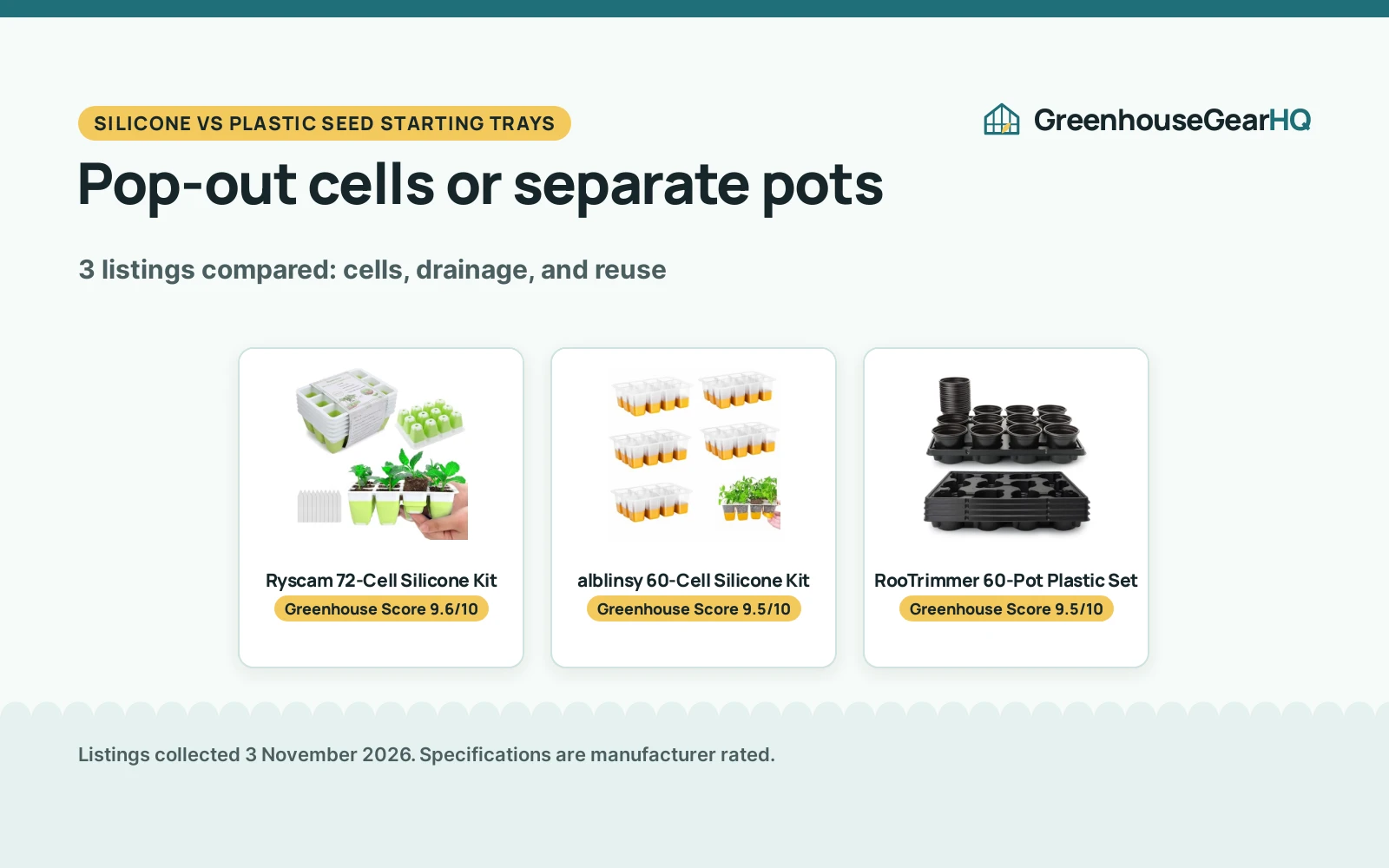
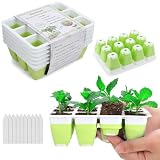 Ryscam 72-Cell Silicone Kit9.6/10View on Amazon
- 2
 alblinsy 60-Cell Silicone Kit9.5/10View on Amazon
- 3
 RooTrimmer 60-Pot Plastic Set9.5/10View on Amazon
Late winter seed starting begins with trays on a bench, damp mix, and seedlings that still need to leave their cells without losing roots, and the silicone vs plastic seed starting trays choice shapes that move. This comparison looks at silicone cells that bend and pop out against plastic pots that lift out separately, using the listings as concrete examples, with a short verdict on who should pick which side.
GreenhouseGearHQ earns a commission when you buy through links on this page, at no extra cost to you. As an Amazon Associate I earn from qualifying purchases. Affiliate disclosure.
Quick verdict: choose silicone if transplanting without disturbing roots matters most, since both silicone examples list flexible pop-out cells that release the whole root ball. Choose plastic if separate pots matter more, since the RooTrimmer example lists 60 4 inch pots in 5 trays. Neither side wins on cell size alone: the silicone examples list cells 1.5 inches wide, while the plastic example lists 4 inch pots.
The examples
| # | Product | Greenhouse Score | Buy |
|---|---|---|---|
| 1 | Ryscam 72-Cell Silicone Kit | 9.6/10 | Buy on Amazon |
| 2 | alblinsy 60-Cell Silicone Kit | 9.5/10 | Buy on Amazon |
| 3 | RooTrimmer 60-Pot Plastic Set | 9.5/10 | Buy on Amazon |
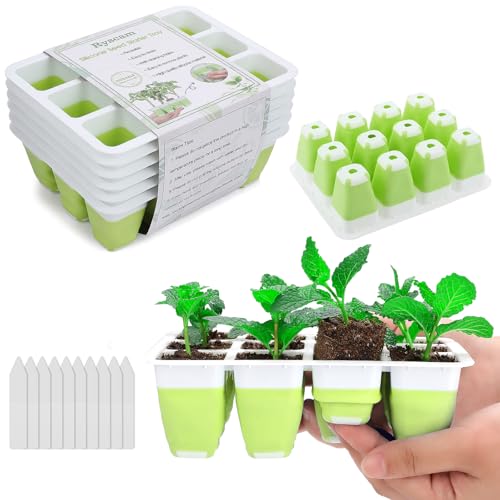
Ryscam 72-Cell Silicone Kit
A silicone seed starting kit with 72 pop-out cells across 6 trays and base trays for watering from below, suited to growers who want whole root balls moved intact.
Pros
- Flexible pop-out cells that release the whole root ball with a push from below
- Base trays collect drainage and allow watering from below
- Corner slots in each cell improve drainage and soil aeration
- Silicone and reinforced plastic construction, washable and reusable for a few seasons
Cons
- No warranty term is stated
- Only the green color is listed

alblinsy 60-Cell Silicone Kit
A silicone seed starting kit with 60 pop-out cells across 5 trays, suited to growers who want food grade silicone cells that bend for transplanting.
Pros
- 60 pop-out cells across 5 trays, with 12 cells per tray
- Food grade silicone cells that bend and pop out for transplanting
- Small holes in the bottom of each cell improve drainage and soil ventilation
- Thickened plastic material described as corrosion resistant and easy to clean
Cons
- No warranty term is stated, only a promise of after-sale help
- Only the orange color is listed
- No base tray for collecting drainage is stated

RooTrimmer 60-Pot Plastic Set
A plastic seed starting set with 60 4 inch pots and 5 trays that hold 12 pots each, suited to growers who want separate pots they can move and carry.
Pros
- 60 4 inch pots with 5 trays, with 12 pots fitting each tray
- BPA free material described as tough, not easy to deform, and reusable
- Trays double as carriers for moving seedling pots
- 0.2 inch space under pots in the tray increases gas permeability of pot soil
Cons
- Bullets describe trays without holes, then describe a drainage hole in each of the four corners
- Separate pots, with no pop-out cell release stated
- No warranty term is stated
- Drainage holes in the pots themselves are not stated
As an Amazon Associate I earn from qualifying purchases.
Other options worth a look
 VUWEZ 6 Pack Plastic Plant Tray Saucer RectangularCheck price on Amazon
 4 Pack Square Plant Saucer Tray 12 inchCheck price on Amazon
 4 Pack Square Plant Saucer Tray 8 inchCheck price on Amazon
 2 Pack Square Plant Saucer Tray 12 inchCheck price on Amazon
 1020 Seed Starting TraysCheck price on Amazon
 Rectangle Plant Tray 13 InchCheck price on Amazon
Silicone vs plastic seed starting trays: side by side
| Seed Starting Tray | Greenhouse Score | Material | Cells or Pots | Cell or Pot Size | Drainage | Warranty | Amazon |
|---|---|---|---|---|---|---|---|
| Ryscam 72-Cell Silicone Kit | 9.6/10 | Silicone and reinforced plastic | 72 cells | 1.5 x 1.5 x 2 inches | Corner slots, base tray | Not stated | View on Amazon |
| alblinsy 60-Cell Silicone Kit | 9.5/10 | Food grade silicone and thickened plastic | 60 cells | 1.5 x 1.5 x 2 inches | Small holes in cell bottoms | Not stated | View on Amazon |
| RooTrimmer 60-Pot Plastic Set | 9.5/10 | BPA free plastic | 60 pots, 5 trays | 4 inch pots | Corner holes stated, trays described without holes | Not stated | View on Amazon |
Size and build specs are the manufacturer’s ratings as published on each listing, gathered 3 November 2026.
Cell material and transplanting
The silicone side bends. The Ryscam example lists silicone seed starting trays with flexible pop-out cells, and the maker says a gentle push at the bottom of the tray releases an entire root ball, with no tugging or tearing. The alblinsy example lists silicone cells that bend and pop out when transplanting time arrives, and the maker links that movement to less stress on seedlings and less damage to roots. Both silicone examples list 12 flexible pop-out cells per tray, with cells 1.5 inches wide and 2 inches deep.
The plastic side lifts out instead of popping out. The RooTrimmer example lists 60 4 inch plastic plant pots with 5 trays, and 12 pots fit into each tray. Pots can be moved and carried as separate units, which suits growers who want to move part of a batch without moving a whole tray. No pop-out cell release is stated for the plastic example, so transplanting means lifting a pot, not pushing a cell from below.
Drainage and watering
Drainage differs by design, not by material alone. The Ryscam example lists corner slots in each cell to improve drainage and soil aeration, and a base tray that collects drainage from the cells and allows watering seedlings from below. The alblinsy example lists small holes in the bottom of each cell to improve drainage and soil ventilation, with holes that discharge water and let oxygen reach roots. For growers who want bottom watering, the Ryscam example is the only listing here that states a base tray for that method, and the seed starting trays for bottom watering roundup covers more kits built around it.
The RooTrimmer example is less clear on drainage. Its bullets describe the trays as without holes, then describe a drainage hole in each of the four corners of the tray, so the tray drainage description contradicts itself. The listing also states a 0.2 inch space under pots in the tray to increase gas permeability of pot soil. Pot drainage holes are not stated, so ask the seller before ordering if you need confirmed pot drainage.
Size and capacity
Capacity separates the listings more than material does. The Ryscam example holds 72 seedlings across 6 trays, with 12 cells per tray. The alblinsy example holds 60 cells in total across 5 trays, with 12 cells per tray. The RooTrimmer example holds 60 pots across 5 trays, with 12 pots fitting each tray.
Reuse is stated on every side. The Ryscam example lists silicone and reinforced plastic in one piece, washable and reusable for a few seasons. The alblinsy example lists food grade silicone and thickened plastic material, described as corrosion resistant, easy to clean, and reusable for the next planting season. The RooTrimmer example lists a high-quality new material, described as BPA free, with high toughness, not easy to deform, and reusable. No side states a warranty term.
Listing gaps to check
The Ryscam example contradicts itself on count: the title says 6 pieces, while the spec table lists 5 items. Trust the title and bullets, which give 12 cells per tray and 72 seedlings in total. The RooTrimmer example contradicts itself on holes, as noted above, and its spec table lists 0.2 pounds with no clear per-piece breakdown. The alblinsy example lists spec table dimensions of 5.0 inches by 1.0 inches by 3.0 inches, which do not clearly describe the tray layout, so confirm tray size with the seller if bench space is tight. None states a warranty term, or a light, heat, or watering schedule.
Which should you choose?
Choose silicone if you want flexible cells that pop out with the root ball intact, drainage holes in each cell, and a kit you can wash and reuse. The Ryscam example adds a base tray for watering from below, while the alblinsy example adds food grade silicone. More options for gentle transplanting appear in the seed starting trays for transplanting roundup.
Choose plastic if you want separate 4 inch pots that can be moved, carried, and spaced apart, with trays that hold 12 pots each. The RooTrimmer example suits growers who pot on in stages or carry pots to another bench. If a tray with a lid or a dome matters, check those listings separately, since none of the listings here states a lid or dome.
If you only need a small batch, a kit with fewer cells may suit better, since capacity here runs from 60 to 72.
In the Greenhouse
- Place silicone trays in base trays for bottom watering, as the Ryscam example states, and keep drainage water from pooling under trays.
- Push silicone cells gently from below at transplanting, as the Ryscam example and the alblinsy example describe, rather than pulling seedlings by their stems.
- Space RooTrimmer pots in their trays so air can move through the 0.2 inch gap under the pots.
- Wash and dry trays and pots between plantings, since every listing here describes its kit as reusable.
- Confirm tray count and drainage with the seller where a listing contradicts itself, before ordering.
Scoring notes
| Product | Greenhouse Score | Perf. /35 | Build /25 | Value /25 | Safety /10 | Warranty /5 |
|---|---|---|---|---|---|---|
| Ryscam 72-Cell Silicone Kit | 9.6 | 32 | 22 | 22 | 0 | 0 |
| alblinsy 60-Cell Silicone Kit | 9.5 | 28 | 21 | 20 | 3 | 0 |
| RooTrimmer 60-Pot Plastic Set | 9.5 | 28 | 20 | 20 | 3 | 0 |
Greenhouse Scores use 9.2 as the lowest value and 9.8 as the highest, with weighted points placed between them in proportion. More points always earns more score.
The Greenhouse Score weighs performance, build, value, safety and warranty, and How we pick explains the weights. For seed starting trays, safety reflects stated material features such as food grade silicone or BPA free material; Ryscam states neither and earns no safety points, while alblinsy and RooTrimmer each earn safety points. No listing states a warranty term, so no listing earns warranty points. Ryscam scores highest for its 72 cells, pop-out release, and base tray watering, with points lost for the count contradiction. alblinsy follows for its food grade silicone and drainage holes, and RooTrimmer follows for its separate pots and carrying trays, with points lost for the drainage contradiction.
FAQ for growers
Are silicone seed starting trays better than plastic seed starting trays?
It depends on transplanting style. Silicone examples list flexible pop-out cells that release the whole root ball, while the RooTrimmer example lists separate 4 inch pots that lift out individually.
Do silicone seed trays drain well?
Ryscam lists corner slots in each cell, and alblinsy lists small holes in the bottom of each cell, both linked by the makers to drainage and soil aeration.
Can plastic seed starting trays be reused?
RooTrimmer describes its material as reusable, with high toughness and not easy to deform. Silicone examples also describe washable, reusable trays.
How many seedlings do these trays hold?
Ryscam holds 72 seedlings, alblinsy holds 60 cells, and RooTrimmer holds 60 pots. Capacity is per listing, so check the count before ordering.
Keep reading
See every seed starting tray guide and all seed starting guides.
More picks: seed starting trays, seed starting trays vs peat pots, styrofoam vs plastic seed trays and wood vs plastic seed starting trays.