On this page
Top picks at a glance
As an Amazon Associate I earn from qualifying purchases.
- 1
 RooTrimmer 60-Pot Plastic Seed Starting Set with 5 Nursery9.5/10View on Amazon
- 2
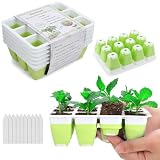 Ryscam 72-Cell Silicone Seed Starter Kit with Pop-Out Cells9.6/10View on Amazon
- 3
 alblinsy 60-Cell Silicone Seed Starter Kit with Pop-Out Cells9.5/10View on Amazon
- 4
 VUWEZ 6 Pack Plastic Plant Tray Saucer RectangularView on Amazon
- 5
 2 Pack Square Plant Saucer Tray 12 inchView on Amazon
- 6
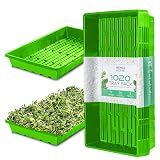 1020 Seed Starting TraysView on Amazon
- 7
 Rectangle Plant Tray 13 InchView on Amazon
- 8
 Handy Pantry Black Plastic Garden Tray InsertsView on Amazon
- 9
 Bootstrap Farmer 32 Cell TraysView on Amazon
Late winter, seed packets open on the table, and the question is what to sow into. The wood vs plastic seed starting trays question has a short answer on the listings reviewed here: every tray listed is plastic, so the choice is not wood against plastic but which plastic form fits the job. A flat with no holes suits microgreens and carrying pots, a cell tray with drainage suits starting seeds, and a clear tray suits watching roots. This guide compares the plastic trays listed, in ranked order, and says plainly where a listing contradicts itself.
Other options worth a look
 VUWEZ 6 Pack Plastic Plant Tray Saucer RectangularCheck price on Amazon
 2 Pack Square Plant Saucer Tray 12 inchCheck price on Amazon
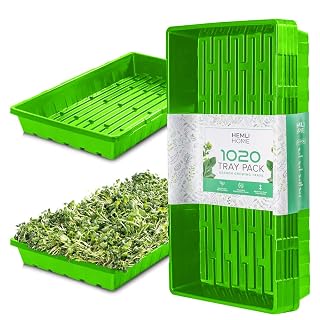 1020 Seed Starting TraysCheck price on Amazon
 Rectangle Plant Tray 13 InchCheck price on Amazon
 Handy Pantry Black Plastic Garden Tray InsertsCheck price on Amazon
 Bootstrap Farmer 32 Cell TraysCheck price on Amazon
GreenhouseGearHQ earns a commission when you buy through links on this page, at no extra cost to you. As an Amazon Associate I earn from qualifying purchases. Affiliate disclosure.
Wood vs plastic seed starting trays at a glance
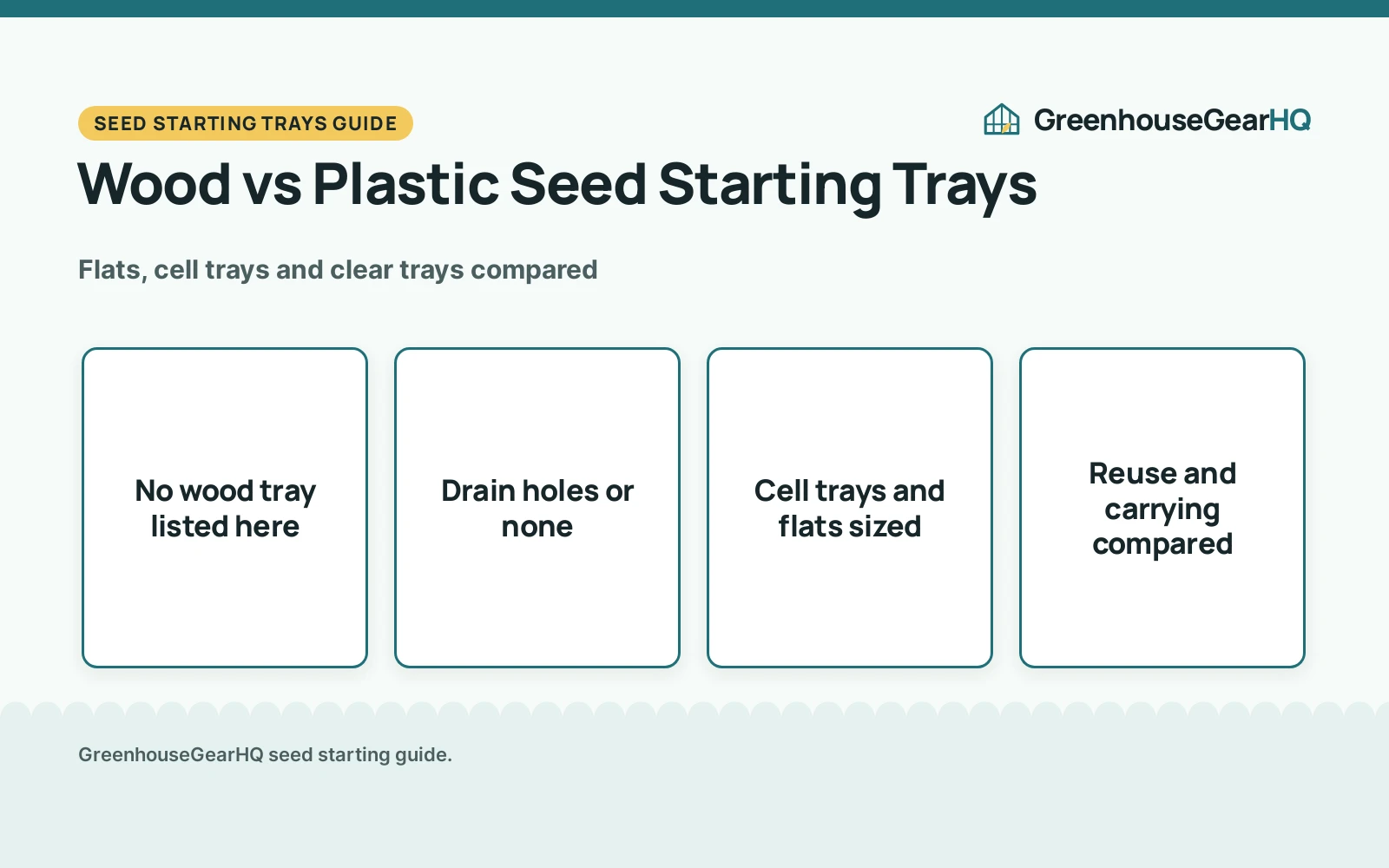
No wood tray appears in the listings reviewed here, so this guide cannot award wood a win on any feature. That gap matters: a buyer who wants wood must look beyond these listings. On the plastic side, the listings cover open flats with no drain holes, cell trays with drainage holes, and a clear cell tray for watching growth. The rest of this guide ranks those plastic forms by drainage, size and reuse.
The gear, in ranked order
The trays below are ranked by drainage, size clarity and reuse, from the clearest listing to the least settled.
Gardzen 6-cell clear tray. A clear plastic tray with 6 cells, each cell 1.5 inches square by 2.2 inches deep, sized 5.4 inches by 3.7 inches, with drain holes, guide channels at the top, and a removable bottom that pushes out from below. The clear walls suit watching germination and roots. One wrinkle: the spec table lists height as 2.25 inches in one field and 2.2 inches in the dimensions field, so this guide uses the 2.2 inch figure from the bullets and dimensions.
RooTrimmer 72-cell tray, 10-pack. A thickened plastic tray with 72 cells, sized 21 inches by 11 inches at 1.81 inches high, with bottom drip holes and a top drip port, sized to pair with a 1020 flat. The listing says the trays do not warp easily in sun and can be cleaned and reused. One wrinkle: the spec table model fields say 128 cell and 200 cell tray against the 72 cell title, so this guide trusts the title and bullets.
RooTrimmer 1020 flat, 5-pack. A BPA-free plastic flat sized 21.3 inches by 10.9 inches by 2.1 inches, with no drainage holes, for holding and carrying pots, starting seeds and growing microgreens. The listing says the flat moves without leakage and saves watering time.
Living Whole Foods flat, 5-pack. A black plastic tray sized 21 inches by 11 inches at the top and 20 inches by 10 inches at the bottom, 2 inches high, with no drain holes, for use as a drip tray and for seed starting, wheatgrass and microgreens. One wrinkle: the spec table lists a drainage-hole feature while the title and bullets say no drain holes, so this guide trusts the title and bullets.
Drain holes or none
Drainage splits the trays into pairs. The Gardzen cell tray and the RooTrimmer 72-cell tray have drainage holes: the Gardzen listing says drain holes prevent overwatering and guide channels send water to every cell, while the RooTrimmer listing cites bottom drip holes that keep roots from sitting in too much water. The Living Whole Foods flat and the RooTrimmer 1020 flat have no drain holes, which suits microgreens and carrying pots without leakage, and the Living Whole Foods flat doubles as a drip tray. Pick drainage for seeds that stay in the tray until transplant, and pick no holes for microgreens or for catching water under pots.
Cells or flats
Cell trays give each seedling its own pocket, while flats hold soil or pots in one open bed. The Gardzen tray has 6 cells at 1.5 inches square by 2.2 inches deep, and the RooTrimmer tray has 72 cells paired with a 1020 flat. The flats measure 21 inches by 11 inches at the top for the Living Whole Foods tray and 21.3 inches by 10.9 inches for the RooTrimmer tray, so both sit in the standard flat footprint. Cells suit starting seeds for transplant, and the Gardzen tray pushes out from the base for removal; flats suit microgreens, wheatgrass and moving pots in bulk.
What this guide does not cover
Wood trays, heat mats, grow lights and humidity domes are outside this guide. No wood tray is listed here, so wood gets no section. Heat mats, lights and domes appear in other GreenhouseGearHQ guides, linked below.
FAQ for growers
Do seed starting trays need drain holes?
For seeds started for transplant, drainage helps: the Gardzen listing says drain holes prevent overwatering, and the RooTrimmer 72-cell listing cites bottom drip holes. For microgreens and drip trays, no holes suits the job: both flats here have no drain holes and the RooTrimmer flat is listed for microgreens.
What size tray fits a 1020 flat?
The RooTrimmer 72-cell tray is listed for pairing with a 1020 flat, and the Living Whole Foods tray measures 21 inches by 11 inches at the top and 20 inches by 10 inches at the bottom, matching the 20 inch by 10 inch pads the listing names.
Can I reuse plastic seed trays?
Yes, on these listings: the Living Whole Foods trays are listed as reusable, the RooTrimmer 72-cell trays can be cleaned and reused, and the RooTrimmer flat is listed as reusable.
Why would I pick a clear tray?
To watch growth: the Gardzen clear trays make it easy to observe germination and the root system, per the listing, which helps decisions about watering and transplanting.
Keep reading
Also see our seed starting trays. Also see our seedling heat mats. Also see our grow lights for seedlings. Also see our humidity domes.
More picks: seed starting trays, greenhouse shelving, seedling heat mats and grow lights for seedlings.