On this page
Top picks at a glance
As an Amazon Associate I earn from qualifying purchases.
- 1
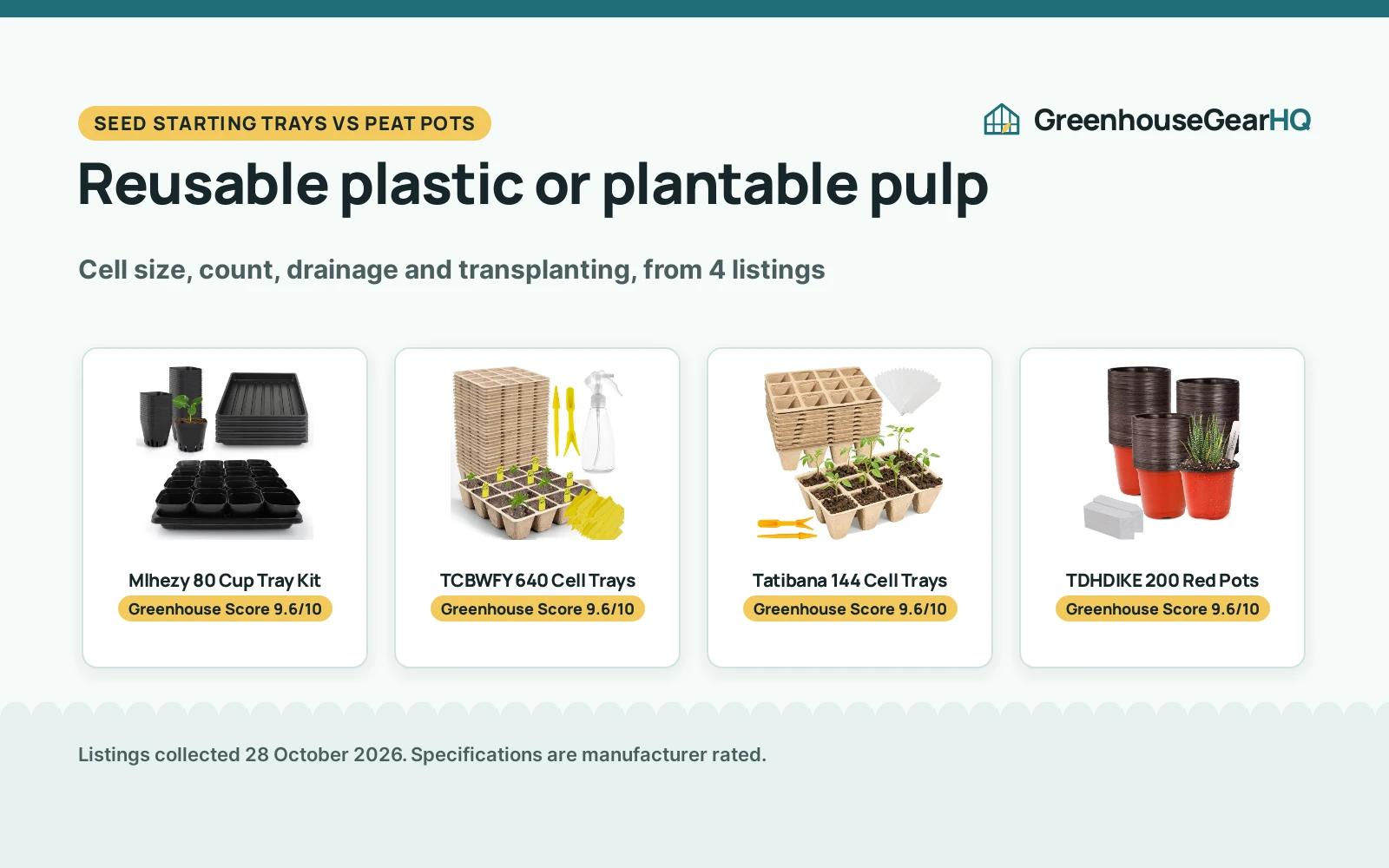
 Mlhezy 80 Cup Tray Kit9.6/10View on Amazon
- 2
 TCBWFY 640 Cell Trays9.6/10View on Amazon
- 3
 Tatibana 144 Cell Trays9.6/10View on Amazon
- 4
 TDHDIKE 200 Red Pots9.6/10View on Amazon
On a late winter windowsill lined with seed trays for the new season, the seed starting trays vs peat pots choice decides whether seedlings move out in their pots or get lifted out at transplant time. We compared 4 listings, 2 on the reusable plastic side and 2 on the biodegradable pulp side, by cell size, count, material and what each listing states about transplanting.
GreenhouseGearHQ earns a commission when you buy through links on this page, at no extra cost to you. As an Amazon Associate I earn from qualifying purchases. Affiliate disclosure.
Quick verdict: choose reusable plastic trays and pots if you want to reuse the kit across seasons and catch water in a tray, as the Mlhezy kit does with 5 trays for 80 cups. Choose biodegradable peat pots if you want to plant the pot into the soil without lifting the seedling, as the TCBWFY and Tatibana pulp trays allow. Neither side states a warranty term, and cell sizes run from 1.6 in on the pulp side to 2.5 in and 4 in on the plastic side, so match the cell to the seed, not just the material.
Our picks for the greenhouse
| # | Product | Greenhouse Score | Buy |
|---|---|---|---|
| 1 | Mlhezy 80 Cup Tray Kit | 9.6/10 | Buy on Amazon |
| 2 | TCBWFY 640 Cell Trays | 9.6/10 | Buy on Amazon |
| 3 | Tatibana 144 Cell Trays | 9.6/10 | Buy on Amazon |
| 4 | TDHDIKE 200 Red Pots | 9.6/10 | Buy on Amazon |

Mlhezy 80 Cup Tray Kit
A kit of 80 square 2.5 in nursery cups with 5 fitted trays, in BPA-free plastic with drainage holes in the cups.
Pros
- 80 cups and 5 trays fitted 4 by 4 per tray
- BPA-free plastic for cups and trays
- Cups are deformable plastic for repeated use
- Trays have no drainage holes and collect excess water
Cons
- Indoor use only, per the spec table
- No warranty term is stated
- 2.5 in cups are smaller than the 4 in pots here
- Black is the single color stated

TCBWFY 640 Cell Trays
A 40-pack set of biodegradable pulp trays with 640 cells at 1.6 x 1.6 x 2 in, plus labels, tools and a spray bottle.
Pros
- 640 cells across 40 packs for large sowings
- Biodegradable pulp pots plant straight into soil
- Each pack cuts into 16 small cells
- 400 labels, 2 tools and a spray bottle included per the bullets
Cons
- Biodegradable pulp is not reusable like plastic
- No warranty term is stated
- 1.6 in cells are smaller than the plastic cups here

Tatibana 144 Cell Trays
A 12-tray set of biodegradable pulp pots with 144 cells at 1.6 x 1.6 x 2 in, plus labels and transplanting tools.
Pros
- 144 cells across 12 trays
- Biodegradable wood pulp pots plant straight into soil
- Each tray cuts into 12 small cells
- 100 labels and 2 transplanting tools included
Cons
- Title and bullets say indoor and outdoor use while the spec table says indoor only
- No warranty term is stated
- 1.6 in cells are smaller than the plastic cups here

TDHDIKE 200 Red Pots
A set of 200 small red plastic pots with 200 labels, 8 drainage holes per pot, and reusable PP plastic.
Pros
- 200 pots with 200 labels for marking seedlings
- 8 drainage holes per pot, upgraded from 6
- Reusable PP plastic, break-resistant per the listing
- Indoor and outdoor use stated
Cons
- No tray is stated, only pots and labels
- No warranty term is stated
- Red is the single color stated
As an Amazon Associate I earn from qualifying purchases.
Other options worth a look
 Dalzom® 60Pcs 4” Peat Pots with 60Pcs Plant LabelsCheck price on Amazon
 Dalzom® 60Pcs 3.1” Peat Pots with 60Pcs Plant LabelsCheck price on Amazon
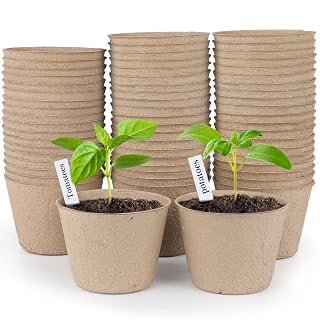 60 Pcs 4 Inch Peat PotsCheck price on Amazon
 Jiffy-Pots Organic Seed Starting 2" Biodegradable Peat PotsCheck price on Amazon
 2 Pack Square Plant Saucer Tray 12 inchCheck price on Amazon
 VIVOSUN 3.15“ Peat PotsCheck price on Amazon
Seed starting trays vs peat pots: side by side
| Tray or Pot | Greenhouse Score | Material | Cell or pot size | Count | Drainage | Warranty | Amazon |
|---|---|---|---|---|---|---|---|
| Mlhezy 80 Cup Tray Kit | 9.6/10 | BPA-free plastic | 2.5 in square cups | 80 cups, 5 trays | Holes in cups | Not stated | View on Amazon |
| TCBWFY 640 Cell Trays | 9.6/10 | Biodegradable pulp | 1.6 x 1.6 x 2 in cells | 640 cells, 40 packs | Not stated | Not stated | View on Amazon |
| Tatibana 144 Cell Trays | 9.6/10 | Wood pulp | 1.6 x 1.6 x 2 in cells | 144 cells, 12 trays | Not stated | Not stated | View on Amazon |
| TDHDIKE 200 Red Pots | 9.6/10 | PP plastic | 3.9 in top, 3.2 in high | 200 pots, 200 labels | 8 holes per pot | Not stated | View on Amazon |
Each figure is the brand’s own rating, taken from its product page on 28 October 2026.
Material: plastic that lasts or pulp that breaks down
The plastic side is built for reuse. Mlhezy lists BPA-free plastic cups and trays, and TDHDIKE lists PP plastic pots that restore after being compressed and resist breaking, per the listing. The pulp side is built to disappear: TCBWFY and Tatibana list biodegradable pulp trays that plant straight into soil and degrade into fertilizer, with roots growing through the pot wall. Neither side is better on material alone: plastic offers reuse across seasons, while pulp offers planting without lifting, and the choice follows what you want to do at transplant time.
Cell size and count
Cell size and count pull in opposite directions here. The pulp trays give the most cells: TCBWFY lists 640 cells and Tatibana lists 144 cells, all at 1.6 x 1.6 x 2 in. The plastic side gives larger homes: Mlhezy cups are 2.5 in square and TDHDIKE pots are 4 in with a 3.9 in top opening. A small cell suits a small seed started in number, while a larger pot suits a seedling that stays put longer before moving out. Do not compare counts alone: 640 small cells and 80 larger cups are different kinds of capacity.
Transplanting: lift or plant the pot
Transplanting is where the sides split. TCBWFY says its pulp pots help eliminate transplant shock by going straight into soil or a container without disturbing tender young roots, and Tatibana says the same: put the peat pot into the soil and it degrades into fertilizer. Plastic pots work the other way: the seedling comes out of the pot at transplant time, and the pot stays behind for another round. Mlhezy cups are deformable plastic for repeated use, and TDHDIKE pots are reusable PP, so the plastic side trades a lifting step for a kit that serves again.
Water and drainage
Drainage is stated clearly on the plastic side and left unclear on the pulp side. Mlhezy cups have built-in drainage holes while their trays have none, so the trays collect excess water. TDHDIKE pots have 8 drainage holes each, upgraded from 6. Neither pulp listing states drainage holes, so judge the pulp side on the pulp traits each listing does state, like Tatibana’s absorption and breathability, not on a hole count neither pulp listing states.
Listing gaps to check
Three listings carry figure clashes worth checking before ordering. TCBWFY bullets state 400 labels while the spec table states 100. Tatibana title and bullets say indoor and outdoor use while the spec table says indoor only. TDHDIKE bullets state a 3.2 in height while the spec table states 3.54 in. No listing on either side states a warranty term, and the Mlhezy kit states no labels at all, so check the label count on the listing you buy if labels matter to you.
Which should you choose?
Choose reusable plastic trays and pots if you want a kit that serves across seasons, cups and pots you can fill again, and trays that catch water. The Mlhezy kit fits cups to trays at 4 by 4, and the TDHDIKE set gives 200 pots with labels. For more on tray watering, see our self watering vs standard seed starting trays comparison.
Choose biodegradable peat pots if you want to plant the pot into the soil without lifting the seedling, and you sow in number. The TCBWFY set gives 640 cells and the Tatibana set gives 144 cells, both at 1.6 x 1.6 x 2 in. For hardening off before moving plants out, see our best seed starting trays for hardening off picks.
In the Greenhouse
- Set the Mlhezy trays on a flat surface: each tray is 10 x 10 x 1.2 in and holds 16 cups at 4 by 4.
- Cut pulp trays into single cells before planting out: TCBWFY packs cut into 16 cells and Tatibana trays cut into 12 cells.
- Mark seedlings as you sow: TDHDIKE includes 200 labels, TCBWFY lists 400 labels in its bullets, and Tatibana includes 100 labels.
- Place TDHDIKE pots indoors or outdoors as stated, and check the Tatibana indoor-only spec table note against its title before placing trays outside.
Scoring notes
| Product | Greenhouse Score | Perf. /35 | Build /25 | Value /25 | Safety /10 | Warranty /5 |
|---|---|---|---|---|---|---|
| Mlhezy 80 Cup Tray Kit | 9.6 | 30 | 21 | 21 | n/a | 0 |
| TCBWFY 640 Cell Trays | 9.6 | 29 | 20 | 21 | n/a | 0 |
| Tatibana 144 Cell Trays | 9.6 | 28 | 21 | 20 | n/a | 0 |
| TDHDIKE 200 Red Pots | 9.6 | 28 | 20 | 20 | n/a | 0 |
We rescale the weighted total onto a range that ends at 9.2 and 9.8; nothing in the conversion can reorder two picks. If there is no power source and no stated safety feature, the safety criterion is left off and 90 points remain.
The Greenhouse Score weighs performance, build, value, safety and warranty, as explained on our How we pick page. For seed starting gear, safety reflects a stated safety certification; no listing here states one, so no product earns safety points. No listing states a warranty term either. The Mlhezy kit scores highest for its fitted cups and trays and reusable build, while the pulp trays score for cell count and direct planting.
FAQ for growers
Do peat pots really break down in the soil?
That is what both pulp listings state: TCBWFY and Tatibana say their pulp pots degrade into fertilizer after planting, and that roots grow through the pot wall. Plant the whole pot and let it break down in place.
Can you reuse seed starting trays?
The plastic kits here are reusable: Mlhezy cups are deformable plastic for repeated use and TDHDIKE pots are reusable PP plastic. The pulp trays are biodegradable by design, so they are not the reusable choice.
What cell size should I start with?
Compare the stated sizes: pulp cells are 1.6 x 1.6 x 2 in, Mlhezy cups are 2.5 in square, and TDHDIKE pots have a 3.9 in top opening. Match the cell to the seed and to how long the seedling stays before moving out.
Do these kits come with labels?
Three do. TDHDIKE includes 200 labels, TCBWFY lists 400 labels in its bullets, and Tatibana includes 100 labels, while the Mlhezy kit states no labels.
Keep reading
See every seed starting tray guide and all seed starting guides.
More picks: biodegradable vs plastic seed starting pots, terracotta vs plastic seed starting pots and seed starting labels.