On this page
Top picks at a glance
As an Amazon Associate I earn from qualifying purchases.
- 1
 SOLIGT Self-Watering Seed Starter Trays with Humidity Domes9.7/10View on Amazon
- 2
 10-Pack Heavy-Duty 1020 Seed Trays No HolesView on Amazon
- 3
 Burpee SuperSeed 36-Cell Reusable Seed Starting Tray forView on Amazon
- 4
 AC Infinity Self-Watering Fabric Pot BaseView on Amazon
- 5
 AC Infinity Self-Watering Fabric Pot Base XLView on Amazon
- 6
 Propagator Tray with Vented DomeView on Amazon
- 7
 VUWEZ 6 Pack Plastic Plant Tray Saucer RectangularView on Amazon
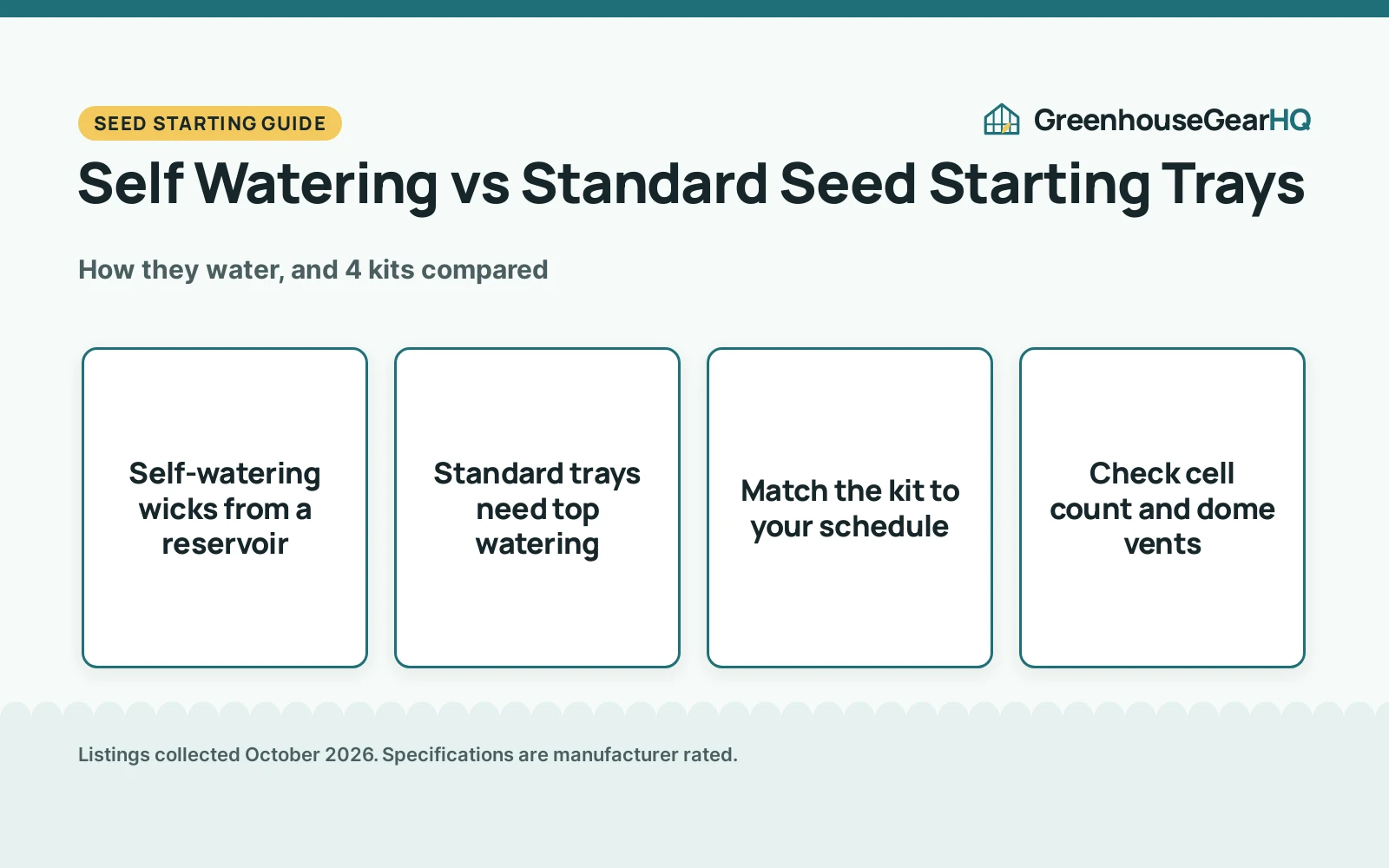
Late winter seed starting means trays that cannot dry out between checks. Self watering vs standard seed starting trays comes down to how water reaches the roots: self-watering trays wick moisture up from a reservoir, while standard trays need watering from above. If the shelf goes unchecked for days, self-watering wins; for daily checkers who want full control, standard trays do the job. Both types start seeds; they differ in daily attention.
Other options worth a look
 10-Pack Heavy-Duty 1020 Seed Trays No HolesCheck price on Amazon
 Burpee SuperSeed 36-Cell Reusable Seed Starting Tray forCheck price on Amazon
 AC Infinity Self-Watering Fabric Pot BaseCheck price on Amazon
 AC Infinity Self-Watering Fabric Pot Base XLCheck price on Amazon
 Propagator Tray with Vented DomeCheck price on Amazon
 VUWEZ 6 Pack Plastic Plant Tray Saucer RectangularCheck price on Amazon
GreenhouseGearHQ earns a commission when you buy through links on this page, at no extra cost to you. As an Amazon Associate I earn from qualifying purchases. Affiliate disclosure.
How self-watering trays work
A self-watering tray holds water in a bottom reservoir and moves it up to the cells through a capillary or wicking mat. The SOLIGT kit includes a capillary mat and a clear bottom tray; the listing notes one side of the mat must touch the reservoir bottom, with the water filled to about 3/4 inch deep. Its 1.5 x 1.5 x 2.17 inch cells support root development, and its dome has adjustable vents. The Jiffy kit uses a water-wicking mat under two 34-cell trays with 68 peat pellets. The MQHUAYU and MQJIAZHI kits describe a self-watering system that keeps moisture consistent without frequent refills. The payoff is steady moisture; the tradeoff is a reservoir that still needs refilling.
How standard trays work
A standard tray has no reservoir: water goes in from the top, drains through, and the grower decides when and how much. That gives full control over moisture for seeds that dislike wet feet, but it punishes a missed day. A standard tray plus a humidity dome still needs the dome lifted and the tray watered by hand. None of the four kits in the gear section is a standard tray; every listing here is self-watering. Standard trays suit growers who check their shelf daily and want to water by hand.
The gear: 4 self-watering kits, ranked
The four kits below are all self-watering, ranked by stated features. The SOLIGT 6-pack leads with 144 cells, humidity domes, support stands and 200 plant labels. It measures 11.9 x 8.2 x 4.25 inches as a compact indoor greenhouse; its spec dimensions list 11.81 x 8.46 x 6.69 inches. The Jiffy 2-pack follows with 34-cell trays and 68 peat pellets for growers who like peat. The MQHUAYU and MQJIAZHI 5-packs add LED grow lights and timers for shelves without lights.
| Kit | Cells | Stated extras | Best for |
|---|---|---|---|
| SOLIGT 6-pack | 144 | Humidity domes, capillary mat, 200 labels, support stands | Biggest cell count with domes |
| Jiffy 2-pack | 34-cell trays, 68 peat pellets | Water-wicking mat | Peat pellet growers |
| MQHUAYU 5-pack | 60 | Grow light, timer, humidity dome | Shelves without lights |
| MQJIAZHI 5-pack | 60 | Grow light, timer, humidity dome | Shelves without lights |
A note on the listings: the MQHUAYU spec table lists outdoor use and conflicting dimensions (16 x 5 x 13 inches against 7.24 x 5.67 x 7.8 inches); its title and bullets describe indoor seed starting, which wins. The MQJIAZHI lists a ceiling mount type and 10 plant boxes for a 5-pack; treat those as listing quirks and check before buying. For more on watering methods, see bottom watering vs top watering seed trays.
Self watering vs standard seed starting trays: which one should you buy?
Buy self-watering if the trays sit unchecked for days: the reservoir and wicking mat keep cells moist between refills. Buy standard if you water daily and want control over every cell. Among the four kits, the SOLIGT suits the most seedlings per shelf with its 144 cells; the Jiffy suits peat pellet fans; the MQHUAYU and MQJIAZHI suit shelves that need their own light, with timers of 4, 8, 12 or 18 hours. The MQHUAYU cover stands 2 to 3.5 inches tall; the MQJIAZHI cover stands 4 inches tall. For windowsill growers, see the seed starting trays for windowsill picks.
FAQ for growers
Do self-watering trays really water themselves?
They wick water from a reservoir; the SOLIGT needs the capillary mat touching the reservoir and the water at 3/4 inch. The Jiffy’s wicking mat serves the same job for its 68 peat pellets. Refills are still needed.
Can I use a self-watering tray outdoors?
The MQHUAYU spec lists outdoor use, but its title and bullets describe indoor seed starting. The Jiffy lists indoor and outdoor. Check the listing.
How many cells do I need?
The SOLIGT has 144 cells in a 6-pack; the Jiffy has 34-cell trays; the MQHUAYU and MQJIAZHI have 60 cells each. Match the count to the seed list.
Do these kits include grow lights?
The MQHUAYU and MQJIAZHI include LED grow lights with timers. The SOLIGT and Jiffy do not state grow lights.
Keep reading
See every Seed Starting Trays guide and all Seed Starting guides.
More picks: seed starting trays for wildflowers, seed starter kit vs seed starting trays and aluminum vs plastic seed starting trays.