On this page
Top picks at a glance
As an Amazon Associate I earn from qualifying purchases.
- 1
 Hampton 72-Cell Seed Trays9.6/10View on Amazon
- 2
 Vayantgo 5 Inch Peat Pots 209.6/10View on Amazon
- 3
 Vayantgo 5 Inch Peat Pots 109.6/10View on Amazon
Late winter is seed starting season, and the first trays on the bench set the tone for the whole year. Peat pots vs cell trays is the choice between a pot that goes into the ground with the seedling and a tray that comes back for another round. This comparison uses what each listing publishes to show where the two sides part ways.
GreenhouseGearHQ earns a commission when you buy through links on this page, at no extra cost to you. As an Amazon Associate I earn from qualifying purchases. Affiliate disclosure.
Quick verdict: choose peat pots to plant the whole pot and skip transplant shock, with labels in the box. Choose cell trays to start large numbers of seedlings in trays that last multiple seasons. The Hampton trays score highest here for deep cells and reusable build; the Vayantgo pots win on transplanting ease.
The examples
| # | Product | Greenhouse Score | Buy |
|---|---|---|---|
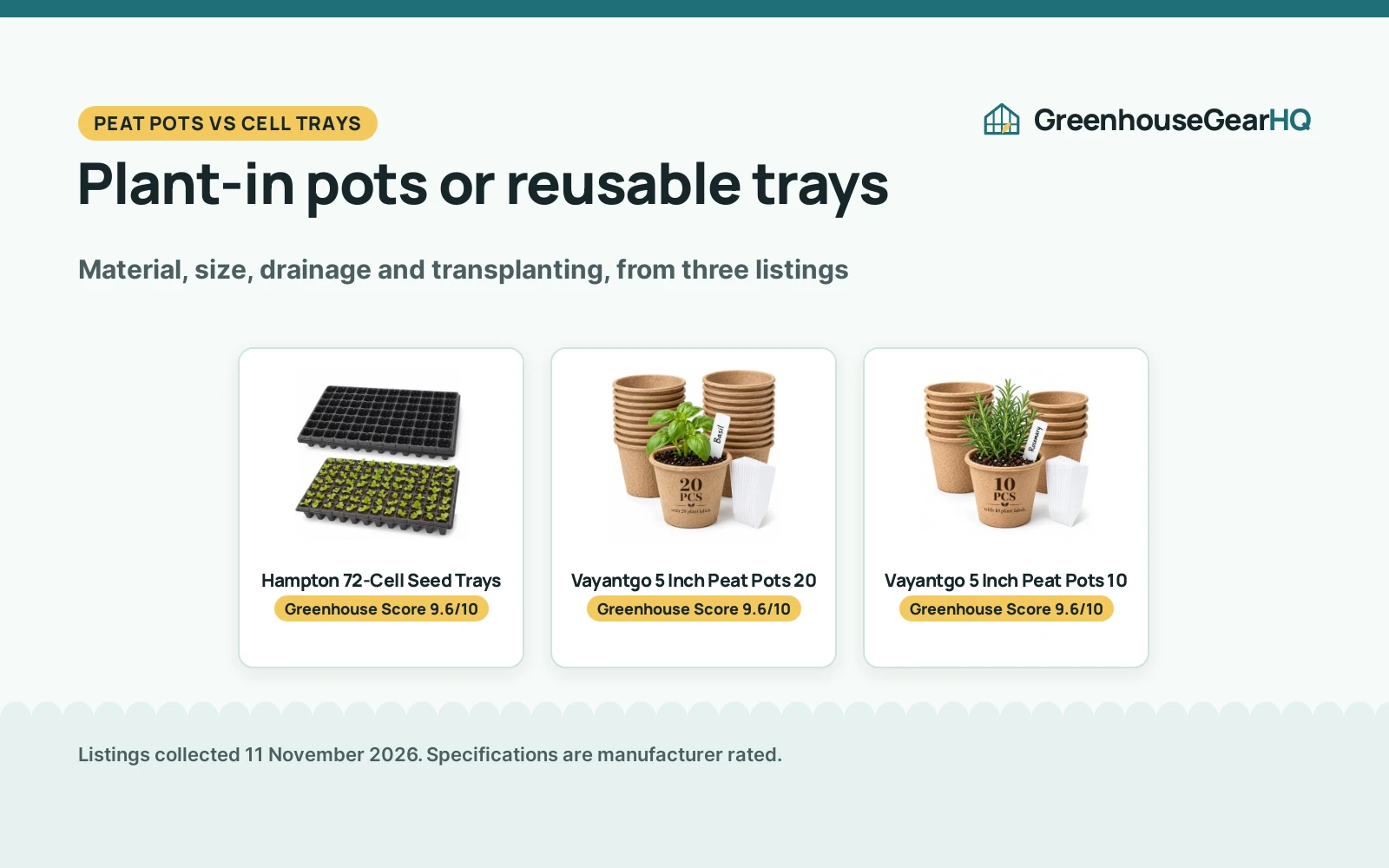
| 1 | Hampton 72-Cell Seed Trays | 9.6/10 | Buy on Amazon |
| 2 | Vayantgo 5 Inch Peat Pots 20 | 9.6/10 | Buy on Amazon |
| 3 | Vayantgo 5 Inch Peat Pots 10 | 9.6/10 | Buy on Amazon |

Hampton 72-Cell Seed Trays
A 10-pack of reusable 72-cell trays with 1.57-inch deep cells and drainage holes.
Pros
- 72 cells per tray, with 1.57-inch deep cells
- Thick plastic built for multiple growing seasons
- Drainage holes in each tray
- Root balls hold their shape at transplanting
Cons
- No warranty term is stated
- No cell width is stated
- Cells need emptying and refilling each sowing
- Trays need storage space between seasons

Vayantgo 5 Inch Peat Pots 20
A 20-pack of 5 inch peat pots with drainage holes and 20 plant labels.
Pros
- Pots plant directly into soil
- Bottom drainage hole and breathable walls
- 20 pots and 20 labels in the box
- 5.1 x 5.1 x 3.94 inch size for vegetables and flowers
Cons
- No warranty term is stated
- Single-use pots that break down after planting
- No item weight is stated
- Each season needs a new pack

Vayantgo 5 Inch Peat Pots 10
A 10-pack of the same 5 inch peat pots with drainage holes and 10 plant labels.
Pros
- Pots plant directly into soil
- Bottom drainage hole and breathable walls
- 10 pots and 10 labels in the box
- 5.1 x 5.1 x 3.94 inch size for vegetables and flowers
Cons
- No warranty term is stated
- Same pot as the 20-pack, only pack size differs
- Single-use pots that break down after planting
- No item weight is stated
As an Amazon Associate I earn from qualifying purchases.
Other options worth a look
 Homenote 60 Pcs 4 Inch Peat PotsCheck price on Amazon
 RooTrimmer 20 Cell Plant Trays for Carrying 3 inch RoundCheck price on Amazon
 Dalzom® 60Pcs 4” Peat Pots with 60Pcs Plant LabelsCheck price on Amazon
 Dalzom® 60Pcs 3.1” Peat Pots with 60Pcs Plant LabelsCheck price on Amazon
 RooTrimmer 12 Cell Round Nursery Pots Trays Thickened DurableCheck price on Amazon
 RooTrimmer 12 Cell Round Nursery Trays Thickened DurableCheck price on Amazon
Peat pots vs cell trays: side by side
| Container | Greenhouse Score | Pack | Pot or cell size | Material | Drainage | Warranty | Amazon |
|---|---|---|---|---|---|---|---|
| Hampton 72-Cell Seed Trays | 9.6/10 | 10 trays, 72 cells each | 1.57-inch deep cells | Thick plastic | Drainage holes | Not stated | View on Amazon |
| Vayantgo 5 Inch Peat Pots 20 | 9.6/10 | 20 pots, 20 labels | 5.1 x 5.1 x 3.94 inches | Natural pulp and plant fibers | Bottom drainage hole | Not stated | View on Amazon |
| Vayantgo 5 Inch Peat Pots 10 | 9.6/10 | 10 pots, 10 labels | 5.1 x 5.1 x 3.94 inches | Natural pulp and plant fibers | Bottom drainage hole | Not stated | View on Amazon |
Size and build specs are the manufacturer’s ratings as published on each listing, gathered 11 November 2026.
Material and transplanting
Vayantgo makes its pots from natural pulp and plant fibers, and the listing says each pot can go straight into the soil, where it breaks down and leaves roots undisturbed. No pulling, no bare roots, no transplant shock.
Hampton takes the other path: thick plastic trays, built to hold soil weight through multiple growing seasons without cracking or warping. Seedlings come out of the cells at transplanting, and the root ball holds its shape. The tray stays behind for the next sowing.
Size and capacity
The Vayantgo pots measure 5.1 x 5.1 x 3.94 inches, with a 5-inch diameter the maker calls roomy enough for seedlings to grow strong before moving outdoors. The 20-pack includes 20 pots and 20 plant labels; the 10-pack includes 10 pots and 10 labels.
The Hampton listing gives 10 trays of 72 cells each, with cells 1.57 inches deep and tray dimensions of 21.0 x 11.0 x 1.77 inches. Deep cells give taproots vertical room. Cell width is not stated.
Drainage and airflow
Each Vayantgo pot has a bottom drainage hole and breathable walls, which the maker links to airflow and protection against overwatering and soil compaction. A pot that breathes dries more evenly.
Hampton lists drainage holes in its trays and thick walls that resist warping under soil weight. Drainage holes let excess water out of each cell, and the listing ties the deep cell shape to strong root growth. Neither side states a drainage hole size.
Listing gaps to check
None of the three listings states a warranty term, so warranty scores sit at zero. No item weight is stated for any listing, and no thickness figure is given for the pot walls or the tray plastic.
The two Vayantgo listings are the same pot in different pack sizes, so the choice between them is purely how many pots and labels the sowing needs. Hampton states no cell width.
How the scoring works
The Greenhouse Score weighs performance, build, value, safety and warranty. For seed starting containers, safety reflects stated safety features or certifications; none of the three listings states one, and no listing states a warranty term either. The Hampton trays score highest on performance and build for deep cells and thick reusable plastic, while the Vayantgo pots score well for plant-in transplanting and for labels in the box. How we pick explains the weights.
| Product | Greenhouse Score | Perf. /35 | Build /25 | Value /25 | Safety /10 | Warranty /5 |
|---|---|---|---|---|---|---|
| Hampton 72-Cell Seed Trays | 9.6 | 30 | 21 | 21 | n/a | 0 |
| Vayantgo 5 Inch Peat Pots 20 | 9.6 | 29 | 20 | 21 | n/a | 0 |
| Vayantgo 5 Inch Peat Pots 10 | 9.6 | 29 | 20 | 20 | n/a | 0 |
Greenhouse Scores use 9.2 as the lowest value and 9.8 as the highest, with weighted points placed between them in proportion. More points always earns more score. Safety counts for heaters, fans, lights and other powered gear and for listings stating safety features; anything else is scored on 90 points.
Which should you choose?
Choose peat pots if you want to set seedlings out without disturbing roots, and you like plant labels in the box. The Vayantgo pots plant straight into the soil and break down there. Compare more options in the peat pots vs plastic cell trays guide.
Choose cell trays if you start large numbers of seedlings and want trays that come back for another season. The Hampton trays offer 72 cells per tray with 1.57-inch deep cells in thick plastic.
In the Greenhouse
- Label Vayantgo pots as you sow, using the 20 plant labels in the 20-pack or the 10 labels in the 10-pack.
- Set Vayantgo pots on a tray that catches water from the drainage hole.
- Fill Hampton cells with mix, sow, and water until the drainage holes run.
- Store Hampton trays dry between seasons so the plastic stays straight.
FAQ for growers
Are peat pots better than cell trays for seedlings?
It depends on the job. Vayantgo peat pots plant straight into the soil with no transplant shock, while Hampton trays are reusable.
Can peat pots go straight into the ground?
Yes. The Vayantgo listing says the pots are made from natural pulp and plant fibers and can be planted directly into the soil.
How deep are the cells in the Hampton trays?
The cells are 1.57 inches deep, with 72 cells per tray and 10 trays in the pack.
Do the Vayantgo peat pots come with plant labels?
Yes. The 20-pack includes 20 plant labels and the 10-pack includes 10 plant labels.
Keep reading
See every seed starting guide and all seed starting trays guides.
More picks: peat pots vs coir pots, peat pots vs paper pots, soil blocker vs peat pots and peat pellets vs peat pots.