On this page
Top picks at a glance
As an Amazon Associate I earn from qualifying purchases.
- 1
 VIVOSUN 3.15 Inch Peat Pots9.6/10View on Amazon
- 2
 RooTrimmer 10-Pack 32-Cell Plug Trays with 10 Solid 1020 Flats9.7/10View on Amazon
- 3
 RooTrimmer 4 Inch Plastic Plant Pots 60 Pcs and 12 CellView on Amazon
- 4
 Dalzom® 60Pcs 3.1” Peat Pots with 60Pcs Plant LabelsView on Amazon
- 5
 RooTrimmer 4 inch Round Nursery Pots 60pcsView on Amazon
- 6
 RooTrimmer 12 Cell Round Nursery Pots Trays Thickened DurableView on Amazon
- 7
 RooTrimmer 2.5 inch Square Pots 3.5 inch Deep 20 CellView on Amazon
- 8
 MIXC Nursery Pots with Humidity DomeView on Amazon
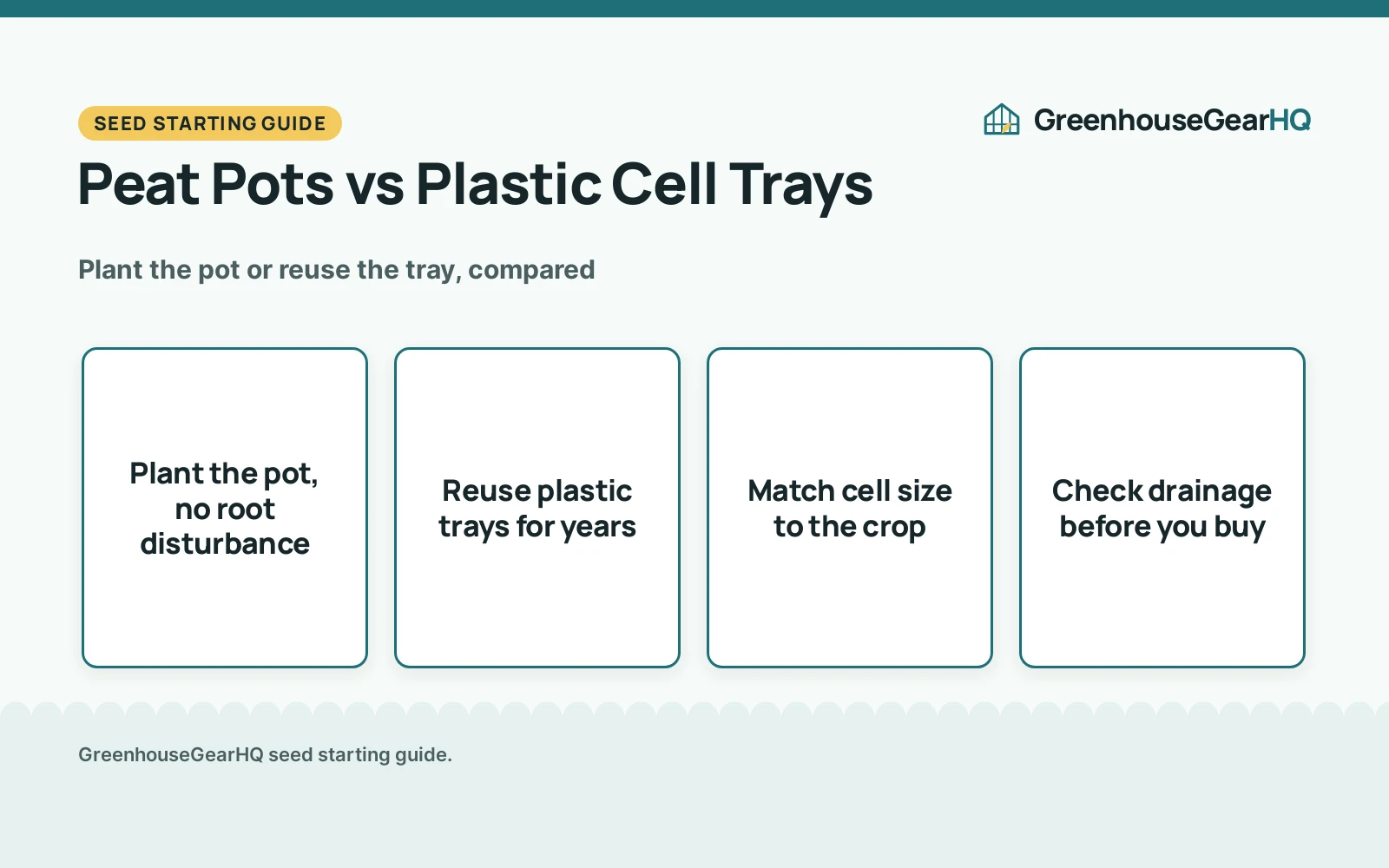
Peat pots vs plastic cell trays comes down to one choice: do you want to plant the pot or reuse the tray? Peat pots go into the ground with the seedling and break down in the soil, while plastic cell trays pop seedlings out and wash up for another season. We compared listings for both types and lay out the trade-offs below, citing each figure to the listing that states it.
Other options worth a look
 RooTrimmer 4 Inch Plastic Plant Pots 60 Pcs and 12 CellCheck price on Amazon
 Dalzom® 60Pcs 3.1” Peat Pots with 60Pcs Plant LabelsCheck price on Amazon
 RooTrimmer 4 inch Round Nursery Pots 60pcsCheck price on Amazon
 RooTrimmer 12 Cell Round Nursery Pots Trays Thickened DurableCheck price on Amazon
 RooTrimmer 2.5 inch Square Pots 3.5 inch Deep 20 CellCheck price on Amazon
 MIXC Nursery Pots with Humidity DomeCheck price on Amazon
GreenhouseGearHQ earns a commission when you buy through links on this page, at no extra cost to you. As an Amazon Associate I earn from qualifying purchases. Affiliate disclosure.
Peat pots vs plastic cell trays: the short version
- Peat pots: plant the whole pot, no root disturbance, no reuse. The Doubleggs 20-pack lists 240 cells in wood pulp that degrade into fertilizer; the Jucoan 40-pack lists 480 cells in paper and grass charcoal.
- Plastic cell trays: pop seedlings out, wash and reuse. The Halatool kit lists thick plastic trays built for multiple uses with 96 cells across 8 trays.
- Hybrid kits: some kits mix both. The Halatool kit pairs 8 plastic trays with 100 peat pellets, and the Jiffy 4-pack pairs a reusable tray with 36 peat pellets under a dome.
What peat pots are
Peat pots are single-use cells made of wood pulp, paper or peat. You fill them with soil, sow, and transplant the whole pot into the ground, where it breaks down. The Doubleggs listings say the wood pulp pots let roots penetrate and naturally degrade into fertilizers. The Kimdozee 24-pack lists 240 cells in natural pulp, 1.97 by 1.97 by 1.97 inches, with drainage holes. The Loongesho 10-pack lists 120 cells with drainage holes and says the trays break down into organic fertilizer. The ARGCONNER 20-pack lists 200 cells in pulp paper with one drainage hole per pot to prevent root rot. The Doter 10-pack lists 120 biodegradable cells with drainage holes.
Cell sizes vary: Doubleggs cells are 1.6 by 1.6 by 2 inches; Kimdozee cells 1.97 by 1.97 by 1.97 inches; Jucoan pots 1.5 by 1.5 by 1.7 inches. Kits bundle extras: the Doubleggs 20-pack includes 200 labels, 2 transplant tools and a foldable sprayer; the Doubleggs 30-pack lists 360 cells with 200 labels; the Jucoan 40-pack includes 40 labels.
What plastic cell trays are
Plastic cell trays are rigid reusable trays you fill with soil, then pop seedlings out at transplant time. The Halatool kit lists 8 base trays with 12 cells each (96 cells total), thick plastic built for multiple uses, easy to wash and dry, with drain holes and transparent humidity domes. It also includes 100 peat pellets, so the same kit covers both approaches. The Ferry-Morse kit bundles a plastic greenhouse with 72 36mm peat pellets per kit, 2 packs for 144 pellets total, plus a SUPERthrive sample. The Jiffy 4-pack lists 36 cells with a reusable tray and clear dome in an 11 by 11 by 4.25 inch footprint.
Peat pots vs plastic cell trays side by side
| Feature | Peat pots | Plastic cell trays |
|---|---|---|
| Transplant | Plant the whole pot; no root disturbance stated (Doubleggs, Kimdozee) | Pop seedlings out of the cells (Halatool) |
| Reuse | Single use; degrades in soil (Loongesho, ARGCONNER) | Multiple uses; wash and dry (Halatool) |
| Drainage | Some list drainage holes (Kimdozee, Doter, ARGCONNER, Loongesho) | Drain holes in the bottom (Halatool) |
| Humidity | No domes listed on plain peat pot packs | Domes listed (Halatool, Ferry-Morse, Jiffy) |
| Cell counts listed | 120 to 480 (Doter, Loongesho, Kimdozee, Doubleggs, Jucoan, ARGCONNER) | 36 to 96, plus pellet kits (Jiffy, Halatool, Ferry-Morse) |
How to choose
If transplant shock worries you
Choose peat pots. The Doubleggs, Kimdozee and ARGCONNER listings all state that planting the pot avoids disturbing roots, which is the main stated benefit over plastic cells.
If you start seeds every year
Choose plastic cell trays. The Halatool listing says the thick plastic trays hold up to multiple uses and are easy to wash and dry between seasons, while peat pots are gone after one season.
If you overwater
Check for drainage. The Halatool trays list drain holes, and the Kimdozee, Doter, ARGCONNER and Loongesho peat pots list drainage holes too. The Halatool domes also control humidity and air circulation.
Match cell size to the crop
Cell sizes in the listings range from 1.5 by 1.5 by 1.7 inches (Jucoan) to 1.97 by 1.97 by 1.97 inches (Kimdozee), with Doubleggs at 1.6 by 1.6 by 2 inches. Larger cells suit tomatoes and peppers; smaller cells suit herbs and flowers. For tomato-specific picks, see our best peat pots for tomatoes.
What this guide does not cover
We do not give sowing depth, germination temperatures or light schedules, because they depend on the crop. Your seed packet gives those figures. We also do not compare prices; no listing in this comparison states one.
FAQ for growers
Do peat pots really break down in the soil?
The listings say so: Doubleggs states the wood pulp pots naturally degrade into fertilizers, and Loongesho says the trays break down into organic fertilizer. Plant the whole pot as the listing directs.
Can I reuse plastic cell trays?
The Halatool listing says its thick plastic trays hold up to multiple uses and are easy to wash and dry. Let trays dry fully before storage.
Do peat pots need drainage holes?
Not all have them. The Kimdozee, Doter, ARGCONNER and Loongesho listings state drainage holes; the Doubleggs and Jucoan listings do not mention them. If you tend to overwater, pick a listing that states them.
What size peat pot cells should I start with?
Listed cell sizes run from 1.5 by 1.5 by 1.7 inches (Jucoan) to 1.97 by 1.97 by 1.97 inches (Kimdozee). Match the cell to the crop: bigger cells for tomatoes and peppers, smaller for herbs and flowers.
Keep reading
See every seed starting trays guide and all seed starting guides. Also see our best seed starting trays with dome.
More picks: seed starting trays for onions, seed starter kit for beginners and peat pots for tomatoes.