On this page
Top picks at a glance
As an Amazon Associate I earn from qualifying purchases.
- 1
 DIGITEN Wireless Thermostat Outlet with Remote Sensor9.7/10View on Amazon
- 2
 EconoHome Adjustable Plug-in Heating and Cooling Thermostat9.6/10View on Amazon
- 3
 Gulfmew 2-Pack Adjustable Heating and Cooling Thermostat9.5/10View on Amazon
- 4
 Broan-NuTone 114 Kickspace Fan-Forced Wall Heater WithoutView on Amazon
- 5
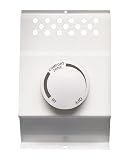 Cadet Double Pole Built-in Baseboard Heater ThermostatView on Amazon
- 6
 Feekoon Built in Thermostat Compatible with CadetView on Amazon
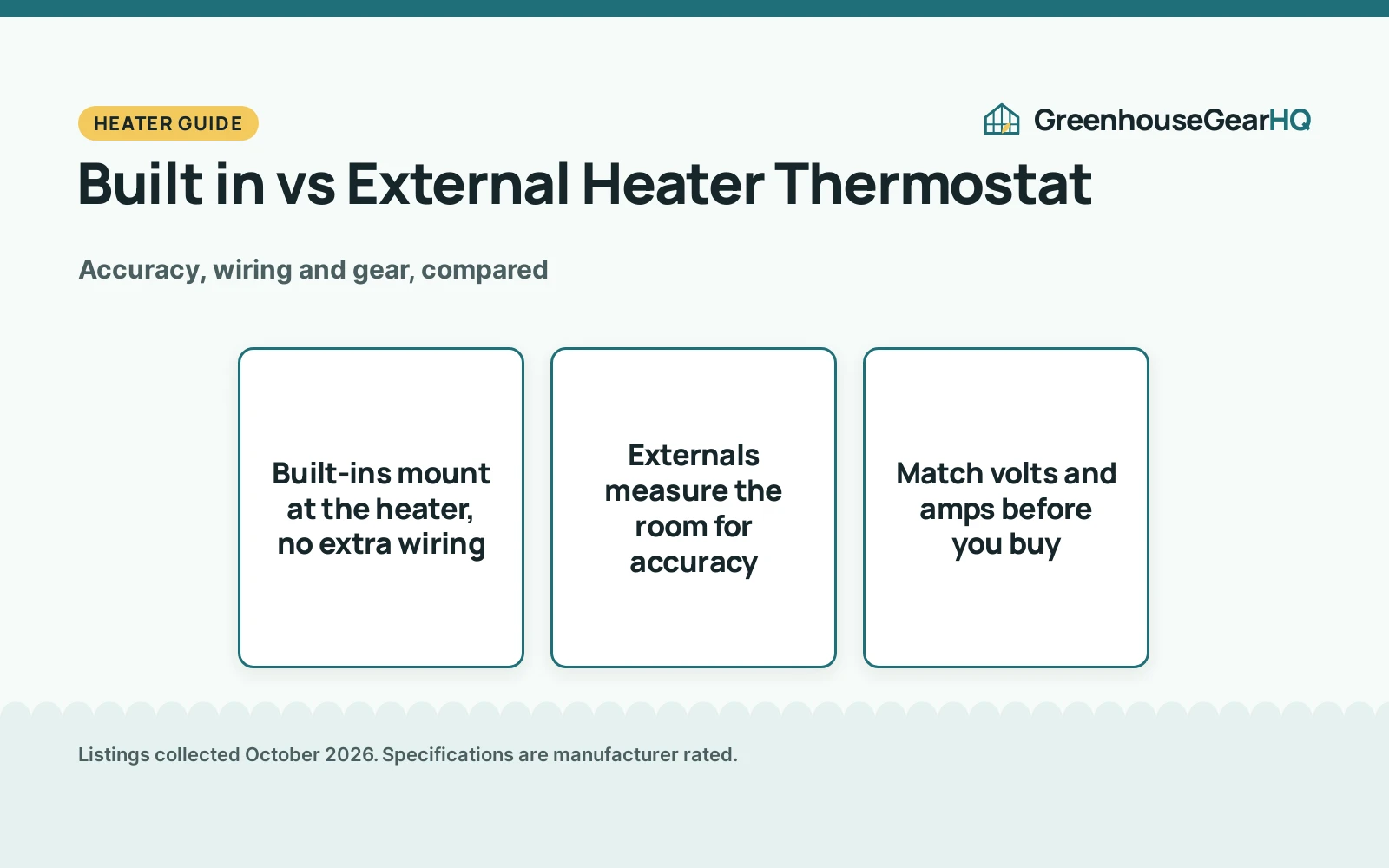
In the built in vs external heater thermostat choice, pick an external thermostat when you want the room at the temperature you set, and a built-in thermostat when you want the simplest wiring. A built-in thermostat reads the temperature right at the heater, so the room can be cooler or warmer than the dial says. An external thermostat sits away from the heater and measures the room itself, which is why growers who care about accuracy put the sensor where the plants are. Where a number appears below, it comes from a product listing we compared, and we name the listing so you can check it.
Other options worth a look
 Broan-NuTone 114 Kickspace Fan-Forced Wall Heater WithoutCheck price on Amazon
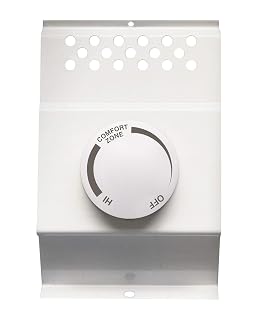 Cadet Double Pole Built-in Baseboard Heater ThermostatCheck price on Amazon
 Feekoon Built in Thermostat Compatible with CadetCheck price on Amazon
GreenhouseGearHQ earns a commission when you buy through links on this page, at no extra cost to you. As an Amazon Associate I earn from qualifying purchases. Affiliate disclosure.
How a built-in thermostat works
A built-in thermostat mounts in or on the heater itself. The Cadet F Series Double Pole Built-In Baseboard Thermostat (model BTF2W) mounts to either end of a Cadet F series baseboard heater with no extra wiring, using a twist dial over a 45 to 80 degree Fahrenheit range at 22 amps and 120, 208 or 240 volts. The Cadet Com-Pak Single Pole Built-in Thermostat Kit (CTT1W) mounts directly inside a Com-Pak wall heater with a simple two-wire connection, adjustable from 40 to 85 degrees Fahrenheit at the same 22-amp, multi-volt rating, and it is UL/ETL listed with a 1-year limited warranty.
The advantage is simplicity: one box, one dial, no wall wiring. The tradeoff is accuracy. The sensor sits inches from the heating element, so it reads heater warmth rather than room warmth, and single-pole designs only drop to a low setting instead of fully off, per both Cadet listings.
How an external thermostat works
An external thermostat mounts on a wall or in a panel away from the heater and switches the heater circuit based on room temperature. The BOWSEN programmable thermostat is wall-mounted, works at 120 or 240 volts and 15 amps (1800 or 3600 watts), and offers 7-day programming with dual air and floor sensing, a backlit LCD, a built-in Class A GFCI and cETL listing. The listing gives it a 5-year limited warranty.
Some heaters are sold expecting one. The Broan-NuTone 114 kickspace heater lists no built-in thermostat and tells you to control temperature with an optional line voltage thermostat (model 86W) or a 60-minute timer. Its 1500-watt, 120-volt fan-forced element covers 100 to 150 square feet, and the listing gives a 1-year limited warranty. With no sensor in the heater at all, the thermostat location is entirely your choice.
| Thermostat listing | Type | Stated range | Stated rating |
|---|---|---|---|
| Cadet F Series BTF2W | Built-in, baseboard | 45-80 F | 22 A, 120/208/240 V |
| Cadet Com-Pak CTT1W | Built-in kit, wall heater | 40-85 F | 22 A, 120/208/240 V |
| BOWSEN programmable | External, wall mount | Programmable, 7-day | 15 A, 120/240 V |
| Broan-NuTone 114 | Heater, no built-in | Via optional 86W | 1500 W, 120 V |
Built in vs external heater thermostat: which one should you buy?
Pick built-in for simplicity
If the heater is the only heat source and the room is small, a built-in dial is enough. The Cadet kits drop into their own heaters with two wires, which keeps a small greenhouse project cheap and fast. Expect to fiddle: because the sensor sits at the heater, you will set the dial higher or lower than the room temperature you actually want.
Pick external for accuracy
If you grow in the room and the plants care about a few degrees, put the sensor where the plants are. An external thermostat reads room air, not heater heat, so the set point means what it says. The BOWSEN’s 7-day programming also cuts heating costs by dropping the set point at night, which a dial cannot do. For thermostat types, see our heating only vs heating and cooling thermostat comparison.
Match volts and amps first
Whatever you choose, the thermostat must handle the heater’s circuit. The Cadet built-ins handle up to 22 amps at 120, 208 or 240 volts; the BOWSEN handles 15 amps. The Broan-NuTone 114 draws 1500 watts at 120 volts, so its optional 86W line voltage thermostat must be rated for that load. For greenhouse sensor placement, see our greenhouse thermostat vs heat mat thermostat comparison.
What this guide does not cover
We do not give wiring instructions, breaker sizing or thermostat placement heights, because they depend on your heater model, your electrical code and your room. Follow the heater and thermostat manuals, and have a licensed electrician make the connections. We also do not cover smart or Wi-Fi thermostats here.
FAQ for growers
Is a built-in thermostat less accurate?
Yes, generally: it senses temperature at the heater, not in the room, so the dial setting and the room temperature differ. An external thermostat on the wall reads the room itself.
Can I add an external thermostat to a heater with a built-in one?
It depends on the heater’s wiring; some heaters accept both, some do not. Follow the heater manual, since bypassing a built-in control can void the warranty.
What does single pole vs double pole mean?
A single-pole thermostat drops to a low setting rather than fully off, per the Cadet listings; a double-pole model breaks both legs for complete shutoff.
Keep reading
See every thermostats and controllers guide and all light and heat guides.
More picks: propane greenhouse heaters with thermostats and seedling heat mats.