On this page
Top picks at a glance
As an Amazon Associate I earn from qualifying purchases.
- 1
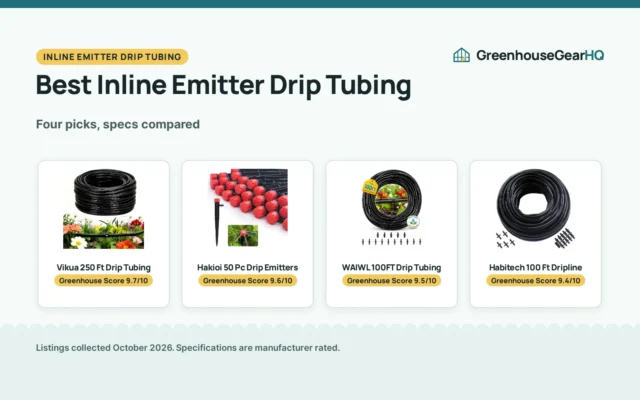
 Vikua 1/4 Inch Drip Irrigation Tubing9.7/10View on Amazon
- 2
 Bonviee 1/4-Inch Drip Irrigation Tubing9.6/10View on Amazon
- 3
 Habitech 1/4 Inch Irrigation Dripline Tubing9.4/10View on Amazon
- 4
 Rain Bird SW20-30PS Drip EmitterView on Amazon
- 5
 Rain Bird SW10-30PS Drip EmitterView on Amazon
- 6
 MIXC Quick-Connect Drip Irrigation Emitters for 1/4" DripView on Amazon
- 7
 Mudder 60 Pcs Flag Drip Emitters for Drip IrrigationView on Amazon
- 8
 100 pcs Drip Emitters for 1/4" Drip Irrigation TubingView on Amazon
- 9
 100Pcs Drip Irrigation EmittersView on Amazon
In midsummer, greenhouse planting shows its thirst unevenly: pots dry fast while shrubs by the door still hold damp soil. The question of drip emitters vs drip line comes down to where the water should land. Point emitters deliver water at chosen spots for shrubs, trees and pots, while drip line runs water along a row. For mixed greenhouse planting, point emitters give control plant by plant, and this guide compares the emitter listings side by side so you can match the format to the planting.
Other options worth a look
 Rain Bird SW20-30PS Drip EmitterCheck price on Amazon
 Rain Bird SW10-30PS Drip EmitterCheck price on Amazon
 MIXC Quick-Connect Drip Irrigation Emitters for 1/4" DripCheck price on Amazon
 Mudder 60 Pcs Flag Drip Emitters for Drip IrrigationCheck price on Amazon
 100 pcs Drip Emitters for 1/4" Drip Irrigation TubingCheck price on Amazon
 100Pcs Drip Irrigation EmittersCheck price on Amazon
GreenhouseGearHQ earns a commission when you buy through links on this page, at no extra cost to you. As an Amazon Associate I earn from qualifying purchases. Affiliate disclosure.
Drip emitters vs drip line: the difference
Drip emitters are small points that release water at one spot. The listings here attach to the end of 1/4 in. feeder line or punch directly into 1/2 in. supply tubing, and the maker lists them for individual shrubs and trees, container pots and hanging baskets. Drip line, by contrast, is tubing that waters along its length, which suits a row of plants that all need the same drink. The choice is about layout: rows of even planting suit line, while mixed planting with pots, shrubs and baskets suits emitters placed where each plant stands.
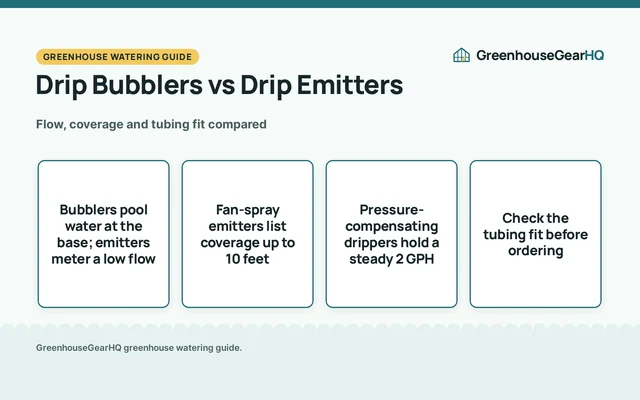
Flow also differs by format. Point emitters in this guide list rates of 1.0 gallon per hour and 2.0 gallons per hour, plus one fan-spray emitter rated up to 25 gallons per hour with a spray diameter up to 10 feet. A slow point rate lets soil absorb water in the root zone, as the Rain Bird listings state, while a fan-spray emitter covers a bed.
The gear, ranked
The four listings below are all emitters, ranked by how completely each listing covers flow control, fit and clogging care.
Raindrip PC8050B pressure-compensating emitters, 50-pack
The Raindrip listing ranks first for range and detail. It lists a constant 2 GPH flow that holds even when the water pressure changes, a turbulent flow design that flushes out sediments to reduce clogging, and a color code for flow: red for ½ GPH in heavy soil and clay areas, black for 1 GPH in medium soil and loam, and green for 2 GPH in sandy soil. It fits the end of 1/4 in. feeder line or punches into 1/2 in. supply tubing, and the maker lists it for shrubs, trees, container pots and hanging baskets. The listing states a 1-year term and lists polyethylene and silicone as materials. One note: the spec table lists a different color than the green title, so check the listing color before ordering.
Rain Bird SW20-30PS emitters, 2.0 GPH, 30-pack
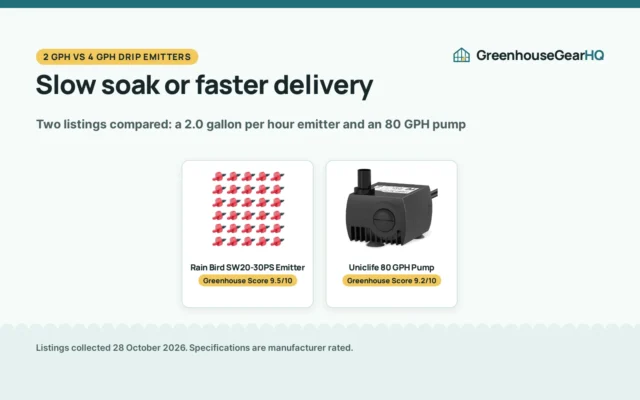
The Rain Bird SW20-30PS listing ranks second. It lists a 2.0 gallon per hour pressure-compensating emitter that delivers the same uniform flow rate from the beginning to the end of tubing runs, with a slow watering rate that lets soil absorb water more completely in the root zones of plants. The self-piercing design works with 1/4 in. drip tubing or inserts into 1/2 in. or larger drip tubing, and large water passages with self-flushing action help prevent clogging. The maker lists highly durable UV and chemical-resistant materials and a maximum pressure of 50 psi. One note: the spec table lists a flow rate of 0.5 GPH while the title and bullets state 2.0 gallons per hour, and the title and bullets are the figures to trust.
Rain Bird SW10-30PS emitters, 1.0 GPH, 30-pack
The Rain Bird SW10-30PS listing ranks third and shares the same build as the SW20: a pressure-compensating emitter, self-piercing design for 1/4 in. tubing or insertion into 1/2 in. or larger tubing, large water passages with self-flushing action, and UV and chemical-resistant materials. The difference is the rate: 1.0 gallon per hour, which suits lighter watering at each point, and the fit type is listed as barbed and self-piercing. Maximum pressure is 50 psi. The same spec table note applies: the table lists 0.5 GPH while the title and bullets state 1.0 gallon per hour.
MIXC quick-connect fan-spray emitters, 30-pack
The MIXC listing ranks fourth. It is a different shape of emitter: a push-to-fit quick connection that presses directly into compatible 1/4-inch tubing without heating the hose or adding a separate barb fitting, with tubing outside diameter no greater than 0.27 inch. The vortex head rotates to change the 360° fan-spray diameter, increase or reduce output, or shut off an individual watering point. Each emitter is rated for output up to 25 gallons per hour and a spray diameter up to 10 feet under suitable pressure, on a 5.2-inch stake, and the detachable head opens for rinsing and routine cleaning. It ranks last for point watering because spray coverage suits beds rather than single plants, and the listing states that actual flow and coverage vary with pressure, tubing length, elevation and parts on the line. Flush the irrigation line before installation and inspect emitters periodically where hard water or sediment may cause buildup.
How to choose the best drip emitters vs drip line
Match the format to the layout
Start with the planting, not the parts. A row of one crop suits drip line, while a mix of shrubs, pots and baskets suits point emitters placed at each plant. The Raindrip and Rain Bird listings here are point emitters for shrubs, trees, pots and hanging baskets, and the MIXC fan-spray emitter covers beds. If the greenhouse holds both rows and pots, the two formats can share a supply line, with emitters tapped where single plants stand and line run along the rows. See our drip irrigation kit for greenhouse picks.
Match flow to soil
Soil decides the rate. The Raindrip color code gives the plainest guide: red for ½ GPH in heavy soil and clay areas, black for 1 GPH in medium soil and loam, and green for 2 GPH in sandy soil. The Rain Bird SW10 at 1.0 gallon per hour and the SW20 at 2.0 gallons per hour give the same choice in a self-piercing form. A fan-spray emitter rated up to 25 gallons per hour is a bed tool, not a pot tool, and its coverage changes with pressure and line length.
Plan for clogging
Every emitter in this guide names clogging care. The Raindrip turbulent flow design flushes out sediments, the Rain Bird listings use large water passages with self-flushing action, and the MIXC head detaches for rinsing. Flush the line before installation, as the MIXC listing directs, and check emitters where hard water or sediment may cause buildup. A watering wand still has a place for spot checks: see our watering wand for greenhouse picks.
FAQ for growers
Do drip emitters work on 1/4-inch tubing?
Yes. The listings here attach to the end of 1/4 in. feeder line or punch into 1/2 in. supply tubing, and the Rain Bird emitters also insert into 1/2 in. or larger tubing. Check the outside diameter of the line before ordering, since the MIXC listing limits tubing to an outside diameter no greater than 0.27 inch.
What flow rate suits sandy soil?
The Raindrip color code lists green for 2 GPH in sandy soil, black for 1 GPH in medium soil and loam, and red for ½ GPH in heavy soil and clay areas. The Rain Bird SW20 lists 2.0 gallons per hour and the SW10 lists 1.0 gallon per hour.
Can one emitter water a hanging basket?
Yes, the Raindrip listing names container pots and hanging baskets among its uses, along with individual shrubs and trees. A point emitter suits a basket because it delivers water at one spot rather than along a row.
How do these emitters resist clogging?
The Raindrip turbulent flow design flushes out sediments, the Rain Bird listings use large water passages with self-flushing action, and the MIXC vortex head detaches for rinsing. Flush the line before installation and inspect emitters where hard water or sediment may cause buildup.
Keep reading
See every drip irrigation kits guide and all air and water guides.
More picks: drip irrigation kit for greenhouse, drip irrigation kit for raised beds, drip irrigation system for garden beds and misting system for greenhouse.