On this page
Top picks at a glance
As an Amazon Associate I earn from qualifying purchases.
- 1
 Vikua 1/4 Inch Drip Irrigation Tubing9.7/10View on Amazon
- 2
 50pcs Adjustable Drip Irrigation Emitters: Garden DrippersView on Amazon
- 3
 Rain Bird SW20-30PS Drip EmitterView on Amazon
- 4
 Rain Bird SW10-30PS Drip EmitterView on Amazon
- 5
 MIXC Quick-Connect Drip Irrigation Emitters for 1/4" DripView on Amazon
- 6
 Mudder 60 Pcs Flag Drip Emitters for Drip IrrigationView on Amazon
- 7
 30PCS Push-to-Fit Drip Irrigation Emitters for 1/4 inchView on Amazon
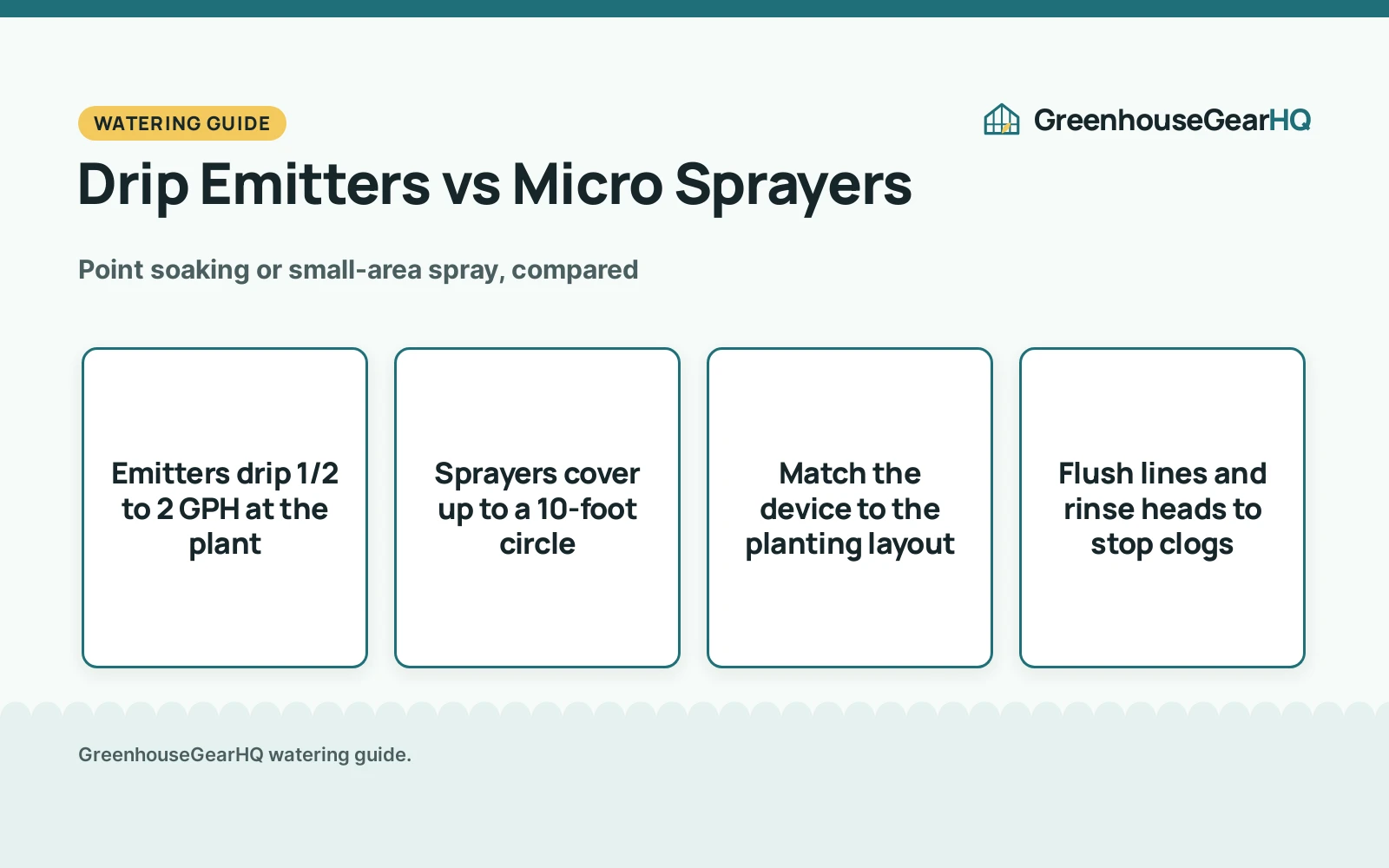
Drip emitters vs micro sprayers comes down to one choice: water the exact root zone point by point, or cover a small area with a fine spray. Drip emitters release a slow, steady drip right at the plant; the Raindrip and Rain Bird listings rate theirs at 1/2 to 2 GPH. Micro sprayers throw a spray pattern across a wider patch; the MIXC listing rates its stream-spray emitters up to 25 GPH with a spray diameter up to 10 feet. Pick emitters for pots and rows where each plant gets its own water, and sprayers for beds where plants grow close together.
Other options worth a look
 50pcs Adjustable Drip Irrigation Emitters: Garden DrippersCheck price on Amazon
 Rain Bird SW20-30PS Drip EmitterCheck price on Amazon
 Rain Bird SW10-30PS Drip EmitterCheck price on Amazon
 MIXC Quick-Connect Drip Irrigation Emitters for 1/4" DripCheck price on Amazon
 Mudder 60 Pcs Flag Drip Emitters for Drip IrrigationCheck price on Amazon
 30PCS Push-to-Fit Drip Irrigation Emitters for 1/4 inchCheck price on Amazon
GreenhouseGearHQ earns a commission when you buy through links on this page, at no extra cost to you. As an Amazon Associate I earn from qualifying purchases. Affiliate disclosure.
What a drip emitter does
A drip emitter is a small device that meters water to one spot. Pressure-compensating models hold a constant flow even when pressure changes along the line: Raindrip lists 2 GPH and 1/2 GPH pressure-compensating drippers, and Rain Bird lists 1 and 2 GPH pressure-compensating emitters. Both brands color code by flow: Raindrip uses red for 1/2 GPH, black for 1 GPH and green for 2 GPH. Installation is simple: Raindrip attaches to the end of a 1/4-inch feeder line or punches directly into 1/2-inch supply tubing, while Rain Bird uses a self-piercing barb for 1/4-inch or 1/2-inch tubing and rates a maximum pressure of 50 psi. To fight clogs, Raindrip uses a turbulent-flow self-cleaning design and Rain Bird uses large water passages with self-flushing action. Adjustable emitters add control: the La Farah listing lets you rotate the cap to change flow and distance down to a complete shut-off, on a 5-inch arrow stake, with a maximum flow of 18 GPH and a maximum recommended pressure of 40 psi.
What a micro sprayer does
A micro sprayer spreads water over a small area instead of one point. The MIXC listing describes a push-fit stream-spray emitter for 1/4-inch tubing: rotate the head to adjust the 360-degree pattern, increase or reduce output, or shut off an individual watering point, with output up to 25 GPH and spray diameter up to 10 feet on a 5.2-inch stake. The Korty listing offers 100 adjustable drippers with 8 spray holes that cover a 10 to 12 inch circle when fully open, with a ratchet cap that adjusts flow down to a complete shut-off. Because sprayers push more water through small openings, pressure matters more: the MIXC listing notes that actual flow and coverage vary with inlet pressure, tubing length, elevation and the number of parts on the same line. For maintenance, the MIXC head detaches for rinsing, and the listing advises flushing the line before installation where hard water or sediment may cause buildup.
Drip emitters vs micro sprayers: which one for your greenhouse
Match the device to the planting layout. Single plants in pots, grow bags or spaced rows suit emitters: one 1 or 2 GPH emitter per plant keeps water in the root zone. Dense beds, seedling flats and ground cover suit sprayers: one head waters many plants at once. Mixed greenhouses can run both, but keep them on separate zones so the higher-flow sprayers do not starve the emitters of pressure. For the rest of the system, our drip tape vs drip tubing guide covers the lines that feed both.
| Feature | Drip emitter | Micro sprayer |
|---|---|---|
| Water delivery | Point drip at the root zone | Small spray pattern over an area |
| Typical flow | 1/2 to 2 GPH (Raindrip, Rain Bird) | Up to 25 GPH (MIXC) |
| Coverage | One plant per emitter | Up to 10-ft diameter (MIXC); 10-12 in circle (Korty) |
| Pressure behavior | Pressure-compensating holds the rate | Varies with inlet pressure |
| Clog resistance | Self-flushing designs (Rain Bird, Raindrip) | Detachable heads for rinsing (MIXC) |
Overhead wetting is the tradeoff with sprayers: leaves stay wetter, which suits some crops and not others. Emitters keep foliage dry but need one device per plant. If you are choosing between spray types, our misting nozzles vs drip emitters comparison covers finer mist options.
What this guide does not cover
This guide covers emitters and sprayers only, not the timers, filters, pressure regulators or backflow preventers that complete a drip system. Check the product label for pressure limits before connecting to a hose bib, and check local rules for backflow protection where required.
FAQ for growers
How much water does a drip emitter put out?
The Raindrip and Rain Bird listings rate pressure-compensating emitters at 1/2, 1 and 2 GPH. The La Farah adjustable emitter lists a maximum of 18 GPH.
Can I mix emitters and sprayers on one line?
The MIXC listing notes that flow and coverage vary with the number of parts on the same line. Run sprayers and emitters on separate zones so pressure stays even.
What tubing do they fit?
Raindrip, Rain Bird and MIXC listings fit 1/4-inch feeder lines and 1/2-inch supply tubing. The La Farah emitter fits 4 to 7 mm micro tubing.
How do I stop emitters from clogging?
Raindrip lists a turbulent-flow self-cleaning design and Rain Bird lists self-flushing action. The MIXC head detaches for rinsing, and its listing advises flushing the line before installation.
Keep reading
See every drip irrigation kits guide and all greenhouse ventilation and watering guides.
More picks: automatic drip irrigation indoor, misting nozzles vs drip emitters and greenhouse watering system.