On this page
Top picks at a glance
As an Amazon Associate I earn from qualifying purchases.
- 1
 Toolazy Ebb and Flow Fitting Kit9.6/10View on Amazon
- 2
 DPROOTS 36 Sites NFT Hydroponic Growing System with Grow9.6/10View on Amazon
- 3
 Botanicare Ebb & Flow 1 in Barbed FittingView on Amazon
- 4
 Botanicare Ebb & Flow Barbed FittingView on Amazon
- 5
 Active Aqua GFO7CB Ebb & Flow Hydroponic Growing System w/ 2View on Amazon
- 6
 EcoPlus GL56708575 Ebb & Flow Tub Outlet FittingView on Amazon
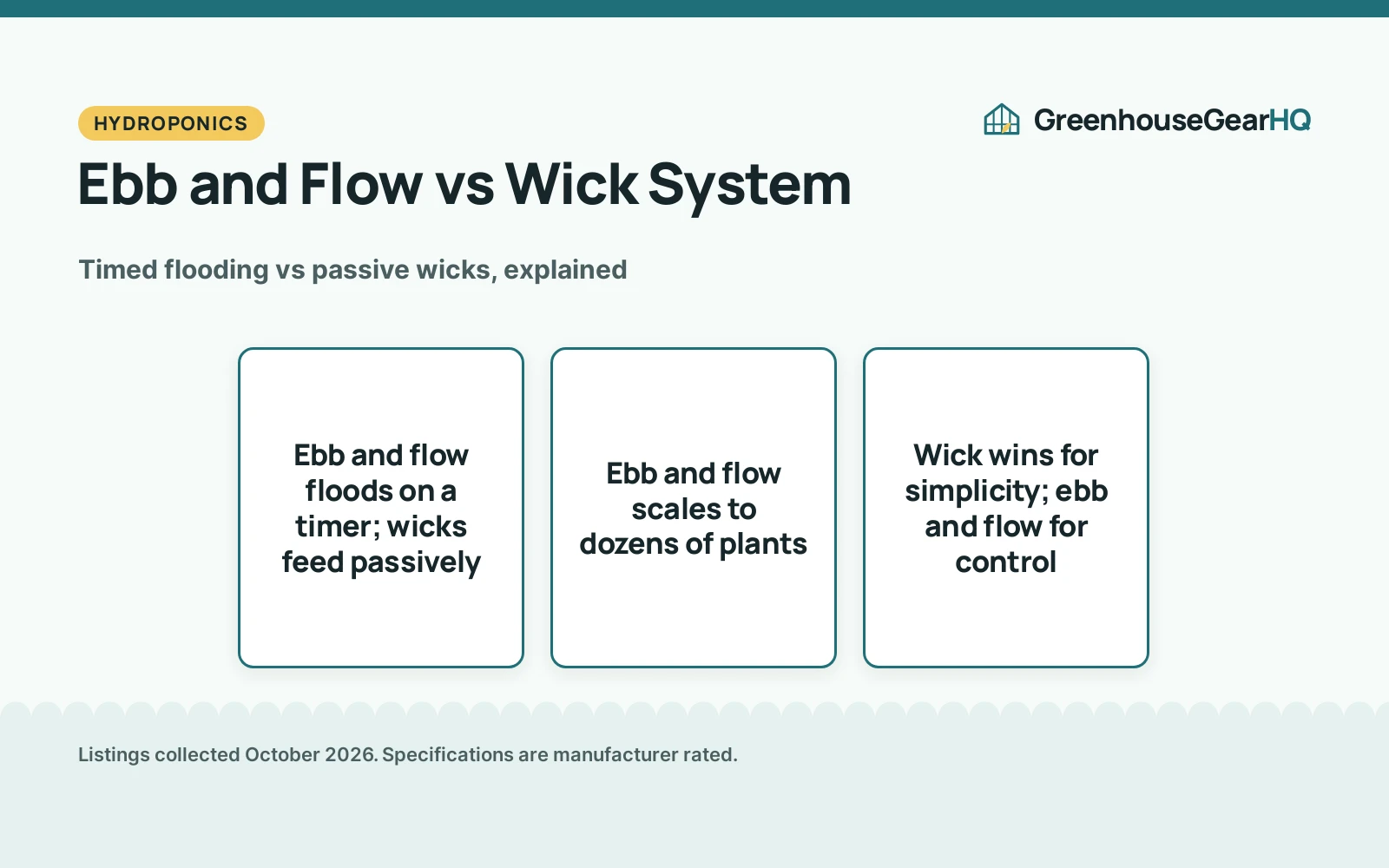
In the ebb and flow vs wick system question, ebb and flow floods the grow tray on a timer and drains it back; a wick system feeds plants passively through wicks that draw nutrient solution up by capillary action. For a greenhouse, ebb and flow wins for anything beyond a few small plants, while the wick system wins for simplicity on a windowsill scale. This guide explains how each works, with figures from real listings.
Other options worth a look
 Botanicare Ebb & Flow 1 in Barbed FittingCheck price on Amazon
 Botanicare Ebb & Flow Barbed FittingCheck price on Amazon
 Active Aqua GFO7CB Ebb & Flow Hydroponic Growing System w/ 2Check price on Amazon
 EcoPlus GL56708575 Ebb & Flow Tub Outlet FittingCheck price on Amazon
GreenhouseGearHQ earns a commission when you buy through links on this page, at no extra cost to you. As an Amazon Associate I earn from qualifying purchases. Affiliate disclosure.
How ebb and flow works
Ebb and flow, also called flood and drain, uses a pump on a timer to flood the grow tray with nutrient solution, then lets it drain back to the reservoir. The flooding feeds the roots and the draining pulls fresh air to them. The Active Aqua GFO7CB shows the shape: a controller bucket with 2 submersible pumps at 4.16 gallons per minute on 120 volts, controlling up to 24 five-gallon or 48 two-gallon growing modules, with ladder level control to set the exact water height and an emergency shut-off valve against overflow. Fill and drain fittings make it work: the Toolazy 7-piece kit gives 1/2 in and 3/4 in outlets with screen fittings and extensions to adjust the flood height, and Botanicare fittings come in 1/2 in, 3/4 in and 1 in barbed sizes with interior threads that accept 3/4 in standard pipe thread.
How a wick system works
A wick system has no pump and no timer. Wicks run from a reservoir up into the growing medium, and capillary action draws the nutrient solution to the roots continuously. It is the simplest hydroponic method: a container, a wick and a reservoir are the whole system. The tradeoff is control: the wick delivers solution at its own pace, so fast-drinking plants can outpace it and the reservoir needs topping up. It suits herbs and leafy greens in small setups, not heavy feeders at greenhouse scale.
Scale and plant count
Scale is where the two part ways. The Active Aqua controller handles up to 24 five-gallon modules or 48 two-gallon modules, which is a serious grow room or greenhouse corner. A wick system scales one container at a time; each new plant needs its own wick and reservoir share. For a handful of herbs, the wick wins on simplicity. For dozens of plants, ebb and flow’s central pump and timer do the work of dozens of wicks. Our dutch bucket vs ebb and flow guide compares another scaled-up method.
Power, parts and failure points
Ebb and flow needs power for the pump and a timer; if the pump fails or the power cuts, the flood cycle stops. The Active Aqua answers with 2 pumps for redundancy and an emergency shut-off valve for overflow protection. Fittings are the wear parts: bulkhead fittings with O-rings and locknuts create the watertight seals, and screen fittings keep roots out of the drains. A wick system has no moving parts to fail, which is its quiet strength, but it cannot be automated beyond the reservoir level. No timer, no pump, no flood: nothing to break, and nothing to adjust.
Nutrient control
Ebb and flow refreshes the whole tray each cycle, so nutrients and oxygen reach every root evenly, and the reservoir can be checked and adjusted in one place. The 7-gallon controller bucket on the Active Aqua is the single point where the solution is managed. A wick system is harder to manage: salts accumulate in the medium because the same solution keeps wicking up and evaporating, and there is no drain cycle to flush it. For precision feeding, ebb and flow wins; for low-maintenance herbs, the wick is forgiving enough.
Ebb and flow vs wick system: which should you choose?
Choose ebb and flow if you grow more than a few plants, want automated watering on a timer, and can run a pump. The fittings and controllers in the listings scale from a single tray to 48 modules.
Choose a wick system if you want the simplest possible setup with no power and no moving parts, for herbs and leafy greens at a small scale.
Whichever you pick, keep the reservoir clean and the solution fresh; stagnant water hurts both systems.
In the Greenhouse
- Set the flood height with extension fittings to match the plant size.
- Keep screen fittings clear of roots so drains stay open.
- Check the reservoir solution regularly and top up or replace it.
- Keep a spare pump for ebb and flow; pumps are the failure point.
- Shade reservoirs to slow algae growth.
FAQ for growers
Does a wick system need a pump?
No. Capillary action draws the solution up the wick with no power and no moving parts.
How many plants can ebb and flow handle?
The Active Aqua controller in the listings handles up to 24 five-gallon or 48 two-gallon modules.
Which is better for beginners?
The wick system is simpler to build and cannot break down. Ebb and flow needs a pump, timer and fittings but waters far more plants.
What fittings do I need for ebb and flow?
Fill and drain bulkhead fittings with O-rings and locknuts; the Toolazy kit gives 1/2 in and 3/4 in outlets with height extensions.
Can wick systems feed big plants?
Poorly. Fast-drinking plants outpace the wick; ebb and flow’s timed flooding suits them better.
Keep reading
See every hydroponic system guide and all indoor growing guides.
More picks: ebb and flow vs NFT and dutch bucket vs ebb and flow.