On this page
Top picks at a glance
As an Amazon Associate I earn from qualifying purchases.
- 1
 Toolazy Ebb and Flow Fitting Kit9.6/10View on Amazon
- 2
 DPROOTS 36 Sites NFT Hydroponic Growing System with Grow9.6/10View on Amazon
- 3
 Botanicare Ebb & Flow 1 in Barbed FittingView on Amazon
- 4
 Botanicare Ebb & Flow Barbed FittingView on Amazon
- 5
 Active Aqua GFO7CB Ebb & Flow Hydroponic Growing System w/ 2View on Amazon
- 6
 EcoPlus GL56708575 Ebb & Flow Tub Outlet FittingView on Amazon
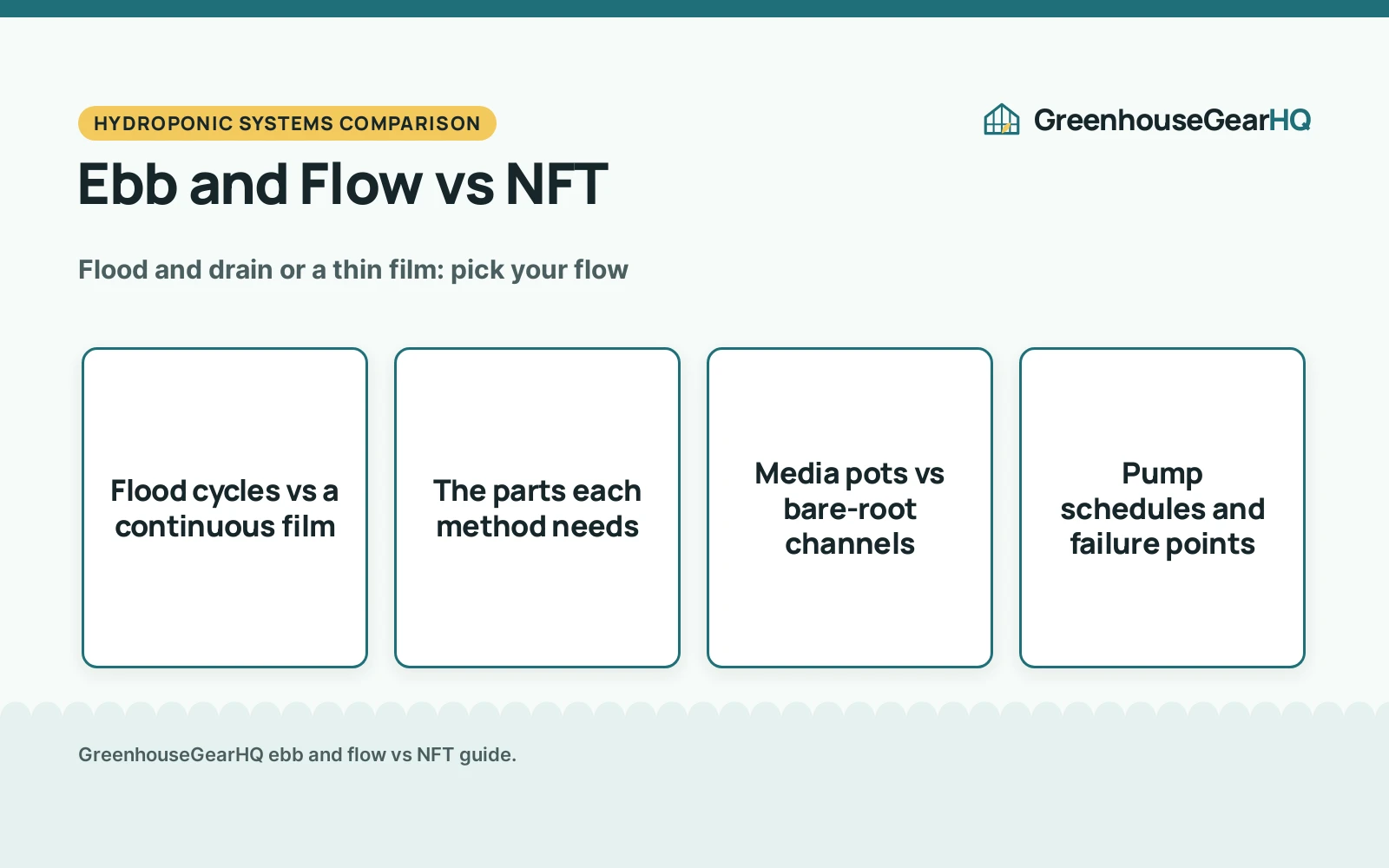
Ebb and flow vs NFT comes down to how the nutrient solution reaches the roots: in floods or in a film. An ebb and flow system, also called flood and drain, pumps solution up into a grow tray on a timer, soaks the roots and media, then drains it back to the reservoir. An NFT system, short for nutrient film technique, runs a thin, continuous stream of solution past bare roots in a sloped channel. Both grow without soil, and the right one depends on how many plant sites you run, what media you like, and how much plumbing you want to manage.
Other options worth a look
 Botanicare Ebb & Flow 1 in Barbed FittingCheck price on Amazon
 Botanicare Ebb & Flow Barbed FittingCheck price on Amazon
 Active Aqua GFO7CB Ebb & Flow Hydroponic Growing System w/ 2Check price on Amazon
 EcoPlus GL56708575 Ebb & Flow Tub Outlet FittingCheck price on Amazon
GreenhouseGearHQ earns a commission when you buy through links on this page, at no extra cost to you. As an Amazon Associate I earn from qualifying purchases. Affiliate disclosure.
Ebb and flow vs NFT: the one-paragraph version
Choose ebb and flow when you want plants in pots or trays with growing media, because each flood cycle waters and feeds them, then the drain pulls fresh air down to the roots. Choose NFT when you want bare-root plants in channels with no media at all, fed by a constant thin stream. The listings we compared show the scale ebb and flow reaches: the Active Aqua GFO7CB controller lists control of up to 24 five-gallon or 48 two-gallon growing modules, with 2 submersible pumps and a 7-gallon controller bucket.
How ebb and flow works
Ebb and flow runs on a timer and a pump. The pump lifts nutrient solution from the reservoir into the grow tray, the tray fills to the height the fittings allow, the roots and media soak, and then the solution drains back down. The Toolazy 7-piece fitting kit lists the parts that make this happen: 1x 1/2 inch tub outlet fitting, 1x 3/4 inch tub outlet fitting, 2x screen fittings and 3x outlet extension fittings, with the extensions letting you adjust the water height in the flood table to match different plant needs.
Fittings come in standard plumbing sizes. The Botanicare listings give a 3/4 inch fitting kit with 2 extensions, a 1 inch barbed fitting whose interior threads accept 3/4 inch standard pipe thread, and a 1/2 inch barbed fitting at 2.2 pounds. The EcoPlus 10-pack lists 3/4 inch tub outlet fittings with a rubber O-ring and locknut for a watertight seal. Because every joint sits below the flood line at some point, the listings stress tight seals: the Toolazy kit states BPA-free black plastic made to resist cracking and warping from continuous water exposure.
Complete systems package the plumbing with control. The Active Aqua GFO7CB lists an electric ebb and flow controller unit, 2 submersible transfer pumps with heavy-duty float switches, a premium timer, tubing, fittings and sample nutrients. The controller bucket measures 19 x 13 x 16 inches, the spec table lists a 4.16 gpm flow rate and 120 volts, and an emergency shut-off valve gives fail-safe overflow protection during drain cycles. For readers who want the full method, the book Ebb and Flow by Déjà Rae, published September 5, 2021, covers flood and drain growing for beginners.
How NFT works
NFT skips the tray and the media. Plants sit in holes along a slightly sloped channel, their bare roots dangling into a thin film of nutrient solution that flows past continuously and returns to the reservoir. A small pump runs the whole time rather than on a timer, and the roots get oxygen from the shallow, moving stream and from the air above it.
That simplicity has a tradeoff. With no media to hold water, a pump stoppage leaves bare roots exposed, so NFT growers watch their pumps closely and keep a spare or a backup plan. The channels also suit one crop at a time, since every plant in the run shares the same stream. Ebb and flow trays, by contrast, hold separate pots, so different plants can sit in the same system with their own media.
Ebb and flow vs NFT at a glance
| Feature | Ebb and flow | NFT |
|---|---|---|
| How roots are fed | Flooded on a timer, then drained | A thin film flows past bare roots continuously |
| Growing media | Yes: pots and trays hold media around the roots | None: roots hang bare in the channel |
| Pump schedule | Runs on a timer for flood cycles | Runs continuously for the film |
| Typical scale | Up to 24 five-gallon or 48 two-gallon modules on one Active Aqua controller | Rows of channels, one crop per run |
| Failure point | A stuck drain floods the tray; the shut-off valve guards overflow | A dead pump leaves bare roots dry with no media buffer |
Choosing between ebb and flow and NFT
When ebb and flow wins
Ebb and flow wins when you like media and mixed plants. Clay pebbles, rockwool or coco in pots give roots a buffer between floods, and one controller can run dozens of modules, as the Active Aqua listing’s 24 five-gallon or 48 two-gallon figure shows. The fitting sizes are standard plumbing, 1/2 inch and 3/4 inch, so spare parts like the EcoPlus 10-pack are easy to keep on the shelf. See our ebb and flow vs drip hydroponics comparison for how flood cycles compare with emitter feeding.
When NFT wins
NFT wins for leafy greens in neat rows with no media to buy, rinse or replace. The channels, pump and reservoir are the whole system, which keeps the parts list short and the water use tight. It suits a single crop run hard, like a bed of lettuce or basil, where every plant wants the same stream. Our RDWC vs NFT guide compares the film method with another bare-root system.
Running either in a greenhouse
Both methods fit a greenhouse corner or a spare room where power and water are close. Ebb and flow trays sit well on benches, and the Toolazy kit’s note about indoor and outdoor use covers a greenhouse build. NFT channels want a level, sloped run, so plan the bench height before cutting channel. Whichever you pick, keep electrics above any possible splash and keep spare fittings on hand, since a cracked bulkhead at the bottom of a tray is the surest way to lose a reservoir. Our DWC vs NFT hydroponics guide covers the other common water-based choice.
FAQ for growers
What fittings does an ebb and flow tray need?
Fill and drain fittings sized to your tray. The Toolazy 7-piece kit lists 1/2 inch and 3/4 inch tub outlet fittings, 2 screen fittings and 3 outlet extensions for setting the flood height, while Botanicare lists 1/2 inch, 3/4 inch and 1 inch barbed fittings with standard pipe threads.
How many plants can one ebb and flow controller run?
It depends on the controller. The Active Aqua GFO7CB lists control of up to 24 five-gallon or 48 two-gallon growing modules from its 7-gallon controller bucket, with 2 submersible pumps doing the lifting.
Does NFT use growing media?
No. NFT runs bare roots in channels with a thin film of solution, unlike ebb and flow, where pots hold media that floods and drains on a timer.
Which is more forgiving of a pump failure?
Ebb and flow. Media in the pots holds moisture between floods, while NFT roots hang bare and dry out fast if the continuous stream stops. The Active Aqua controller lists an emergency shut-off valve as overflow protection for the flood side.
Keep reading
See every Hydroponic Systems guide and all Indoor Growing guides. Also see our Ebb and Flow vs Drip Hydroponics. Also see our Ebb and Flow vs DWC Hydroponics. Also see our Hydroponic Tower vs Ebb and Flow.
More picks: DWC vs NFT, RDWC vs NFT and hydroponic systems.