On this page
Top picks at a glance
As an Amazon Associate I earn from qualifying purchases.
- 1
 Hydroponic Tower Indoor Growing System Vertical Garden forView on Amazon
- 2
 SJZX Hydroponics Growing SystemView on Amazon
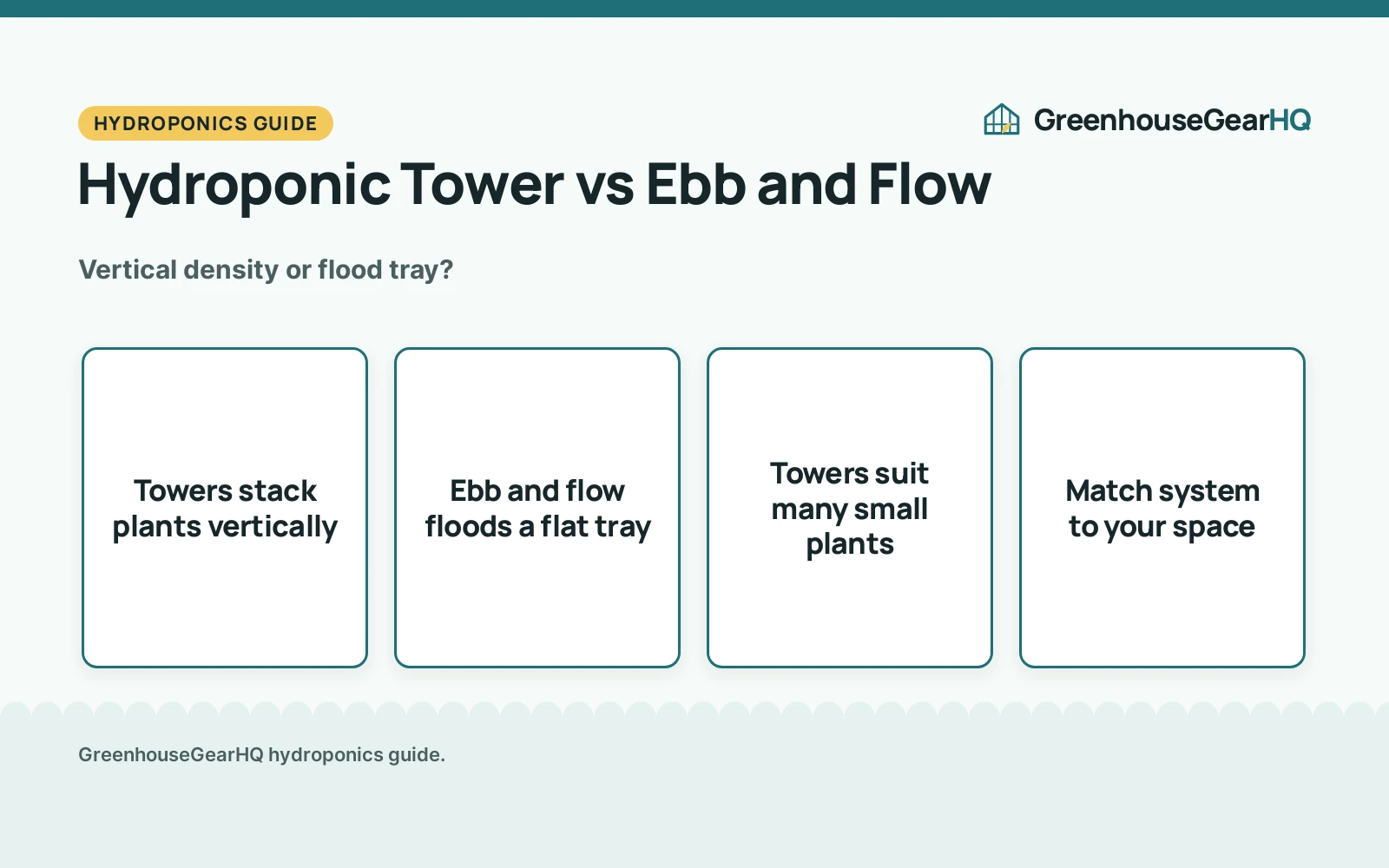
Hydroponic tower vs ebb and flow: a tower stacks plants vertically with water trickling from the top down, while ebb and flow floods a flat tray on a timer and drains it back. Which one should you buy? It depends on whether you want vertical density or a simple horizontal bed. Every number below comes from a product listing we compared; where a listing gives no figure, we say so.
Other options worth a look
 Hydroponic Tower Indoor Growing System Vertical Garden forCheck price on Amazon
 SJZX Hydroponics Growing SystemCheck price on Amazon
GreenhouseGearHQ earns a commission when you buy through links on this page, at no extra cost to you. As an Amazon Associate I earn from qualifying purchases. Affiliate disclosure.
Hydroponic tower vs ebb and flow: the core difference
A hydroponic tower is vertical. The Generic 14-layer tower lists 70 slots in a 15.7 by 15.7 by 64.5 inch footprint with a 20-liter tank. The VEVOR 50-pod tower lists 10 tiers with a 20-liter tank at 13.78 by 13.78 by 51.97 inches. Ebb and flow is horizontal: a pump floods a shallow tray, then the water drains back to a reservoir. No ebb-and-flow listing is in our data, so that side is explained from general knowledge, not figures.
What a tower gives you
Density. The MQHUAYU lists 35 pods in 1.72 square feet of floor space. The LYCereal lists 30 plants with a 10-liter tank at 9.84 by 9.84 by 33.86 inches. The LnzyGarden lists 35 pods with a 10-liter capacity. Towers suit leafy greens and herbs in small spaces. For more, see our hydroponic systems guides.
What ebb and flow gives you
Simplicity. A flat tray, a pump on a timer, and a reservoir. Flood cycles soak the roots, then drain, which pulls fresh oxygen in. It suits larger plants that need root room, like tomatoes or peppers. Because no ebb-and-flow listing is in our data, we state no figures for it.
Water and tanks
Tower tanks here run from 10 liters (LnzyGarden, LYCereal, OvyNewzly, RFnongye) to 20 liters (Generic, VEVOR) to 30 liters (MQHUAYU, 7.9 gallons). The VEVOR 20-liter tank needs refilling about once a month per its listing. Ebb-and-flow reservoirs are typically larger per plant because the whole tray floods.
Plant count and size
Towers here range from 30 pods (LYCereal, OvyNewzly, RFnongye) to 35 (LnzyGarden, MQHUAYU) to 45 (VEVOR) to 50 (VEVOR) to 70 slots (Generic). Towers suit many small plants. Ebb and flow suits fewer, larger plants with room to spread.
Which should you buy?
Buy a tower if you want maximum plants per square foot: the listings show 30 to 70 sites in under 2 square feet. Buy ebb and flow if you want a simple flood tray for bigger plants. Beginners growing herbs and lettuce usually start with a tower.
Choosing the right tower size
Match the tower to your space and appetite. The LYCereal and OvyNewzly list 30 planting sites with 10-liter tanks at about 9.84 by 9.84 by 33.86 inches, which fits a kitchen corner. The VEVOR 50-pod lists 10 tiers with a 20-liter tank at 13.78 by 13.78 by 51.97 inches, which needs more headroom. The Generic 14-layer lists 70 slots with a 20-liter tank at 15.7 by 15.7 by 64.5 inches, the largest here. Taller towers hold more plants but need a spot with enough ceiling clearance and a way to reach the top pods for planting and harvest.
Pumps, timers and lights
Every tower here includes a pump and most include a timer. The LYCereal runs 30-minute on-and-off cycles. The RFnongye uses 5 minutes on and 10 minutes off. The MQHUAYU offers 9 timer modes. Timers matter because roots need both water and air; constant flooding without drain cycles can suffocate them. For lighting, only the VEVOR 45-pod lists a built-in 48W LED grow light. The others assume window light or a separate grow light, so budget for one if your spot is dim.
What to grow in each
Towers excel at leafy greens, herbs, and strawberries: plants that stay compact and harvest repeatedly. The listings mention basil, lettuce, tomatoes, peppers, and strawberries. Ebb-and-flow trays suit larger fruiting plants like full-size tomatoes or peppers that need root space and support. If you want variety, a tower gives you 30 to 70 slots for many small crops; if you want big harvests of a few plants, ebb and flow gives each plant room to spread.
FAQ for growers
How many plants do towers hold?
Listings here range from 30 pods to 70 slots. The Generic 14-layer lists 70; the VEVOR lists 45 and 50.
What tank sizes do towers list?
10 liters on the smaller towers, 20 liters on the mid-size, and 30 liters (7.9 gallons) on the MQHUAYU.
Is ebb and flow good for beginners?
Yes. It is one of the simplest hydroponic methods: a tray, a timer, and a pump. Towers are also beginner-friendly for leafy greens.
Do towers need grow lights?
The VEVOR 45-pod includes a 48W LED grow light. Others do not list lights, so plan for window or supplemental light.
Keep reading
See every hydroponic system guide and all indoor growing guides.
More picks: hydroponic kit for lettuce and hydroponic kit for herbs.