On this page
On a hot July afternoon, a tray of seedlings in a greenhouse can dry out between morning watering and evening, while roots left sitting in standing water can stay wet for too long. What is an ebb and flow? It is a hydroponic watering method that floods a grow tray or plant containers with nutrient water from a reservoir, holds that water around the roots for a short period, then drains it back to the reservoir so air returns to the root zone. This guide explains the parts that make the cycle work and how the flood and drain cycle runs step by step. Where a figure appears, the maker lists it, and the brand is named so the figure can be checked.
GreenhouseGearHQ earns a commission when you buy through links on this page, at no extra cost to you. As an Amazon Associate I earn from qualifying purchases. Affiliate disclosure.
What an ebb and flow system needs
Every working ebb and flow setup has the same core parts: a reservoir, a pump, a tray or containers for the growing medium and roots, fill and drain fittings, tubing, and a timer or controller.
- Reservoir and pump: the reservoir stores the water between cycles, and the pump lifts it to the tray or containers. The Active Aqua Grow Flow controller includes a 7-gallon controller bucket and 2 submersible pumps, stated as a complete kit with timer, tubing and fittings.
- Grow tray or containers: plants sit in a flood tray, in net pots, or in buckets filled with growing medium. Gyfofix deep net pots (on Amazon) for ebb and flow systems are sold as a 3 pack, with lower side openings and an open grid base so water can move into and out of the basket.
- Fill and drain fittings: these set the flood height and the drain path. Grow1 ebb and flow fill drain fittings are stated in 1/2 inch and 3/4 inch sizes, each as a 10 pack.
- Timer or controller: the timer starts and stops the pump so flooding repeats without hand watering. The RooTrimmer rechargeable ebb and flow pump lists timer intervals stated as 1-9 days.
- Tubing and overflow protection: tubing links the reservoir, pump and tray, and an overflow path keeps water from spilling if a drain blocks. The Active Aqua controller lists an emergency shut-off valve for overflow protection.
For a fuller parts list, see our hydroponic system parts guide, and compare this method with other methods in types of hydroponic systems.
What is an ebb and flow and how it works
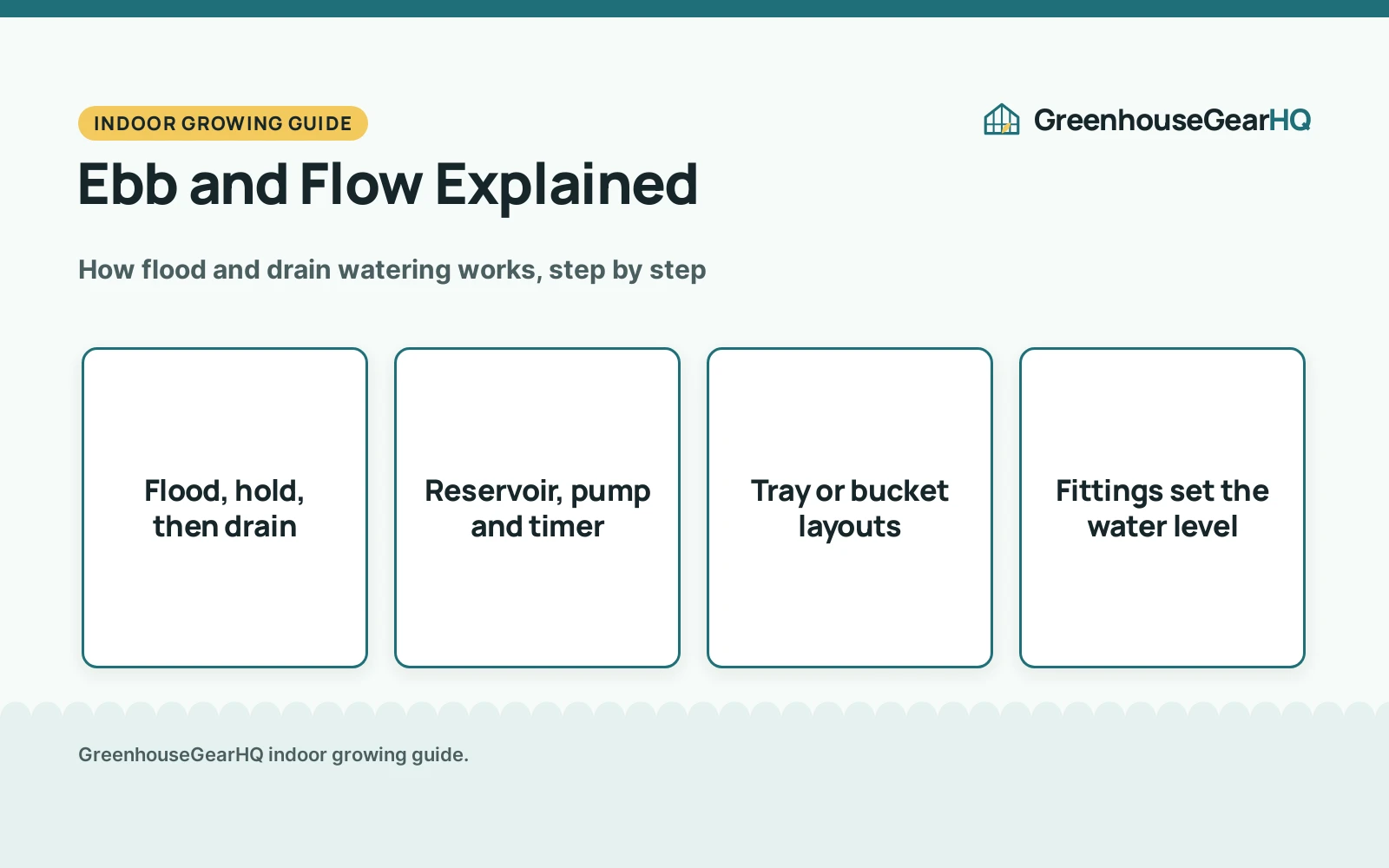
Ebb and flow is also called flood and drain, and the two names describe the same cycle: water rises, water falls.
Step 1: The pump moves water from the reservoir
The cycle starts in the reservoir, where nutrient water waits below or beside the grow tray. When the timer or controller switches the pump on, the pump pushes water through tubing and up through a fill fitting into the tray or into each plant container. In a bucket layout, the Active Aqua Grow Flow controller is stated to control up to 24 five-gallon or 48 two-gallon growing modules, within the stated limit.
Step 2: The tray floods and roots take up water
As water enters, the level in the tray or container rises around the growing medium and roots. The flood height is set by the fittings and, on controller systems, by a level control. The Active Aqua controller lists ladder level control, stated to let the grower fill containers to a chosen water table height. In net pots, water enters through the side openings and grid base; Gyfofix states two rows of openings around the lower sidewall, working with the open grid bottom during watering and draining.
Step 3: The pump stops and the tray drains
When the timed flood ends, the pump stops and gravity takes over. Water flows back through the drain fitting and tubing to the reservoir. AquaSprouts states its plumbing kit this way: use the 1/2 inch fitting to flood and the 3/4 inch fitting to drain, with screen fittings and extension fittings included to set the flood height. As the water leaves, air moves back into the growing medium around the roots. That return of air after each flood is the point of the drain half of the cycle.
Step 4: The timer repeats the cycle
The timer or controller then waits for the next scheduled flood and repeats the same rise and fall. How often to flood, and for how long, depends on the crop, the medium, the room and the system maker directions, so follow the manual for the controller or pump in use and the guidance for the crop being grown. Timer ranges differ by product: the RooTrimmer pump lists intervals stated as 1-9 days, while the Active Aqua kit includes a timer stated as part of the controller set.
| Part | Stated example | Role in the cycle |
|---|---|---|
| Controller kit | Active Aqua Grow Flow, controls up to 24 five-gallon or 48 two-gallon modules | Runs the pump, sets fill level, adds overflow shut-off |
| Fill and drain fittings | Grow1, 1/2 inch and 3/4 inch, 10 pack | Water in, water out, flood height |
| Plumbing kit | AquaSprouts, 1/2 inch to flood and 3/4 inch to drain | Converts a container to ebb and flow use |
| Net pots | Gyfofix deep baskets, 3 pack | Holds medium and roots while water moves through |
Flood tray or bucket modules?
Small setups usually flood a single tray: pots or net pots sit in the tray, and the whole tray fills and drains together. Tiered stands adapt the same idea for seedlings. The RooTrimmer 5-tier stand lists ebb and flow bottom watering for seedbeds, stated to fit 1020 plug trays and 3-7 inch pots, with each shelf stated at 50 lbs per shelf. Water floods from below, then drains back, which suits trays of young plants that share one schedule.
Larger setups often use bucket modules instead: each plant grows in its own bucket of medium, and the controller floods and drains every bucket together. The Active Aqua expansion kit lists 6 growing modules with 5-gallon pots, each stated to hold approximately 13 liters of clay pebbles or similar medium, plus a 25-foot roll of 3/4-inch tubing. The maker states up to 48 modules can connect to one control unit, depending on reservoir size. Buckets suit larger plants that need root room, while a flood tray suits groups of small pots and trays. See our best hydroponic system picks and our hydroponic indoor garden for beginners guide.
What this guide does not cover
This guide explains the watering method and its parts. It does not give nutrient mixing instructions, water quality targets, or flood schedules for specific crops. Follow the nutrient product label, the system maker manual, and advice from the local extension office.
FAQ for growers
What is an ebb and flow in hydroponics?
It is a hydroponic watering method where nutrient water floods a tray or plant containers from a reservoir, then drains back to the reservoir. Roots take up water during the flood, and air returns to the root zone as the water drains.
Is ebb and flow the same as flood and drain?
Yes, the names describe the same cycle of rising and falling water. Grow1 states its ebb and flow fill drain fittings as a flood and drain irrigation kit, using both names for the same parts.
What parts do I need for an ebb and flow system?
A reservoir, a pump, a tray or containers, fill and drain fittings, tubing, growing medium and a timer or controller. The AquaSprouts kit (on Amazon) lists 1 x 1/2 inch outlet fitting, 1 x 3/4 inch outlet fitting, 2 screen fittings and 6 outlet extension fittings for converting a container.
Can ebb and flow work for seedlings in trays?
Yes, tray-based stands use the same flood and drain cycle from below. The RooTrimmer 5-tier stand (on Amazon) is stated to fit 1020 plug trays and 3-7 inch pots, flooding roots from below and draining back to reduce standing water around roots.
Keep reading
See every hydroponic systems guide and all indoor growing guides. Also see our hydroponic system setup guide. Also see our best hydroponic system for growing vegetables picks.
More picks: hydroponic systems, indoor gardens for beginners, hydroponic system parts and types of hydroponic systems.