On this page
Top picks at a glance
As an Amazon Associate I earn from qualifying purchases.
- 1
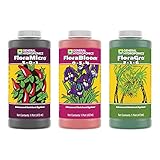 General Hydroponics FloraSeries Advanced Nutrient System9.6/10View on Amazon
- 2
 URUQ 8-Pod Hydroponics Growing System with 24-Watt LED Grow9.5/10View on Amazon
- 3
 Growell 16 Pods Hydroponics Growing System Kit9.5/10View on Amazon
- 4
 iDOO 12Pods Hydroponics Growing System Garden with LED GrowView on Amazon
- 5
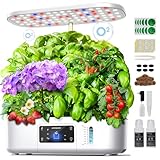 Ahopegarden Hydroponics Growing System: 12 Pods with TouchView on Amazon
- 6
 Small Grow Tent for Aerogarden,30”x18”x36” ,HydroponicsView on Amazon
- 7
 Small Grow Tent for Aerogarden,24”x16”x24” ,HydroponicsView on Amazon
- 8
 Small Grow Tent for Aerogarden,18”x18”x36” ,HydroponicsView on Amazon
- 9
 LETPOT LPH-Max 21-Pod Hydroponic Growing System KitsView on Amazon
A sunny windowsill can hold only so many pots, and the herbs on the kitchen counter have outgrown their jars. That is the moment types of hydroponic systems start to matter: plants grown in water with nutrients, without soil, in a tower, a tray or a tank. The types differ in how the water moves: roots can sit in it, a thin film can flow past them, a tray can flood and drain, drippers can feed each plant, or a wick can draw water up.
Other options worth a look
 iDOO 12Pods Hydroponics Growing System Garden with LED GrowCheck price on Amazon
 Ahopegarden Hydroponics Growing System: 12 Pods with TouchCheck price on Amazon
 Small Grow Tent for Aerogarden,30”x18”x36” ,HydroponicsCheck price on Amazon
 Small Grow Tent for Aerogarden,24”x16”x24” ,HydroponicsCheck price on Amazon
 Small Grow Tent for Aerogarden,18”x18”x36” ,HydroponicsCheck price on Amazon
 LETPOT LPH-Max 21-Pod Hydroponic Growing System KitsCheck price on Amazon
GreenhouseGearHQ earns a commission when you buy through links on this page, at no extra cost to you. As an Amazon Associate I earn from qualifying purchases. Affiliate disclosure.
Types of hydroponic systems: the short answer
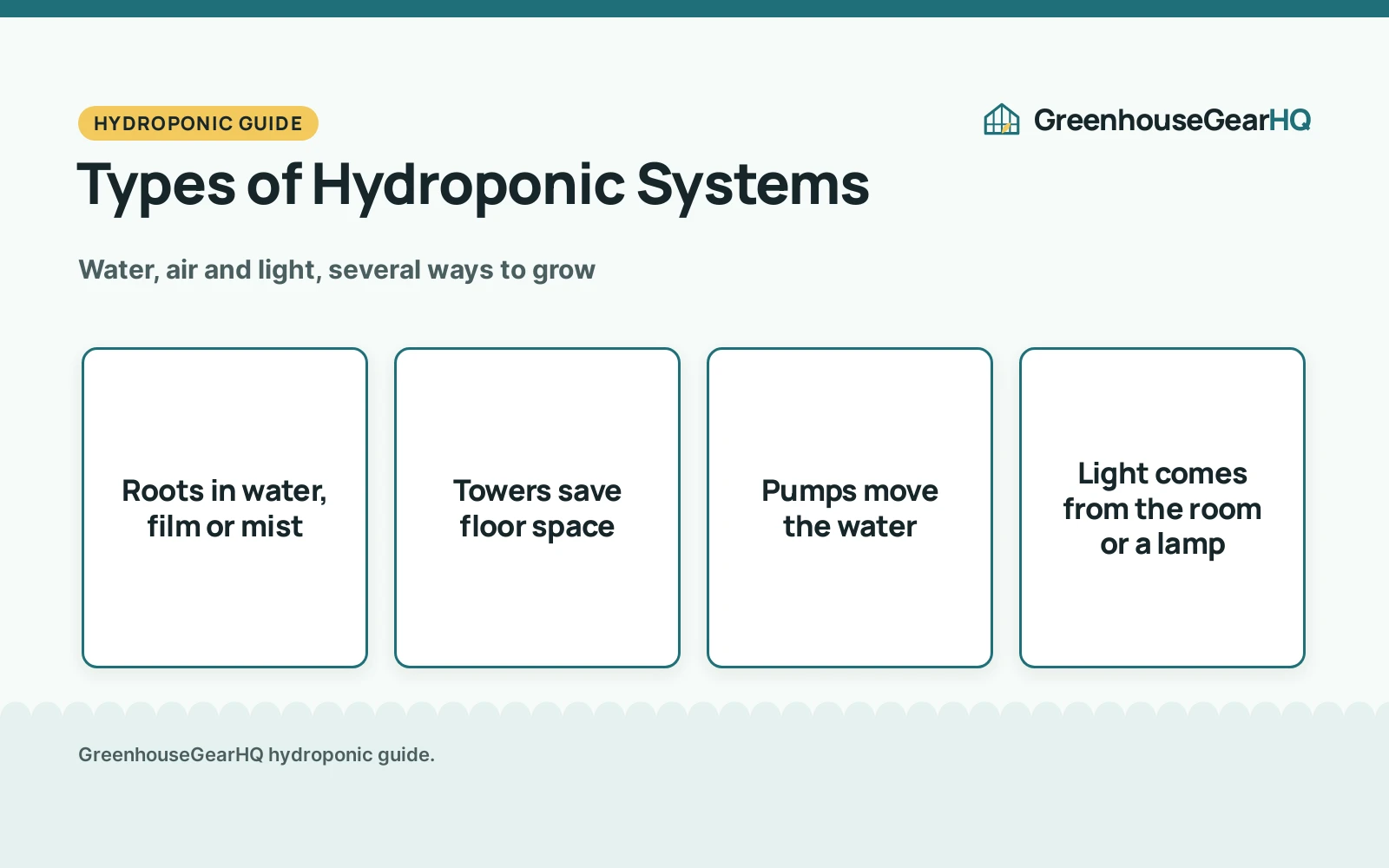
Deep water culture holds roots in oxygenated water. Nutrient film runs a thin film past the roots. Ebb and flow floods a tray and drains it. Drip systems feed each plant through an emitter. Aeroponics mists roots that hang in air. Wick systems draw water up through a wick with no pump at all. A vertical tower shows how several of these ideas fit in a small footprint: the VEVOR tower (on Amazon) lists 50 pods across 10 tiers, a 20L water tank with a pump, and app control for the pump runtime.
| Type | How the water moves | What it suits |
|---|---|---|
| Deep water culture | Roots sit in oxygenated water | Leafy greens and herbs |
| Nutrient film technique | A thin film flows past the roots | Leafy greens and herbs |
| Ebb and flow | The tray floods, then drains | A wide range of crops |
| Drip systems | Emitters drip water to each plant | Larger plants and fruiting crops |
| Aeroponics | Roots hang in air and get misted | Fast growth, more gear |
| Wick systems | A wick draws water up to the roots | Small, simple setups |
Deep water culture
Deep water culture is the simplest powered type. Plants sit in net pots with their roots hanging in a tank of nutrient water, and an air pump keeps the water oxygenated so the roots can breathe. Leafy greens and herbs do well here, since their roots like steady moisture and the tank holds a large volume of water. The main chores are topping up the tank and watching the water level so the roots stay covered.
Nutrient film technique
Nutrient film technique runs a thin film of water along a shallow channel, past the roots, and back to the tank. The roots sit in the film and in the humid air above it, which gives them water and oxygen. This type suits leafy greens and herbs that grow fast and do not need a deep root zone. It needs a pump that runs steadily and a level channel, since the film must reach every plant in the line.
Ebb and flow
Ebb and flow, also called flood and drain, fills a tray with nutrient water and then lets it drain back to the tank. The flood wets the roots and the growing medium, and the drain pulls fresh air down to the roots. This cycle suits a wide range of crops, including plants that like a wet and dry rhythm. A timer controls the flood cycle, and the tray needs a drain that cannot clog.
Drip systems
Drip systems send nutrient water through emitters to the base of each plant, on a timer. The water drips into the growing medium and drains back to the tank, so each plant gets its own feed. This type suits larger plants and fruiting crops that need more water than a leafy green, and it scales well: add an emitter and a line for each new plant. Clogged emitters are the weak point, so check the lines and clean them when the flow slows.
Aeroponics
Aeroponics hangs the roots in air inside a chamber and mists them with nutrient water on a timer. The roots get plenty of oxygen between mists, which is why this type is known for fast growth. It needs more gear than the other types: a pump, mist nozzles, a timer and a sealed chamber. A pump failure or a clogged nozzle dries the roots quickly, so this type suits growers who check their gear often.
Wick systems
Wick systems are the simplest type of all, with no pump and no power. A wick runs from a tank of nutrient water up into the growing medium, and capillary action draws the water up to the roots. This suits small setups and slow-growing plants that do not drink heavily. It does not suit thirsty plants, since a wick can only move so much water, and the tank needs refilling before it runs dry.
How to choose a type
Start with the space you have. A vertical tower fits a kitchen corner or a balcony: the VEVOR tower lists a 13.78 x 13.78 inch footprint and a 51.97 inch height, with 50 pods across 10 tiers, so it grows a lot of plants on very little floor. A flat tray system needs a bench or a shelf instead, and a tank system needs floor space for the reservoir.
Then weigh power and moving parts. Wick systems need no power at all. Deep water culture needs an air pump. Nutrient film, ebb and flow, drip and aeroponics need a water pump and a timer, and the VEVOR tower adds app control for the pump runtime. More moving parts means more to check, so a simple type is the safer start if you travel.
Light is the remaining part of the choice. The VEVOR tower lists no grow light, so its plants need light from the room or a separate lamp. Check what light your spot gets across the day before you buy, and compare lamps in our grow lights for seedlings guide. If you are choosing a system for mint and other herbs, see our best hydroponic system for mint guide.
Indoors or inside the greenhouse?
Most home hydroponic systems live indoors, near a window or under a lamp, where the water stays warm and the pump stays dry. The VEVOR tower is listed for indoor herbs, fruits and vegetables in kitchens and balconies. A greenhouse suits larger tray and tank systems, where the extra humidity is less of a problem and the floor can take a spill. Wherever the system goes, keep the pump and any power above the water line.
What this guide does not cover
This guide covers system types only. It does not give nutrient recipes, pH or EC figures, light hours or feeding schedules, since those depend on the crop, the kit and the water you start with. Your kit manual and seed packet give those figures. We also do not cover pest products; follow the product label.
FAQ for growers
What is the simplest type of hydroponic system?
A wick system. It has no pump and no power: a wick draws nutrient water up from a tank to the roots. It suits small setups and slow-growing plants, and it does not suit thirsty plants that drink heavily.
What is the difference between deep water culture and nutrient film technique?
In deep water culture the roots sit in a tank of oxygenated water. In nutrient film technique a thin film of water flows past the roots in a shallow channel and back to the tank. Each suits leafy greens and herbs.
Do hydroponic systems need a grow light?
It depends on the listing and the spot. The VEVOR tower lists no grow light, so its plants need light from the room or a separate lamp. Check the listing and the light your spot gets before you buy.
How much water does a hydroponic tower hold?
The VEVOR tower lists a 20L water tank, and the listing states the tank needs refilling only once a month. Other towers state their own tank sizes, so compare the listing before you buy.
How many plants fit in a hydroponic tower?
The VEVOR tower lists 50 pods across 10 tiers. Pod counts differ by tower, so compare the pod count and the tier count in the listing against the plants you want to grow.
Keep reading
See every Indoor Growing guide and all hydroponic systems guides. Also see our best hydroponic system for mint guide and our grow lights for seedlings guide.
More picks: greenhouse shelving, seedling heat mats and hydroponic systems.