On this page
Top picks at a glance
As an Amazon Associate I earn from qualifying purchases.
- 1
 T5 Grow Lights for Indoor Plants 1FT9.7/10View on Amazon
- 2
 LED Grow Light 225 LEDs Plant Lights Red Blue White PanelView on Amazon
- 3
 Sondiko LED Grow Light StripView on Amazon
- 4
 Led Grow LightsView on Amazon
- 5
 Black 2-Tube Clip-On Grow Light with Red/Blue/Yellow LEDsView on Amazon
- 6
 2 Heads Clip Solar Grow Lights with Red Blue Spectrum forView on Amazon
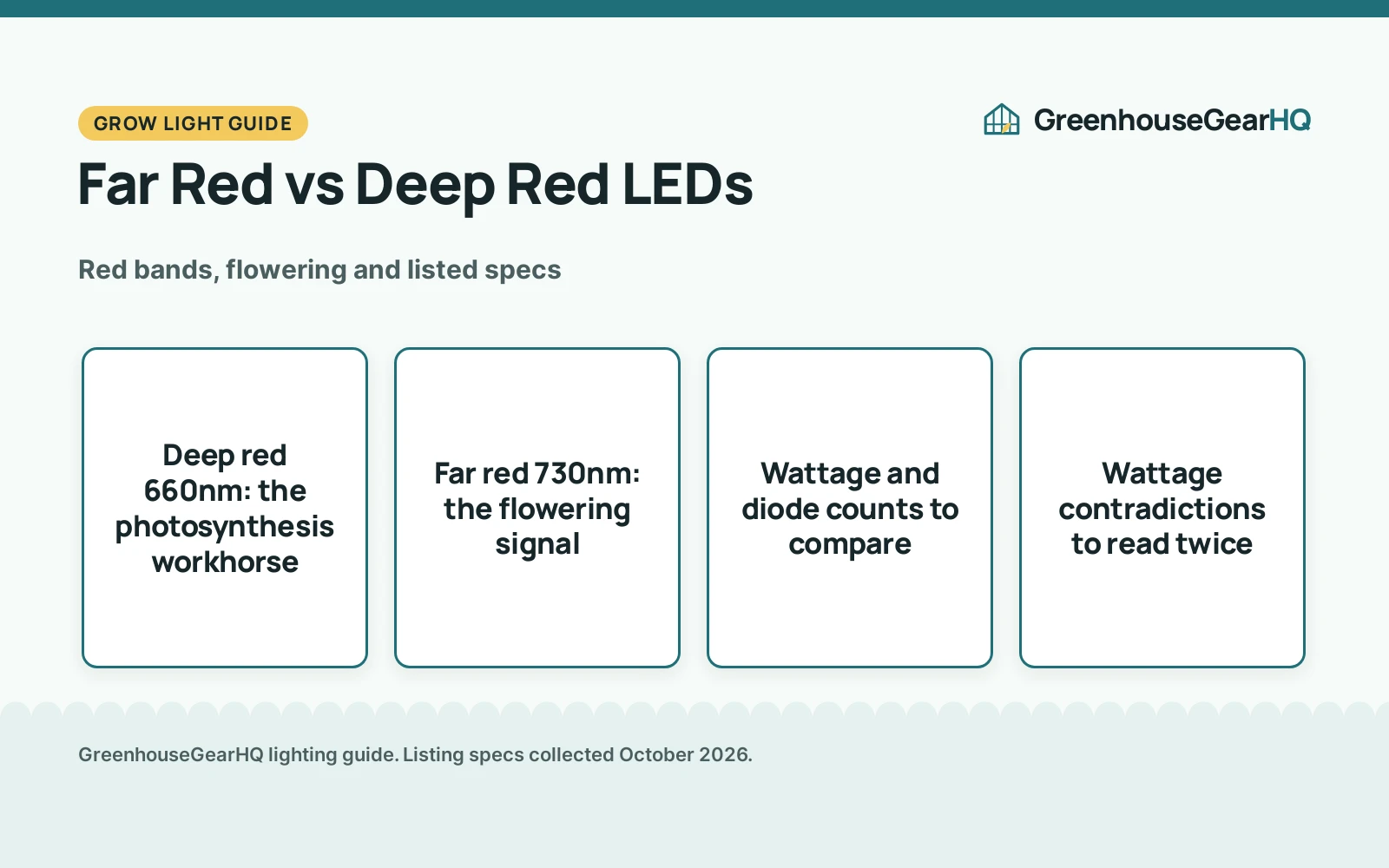
In late summer, when the greenhouse tomatoes are loaded with green fruit that refuses to ripen, light spectrum starts to matter as much as light hours. The question of far red vs deep red grow lights comes down to this: deep red around 660nm drives photosynthesis and fuels growth, while far red around 730nm acts as a signal that nudges plants toward flowering and fruiting. We compared LED listings built around both bands to explain what each one does and which grows each suits. Every number below comes from a product listing; where a listing gives no figure, we say so.
Other options worth a look
 LED Grow Light 225 LEDs Plant Lights Red Blue White PanelCheck price on Amazon
 Sondiko LED Grow Light StripCheck price on Amazon
 Led Grow LightsCheck price on Amazon
 Black 2-Tube Clip-On Grow Light with Red/Blue/Yellow LEDsCheck price on Amazon
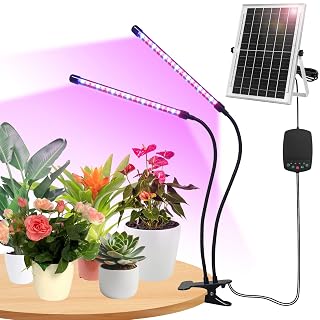 2 Heads Clip Solar Grow Lights with Red Blue Spectrum forCheck price on Amazon
GreenhouseGearHQ earns a commission when you buy through links on this page, at no extra cost to you. As an Amazon Associate I earn from qualifying purchases. Affiliate disclosure.
Far red vs deep red grow lights: the short answer
Buy deep red when you want more growing power: 660nm diodes supplement your main light through veg and bloom, filling the red gap most white LEDs leave. Buy far red when you want to steer flowering: 730nm bars run alongside the main light to push plants toward fruit. If you would rather go straight to the products, our UV vs IR grow lights guide covers the neighboring bands.
What deep red (660nm) does
Deep red sits at the peak of what plants use for photosynthesis, so makers sell it as extra growing power on top of a main light. Spider Farmer’s SUPP-R30 packs 88 diodes at 660nm into two 23.6-inch bars at 30 watts, with daisy chaining for bigger tents. Their GlowR40 lists 72 diodes from 650 to 665nm at 40 watts on two 25-inch bars, IP65 rated, with a 7-day digital timer. HIGROW sells the same idea as a bulb: 18 diodes at 660nm in an E26 socket for 100 to 240V.
Deep red is the everyday band: it runs through veg and bloom alike, and several listings frame it as filling the red gap in white main lights. The SANSI bulb folds both bands into one: 24 watts with 660nm red plus 730nm infrared alongside 3000K and 5000K white, IP54 rated.
What far red (730nm) does
Far red sits just past visible red, and plants read it as a signal about day length and shading, which is why makers tie it to flowering and fruiting. Spider Farmer’s UV and IR sets pair 365 to 370nm UV bars with 730 to 745nm IR bars: the 23.6-inch set lists 30 watts, and the 35.4-inch set lists its bars for 2×4 and 5×5 tents. Mars Hydro’s ADlite pairs UV30 with IR15 diodes for 3×3 ft of far-red coverage, and its listing says the IR mimics sunrise and sunset.
Barrina’s GrowForce BG02 builds far red into a main light: 200 watts with 437nm blue plus 730nm far infrared, 684 LEDs, 60-degree lenses on the red and IR beads, and daisy chaining for up to 100 fixtures. Use far red as a steering tool, not the main course: it complements a full-spectrum main light rather than replacing it.
Deep red vs far red at a glance
| Band | Wavelength | Role | Example listing |
|---|---|---|---|
| Deep red | 660nm (650-665nm) | Photosynthesis power, veg and bloom | Spider Farmer SUPP-R30, 30W, 88 diodes |
| Far red | 730nm (730-745nm) | Flowering signal, day-length cue | Spider Farmer IR bars, 730-745nm |
| Both in one | 660nm + 730nm | Single-bulb supplement | SANSI 24W bulb, 660nm + 730nm |
Which should you buy?
Match the band to the job. If your white main light grows stocky veg but bloom feels slow, deep red is the first add: a 30W Spider Farmer R30 bar or a 40W GlowR40 bar fills the 660nm gap without changing your main light. If plants are healthy but flowering drags, far red is the steering input: 730nm bars run alongside the main light through bloom. For a single-plant shelf, the SANSI 24W bulb puts 660nm and 730nm in one E26 socket.
Check diode count and wattage together before you buy: the R30 lists 88 diodes at 30 watts while the GlowR40 lists 72 at 40 watts, so watts alone do not tell you the red output. Read our full spectrum vs blurple grow lights guide and 100 watt LED grow lights roundup before you decide.
Read the listing twice
Red-light listings contradict themselves on wattage and warranty:
- HIGROW 660nm bulb: the title says 18W while the spec table lists 36 watts.
- Liliful panels: the warranty field says “Na”, so no warranty term is stated.
- Spider Farmer UV60 and IR30 set: the spec table lists 500 watts for a 4-bar supplemental set, far above the 30 watts of its smaller UV30 and IR16 sibling, so confirm before you buy.
Trust the title and bullets over the spec table, and confirm the wavelength in nanometers: that is the number that tells deep red from far red.
What this guide does not cover
This guide covers red bands only. It does not cover hanging height, daily light hours or UV use, which depend on the crop and the fixture. The light maker’s manual gives those figures, and your local extension office can advise on timing for your area.
FAQ for growers
What is the difference between far red and deep red?
Deep red around 660nm drives photosynthesis and runs through veg and bloom. Far red around 730nm acts as a signal for flowering and day length. Listings like the Spider Farmer sets sell them as separate supplemental bars.
Can I use far red during veg?
The listings position far red for flowering: Spider Farmer’s IR bars are sold for bloom, and Mars Hydro’s ADlite pairs its IR with flowering claims. Makers sell deep red, not far red, as the everyday veg supplement.
How many watts of red supplement do I need?
The listings range from 24 watts for the SANSI bulb to 30 and 40 watts for the Spider Farmer bars, up to 200 watts for the Barrina main light. Match the wattage to your tent size and the maker’s stated coverage.
Do these red bars work with any main light?
Most are sold as add-ons: the Spider Farmer bars list daisy chaining and compatibility with quantum board and bar-style main lights. Check the bar’s length against your tent: 23.6-inch and 35.4-inch sets are listed for 2×2 up to 5×5 tents.
Keep reading
See every grow light guide and all light and heat guides.
More picks: UV vs IR grow lights, full spectrum vs blurple grow lights, LED vs HPS grow lights and 100 watt LED grow lights.