On this page
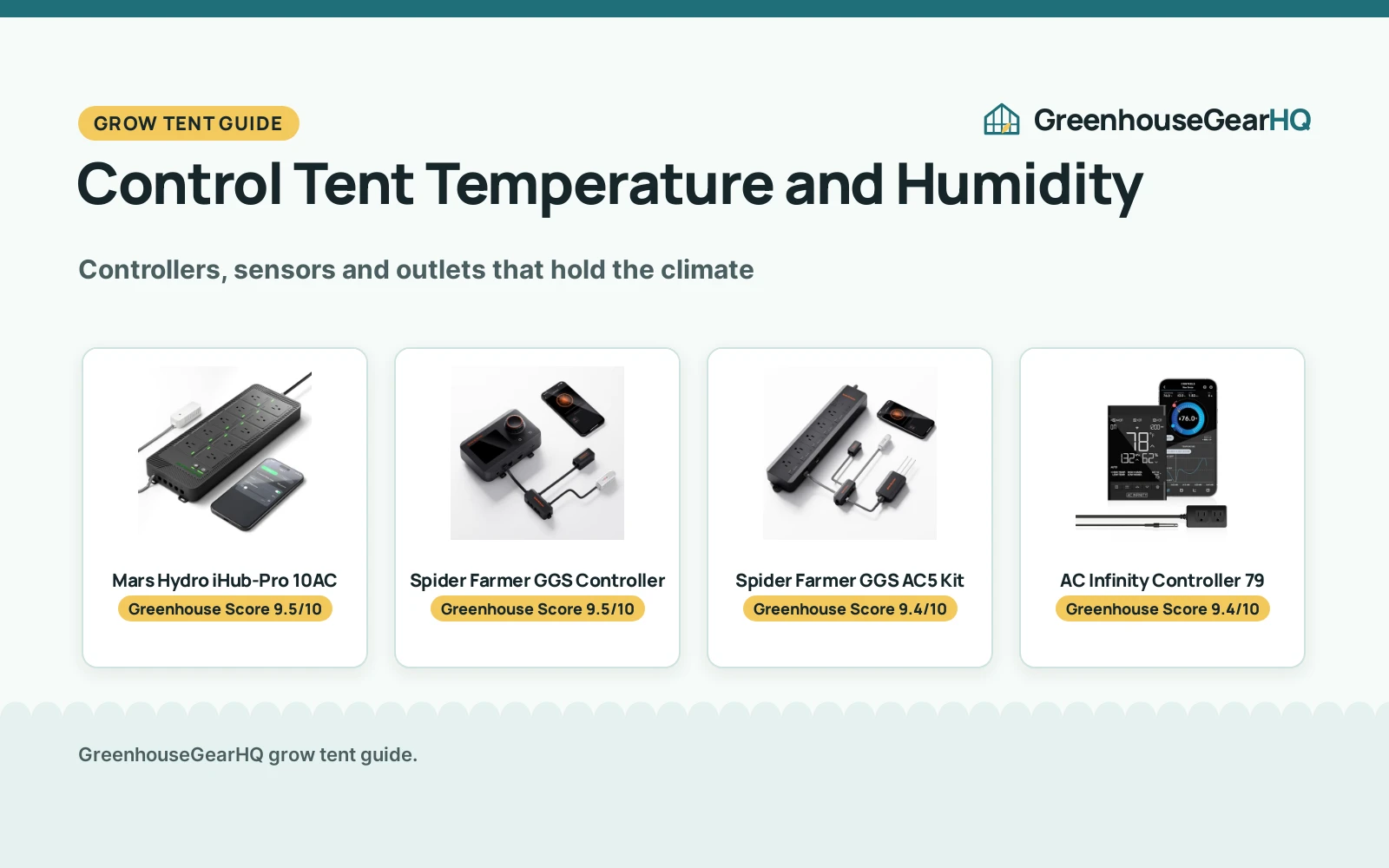
Top picks at a glance
As an Amazon Associate I earn from qualifying purchases.
- 1
 Mars Hydro iHub-Pro 10AC9.5/10View on Amazon
- 2
 Spider Farmer GGS Controller9.5/10View on Amazon
- 3
 Spider Farmer GGS AC5 Kit9.4/10View on Amazon
- 4
 AC Infinity Controller 799.4/10View on Amazon
On a hot July afternoon the tent runs warm, the leaves droop, and the fan that ran all morning has not caught up. Grow tent temperature and humidity control means setting targets on a controller and letting it switch the fan, the heater and the humidifier to hold them. The steps below show what the tent needs, how to set it up, and which controllers and strips run it.
GreenhouseGearHQ earns a commission when you buy through links on this page, at no extra cost to you. As an Amazon Associate I earn from qualifying purchases. Affiliate disclosure.
| # | Product | Greenhouse Score | Buy |
|---|---|---|---|
| 1 | Mars Hydro iHub-Pro 10AC | 9.5/10 | Buy on Amazon |
| 2 | Spider Farmer GGS Controller | 9.5/10 | Buy on Amazon |
| 3 | Spider Farmer GGS AC5 Kit | 9.4/10 | Buy on Amazon |
| 4 | AC Infinity Controller 79 | 9.4/10 | Buy on Amazon |

Mars Hydro iHub-Pro 10AC
A 10-outlet WiFi power strip that runs the tent lights, fans and humidifier from temperature, humidity and VPD triggers, for growers who want the whole tent on one hub.
Pros
- 10 pre-configured outlets manage lights, fans and humidifiers from one hub
- Six modes: temperature, humidity, PPFD, CO2, timer and cycle
- Real-time VPD monitoring with automatic adjustment when readings drift
Cons
- No warranty term is stated
- The Scenario-Based Automated Cultivation bullet appears twice in the listing
- RJ12 ports are required for the devices it controls

Spider Farmer GGS Controller
A controller that sets day and night targets and links lights, fans, humidifiers and heaters toward them, with plans that keep running when WiFi drops, for growers who want set-and-forget control.
Pros
- Day and night settings with device interlocking toward one target
- Pre-set plans keep running through WiFi outages
- Up to 100 same-model lights daisy-chained and up to 6 clip fans connected
Cons
- No warranty term is stated
- Optional CO2, PPFD and soil sensors are sold separately
- Excludes SF300 and SF600 lights from the supported list

Spider Farmer GGS AC5 Kit
A 5-outlet app-controlled power strip with a soil sensor and a temp, humidity and light sensor, for growers who want to add switched outlets to a GGS controller.
Pros
- 5 independent app-controlled outlets for multiple devices at once
- Monitors dual-zone temperature and humidity, VPD, soil moisture and EC
- Works with GGS controllers for offline operation
Cons
- No warranty term is stated
- Expandable CO2 and SensorPro are sold separately
- No outlet wattage limit is stated

AC Infinity Controller 79
A wall-mount controller that switches two outlet devices on independent temperature, humidity and VPD programs, for growers who need a simple two-outlet control.
Pros
- Independent programs for two outlets
- Temperature, humidity and VPD triggers with timers, cycles and scheduling
- Two outlets collectively support up to 1100W
Cons
- No warranty term is stated
- Only two outlets, so a larger setup needs more controllers or a strip
- The listing states no CO2 or light control, only temperature, humidity and VPD
As an Amazon Associate I earn from qualifying purchases.
What grow tent temperature and humidity control needs
Every tent that holds its climate has the same parts: a sensor that reads temperature and humidity, a controller that holds the targets, switched outlets that turn devices on and off, and the devices themselves. The sensor sits in the tent and reports the readings. The controller compares the readings with the targets and switches the outlets. The fan, the heater and the humidifier do the work, and the app shows the readings and the alerts. Buy them in that order, because the controller decides which sensors and strips fit.
- Sensor: reads temperature and humidity in the tent, and VPD where the listing states it. The Spider Farmer GGS AC5 (on Amazon) kit includes a temp, humidity and light sensor, and the GGS Controller reads temp, humidity and VPD.
- Controller: holds the targets and switches the outlets. See the grow tent controller guide for options that match the tent size.
- Switched outlets: turn the fan, heater and humidifier on or off from triggers. The Mars Hydro iHub-Pro (on Amazon) switches 10 outlets and the Spider Farmer GGS AC5 kit adds 5 outlets to a GGS controller.
- Devices: fan for heat, humidifier for dry air, heater for cold nights. Match the outlet wattage to the device: the AC Infinity Controller 79 supports up to 1100W across its two outlets.
How to control grow tent temperature and humidity, step by step
Step 1: Place the sensor where the plants are
Put the sensor at plant height in the tent, away from the light and the fan, so it reads the air the plants feel. The GGS AC5 kit includes a temp, humidity and light sensor, and the GGS Controller reads temp, humidity and VPD. A sensor that sits in direct light or in the fan stream reads the light or the fan, not the tent.
Step 2: Set temperature and humidity targets on the controller
Set temperature and humidity targets in the controller settings, and set day and night targets apart where the controller allows it. The GGS Controller supports day and night settings, and the Mars Hydro iHub-Pro holds phase-specific presets for each growth stage. The controller then works toward the targets on its own, without a trigger set on each device.
Step 3: Plug the fan, heater and humidifier into switched outlets
Plug each device into a switched outlet and give it a trigger: the fan for heat, the humidifier for dry air, the heater for cold nights. The AC Infinity Controller 79 switches two outlet devices on independent programs, and the Mars Hydro iHub-Pro switches 10 outlets across 6 modes. The Spider Farmer GGS AC5 kit adds 5 app-controlled outlets to a GGS controller. Check the outlet wattage against the device: the Controller 79 supports up to 1100W across its two outlets.
Step 4: Check the readings and adjust
Check the readings in the app through the day and look at how the readings move, not at any reading alone. If the tent runs warm at midday, raise the fan trigger or add airflow; if it runs damp at night, check the humidifier setting and the venting. The GGS Controller keeps its pre-set plans running through WiFi outages, so a dropped connection never stops the plan. The Mars Hydro iHub-Pro logs data and sends alerts when readings drift from the preset ranges.
What this guide does not cover
We do not give target temperature or humidity figures, because they depend on the crop and the growth stage; the controller manual and the seed supplier give those figures. We also do not cover CO2 or light control beyond the triggers the listings state, and we do not describe any device as safe to leave running unattended.
The gear: controllers and outlets that run the tent
The controllers and strips below read the tent and switch the fan, the heater and the humidifier, so match the controller to the outlets the tent needs.
FAQ for growers
Do I need a controller for a grow tent?
Not for a small tent with a fan, but a controller earns its place when the tent holds a fan, a heater and a humidifier at once. The controller reads the tent and switches each device on its own, so the climate holds without constant checks. The AC Infinity Controller 79 covers two outlets, while the Mars Hydro iHub-Pro covers 10.
What does VPD mean on a grow tent controller?
VPD stands for vapor pressure deficit, and the listings use it as a reading the controller tracks beside temperature and humidity. The Spider Farmer GGS AC5 kit monitors VPD with its sensors, and the Mars Hydro iHub-Pro watches VPD in real time and adjusts the humidifier, lights and ventilation when readings drift. Set the VPD target the controller allows and let it work from the readings.
Can a grow tent controller run without WiFi?
Yes, on the controllers that state it. The Spider Farmer GGS Controller keeps pre-set plans running through outages and works from its panel with no network at all, and the GGS AC5 kit works with GGS controllers for offline operation. Check the listing for offline operation before you buy, since not every controller states it.
Keep reading
See every indoor growing guide and all grow tents guides.
More picks: temperature and humidity controller, grow tent humidifier, inline fan for grow tent, greenhouse climate controller