On this page
Top picks at a glance
As an Amazon Associate I earn from qualifying purchases.
- 1
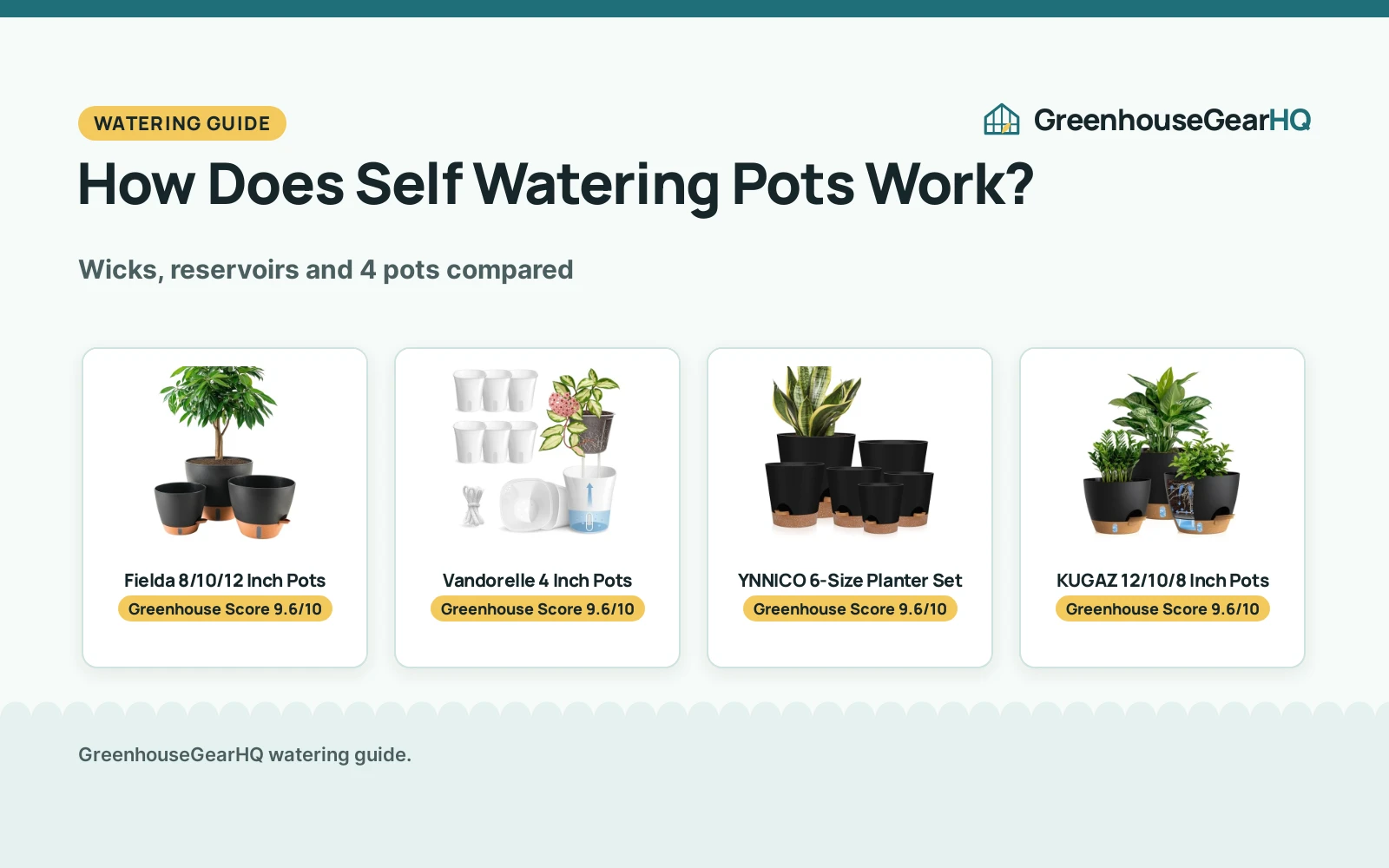
 Fielda 8/10/12 Inch Pots9.6/10View on Amazon
- 2
 Vandorelle 4 Inch Pots9.6/10View on Amazon
- 3
 YNNICO 6-Size Planter Set9.6/10View on Amazon
- 4
 KUGAZ 12/10/8 Inch Pots9.6/10View on Amazon
A tray of seedlings on a bright windowsill can dry out between morning and evening, and a weekend away can leave them limp by Sunday. How does self watering pots work? A pot with a water reservoir below the soil and a cotton wick between them lets the roots draw water as the soil dries, so the plant waters itself for days at a time. This guide explains each part, how the water moves, and which of the pots below suits each kind of plant.
GreenhouseGearHQ earns a commission when you buy through links on this page, at no extra cost to you. As an Amazon Associate I earn from qualifying purchases. Affiliate disclosure.
| # | Product | Greenhouse Score | Buy |
|---|---|---|---|
| 1 | Fielda 8/10/12 Inch Pots | 9.6/10 | Buy on Amazon |
| 2 | Vandorelle 4 Inch Pots | 9.6/10 | Buy on Amazon |
| 3 | YNNICO 6-Size Planter Set | 9.6/10 | Buy on Amazon |
| 4 | KUGAZ 12/10/8 Inch Pots | 9.6/10 | Buy on Amazon |

Fielda 8/10/12 Inch Pots
A set of 8, 10 and 12 inch wick pots with a water level window, for large indoor and outdoor plants.
Pros
- Cotton wick system draws water from the tray to the roots
- Water level window with measurement markings shows the level at a glance
- Listing states soil stays moist for up to 7-10 days
Cons
- Usable planting depth is smaller than the overall height: 5.8, 6.1 and 7.6 inches
- Plastic construction, not ceramic or terracotta
- No warranty term is stated

Vandorelle 4 Inch Pots
A pack of small clear-cup wick pots for cuttings, seedlings and herbs, with a side water window and an extra wick cord.
Pros
- Semi-transparent inner cup shows roots and water level
- Extra 3ft wick cord included for swaps
- Top refill holes mean no disassembly to top up
Cons
- Sized for cuttings and seedlings, not large plants
- Mesh barrier and inner cup add parts to clean
- No warranty term is stated

YNNICO 6-Size Planter Set
A set of wick planters in 8, 7, 6.5, 6, 5.5 and 5 inch sizes with drainage holes and saucers, for small and medium indoor plants.
Pros
- Sizes from 8 down to 5 inches cover small and medium plants
- Thick 4mm sidewalls stated in the listing
- Carbonfree Certified
Cons
- Wick is a string the user places, not a built-in channel
- No water level window is stated
- No warranty term is stated

KUGAZ 12/10/8 Inch Pots
Large wick pots in 12, 10 and 8 inch sizes with a deep reservoir and a water level window, for large houseplants.
Pros
- Deep reservoir with a transparent water level window
- Wick system delivers water straight to the roots
- Sizes suit large plants such as monstera and fiddle leaf fig
Cons
- No warranty term is stated
- No planting depth is stated, so check the fit before ordering
As an Amazon Associate I earn from qualifying purchases.
How does self watering pots work: the short answer
A self watering pot pairs a pot for the plant with a reservoir for water underneath it, joined by a wick. The wick sits with one end in the water and the other end in the soil, and it carries water upward by capillary action, the same pull that draws water up a paper towel dipped in a glass. As the soil dries, it pulls more water through the wick, and as the soil stays moist, the flow slows, so the roots take what they need and the soil stays evenly damp rather than swinging between soaked and dry.
The reservoir is what makes the pot different from a saucer. A saucer catches what drains out of the pot, while a reservoir holds clean water ready to be drawn up, and a water level window shows how much is left without lifting the plant. The system suits plants that like steady moisture, and it suits growers who are away for days at a time, since the pot keeps working while no one is there to water.
The parts of a self watering pot
Every self watering pot in this guide has the same core parts, and the differences are in how each part is built:
- Reservoir: the water store under the soil. The Fielda set lists a detachable bottom tray as its reservoir, the Vandorelle pots (on Amazon) list a bottom reservoir with a side window, and the KUGAZ set lists a deep reservoir under each pot.
- Wick: the cotton cord that carries water to the roots. Fielda, Vandorelle and KUGAZ all list an absorbent cotton wick system, and Vandorelle includes one extra 3ft wick cord for swaps. YNNICO lists a string that goes at the bottom of the pot for bottom watering.
- Water level window: a clear strip that shows the water level. Fielda lists a transparent window with measurement markings, Vandorelle lists a side window, and KUGAZ lists a transparent water level window.
- Drainage holes: holes that let air reach the roots and stop the soil from staying soggy. Fielda, YNNICO and KUGAZ all list drainage holes, and YNNICO pairs them with a watering lip that the listing says gives the roots an air circulation system.
- Inner cup: a separate cup that holds the plant above the reservoir. Vandorelle lists a semi-transparent inner cup that makes it easy to watch root growth and check the water level, with ventilation holes for airflow.
How the wick moves water
The wick works because dry soil pulls water harder than wet soil does. When the soil around the wick dries out, it draws water up the cotton fibres, and when the soil is moist, the pull eases and the flow slows. That is why a self watering pot keeps soil evenly moist rather than wet: the plant sets the pace, and the wick only moves as much water as the soil asks for. The Fielda listing states that its wick system keeps soil evenly moist for up to 7-10 days, which is the kind of span that covers a holiday or a busy week.
For the wick to work, it needs contact with the water and the soil, so check that the wick reaches into the reservoir and into the potting mix when the pot is set up. A wick that hangs short of the water does nothing, and a wick buried too shallow in the soil only wets the top layer. The mesh barrier in the Vandorelle pots keeps substrate out of the reservoir, which keeps the water clean and the wick clear.
Sizing the pot to the plant
Self watering pots come in a wide range of sizes, and the right size is the one that fits the plant and its nursery pot. The table below lists the sizes each listing states.
| Pot | Sizes listed | Planting depth or fit | Water window | Amazon |
|---|---|---|---|---|
| Fielda | 8, 10 and 12 inch | Depths of 5.8, 6.1 and 7.6 inches; fits 4-6, 6-8 and 8-10 inch nursery pots | Transparent, with markings | |
| YNNICO | 8, 7, 6.5, 6, 5.5 and 5 inch | Small and medium plants | Not stated | |
| Vandorelle | 4 inch | 3.76 inches wide and 4.67 inches tall | Side window | |
| KUGAZ | 12, 10 and 8 inch | Large plants such as monstera and fiddle leaf fig | Transparent |
Note that the planting depth is smaller than the overall height of the pot, because the reservoir takes up room at the bottom. Fielda states this plainly: its 8, 10 and 12 inch pots have usable depths of 5.8, 6.1 and 7.6 inches. Measure the nursery pot or root ball before ordering, and match it to the depth the listing states rather than the height of the pot.
Self watering pots to compare
The pots below cover the job from cuttings to large houseplants: each one handles a different size of plant, and each card says which part of the watering job it covers.
FAQ for growers
Do self watering pots overwater plants?
Not when the wick is working as the listing describes, since dry soil pulls water up the wick and wet soil slows the flow. The risk is a pot with no drainage, so check that the listing states drainage holes, as Fielda, YNNICO and KUGAZ all do.
How often do you refill a self watering pot?
It depends on the size of the reservoir and how fast the plant drinks. Fielda states that its wick system keeps soil evenly moist for up to 7-10 days, so check the water level window and refill when it runs low.
Can you use a self watering pot for seedlings?
Yes, if the pot is small enough. The Vandorelle pots are 4 inches wide and the listing says they suit cuttings, seedlings and small plants such as African violets and herbs, with a clear inner cup for watching root growth.
What size self watering pot do I need?
Match the pot to the nursery pot the plant came in. Fielda states its pots fit 4-6, 6-8 and 8-10 inch nursery pots, with usable depths of 5.8, 6.1 and 7.6 inches, so measure the root ball before ordering.
Keep reading
See the self watering pot vs regular pot comparison, the watering globes guide and the best self watering net pots.
More picks: watering cans, seed starting pots, planting seed in a pot and mini greenhouses.