On this page
Top picks at a glance
As an Amazon Associate I earn from qualifying purchases.
- 1
 RAINPOINT WiFi Water Timer for Garden Hose9.7/10View on Amazon
- 2
 BN-LINK Outdoor Water Timer for Garden Hose9.7/10View on Amazon
- 3
 BN-LINK 2-Zone Outdoor Water Timer with Rain Delay9.7/10View on Amazon
- 4
 Raindrip R560DP Drip Watering SystemView on Amazon
- 5
 Raindrip R675CT Analog 3-Dial WaterView on Amazon
- 6
 Orbit 27896View on Amazon
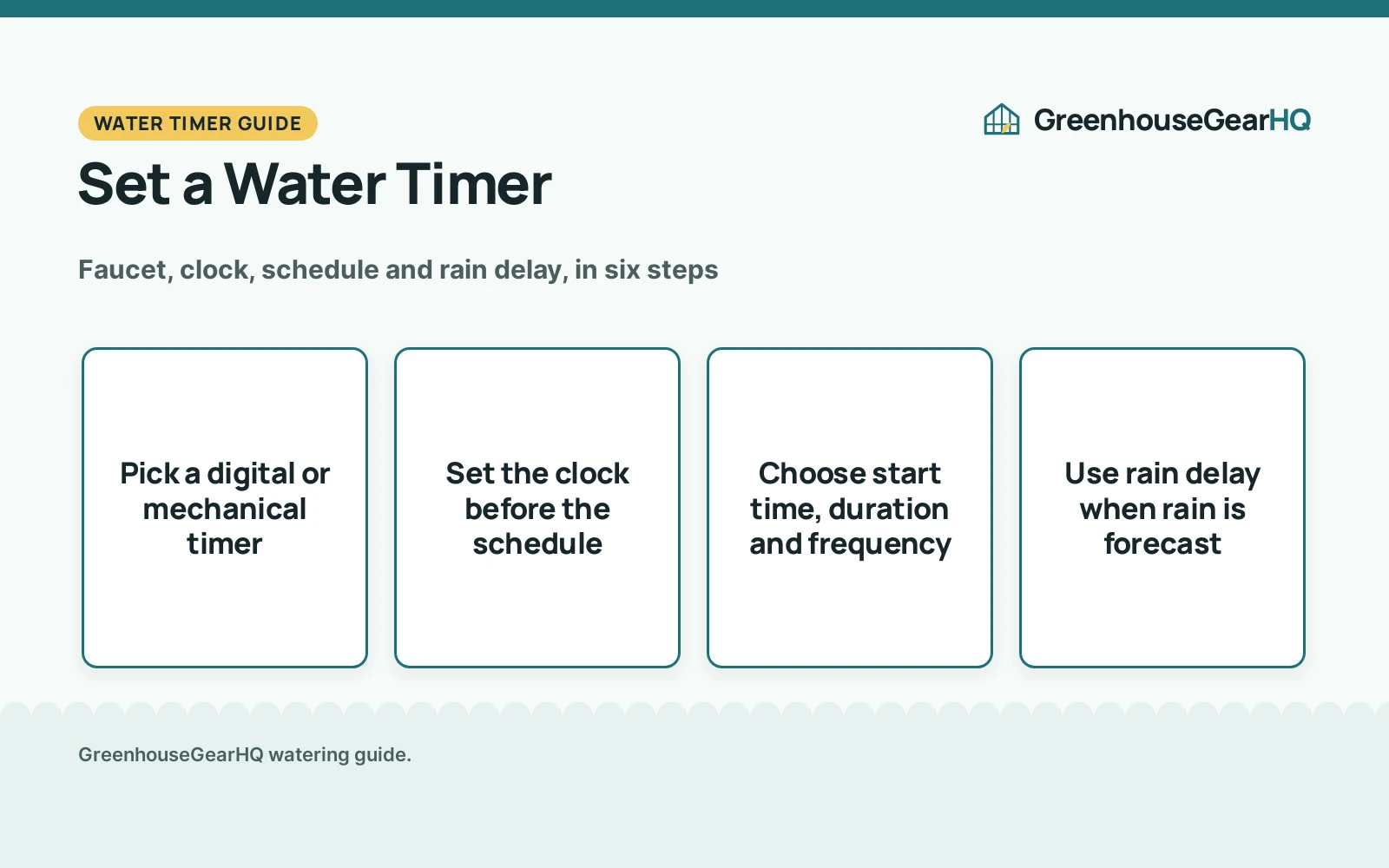
A hot July afternoon is a bad time to discover the greenhouse beds only got water when you remembered, which is why learning how to set water timer schedules pays off before the heat arrives. To set a water timer: attach it to the faucet, set the clock, pick a start time, set how long each watering lasts, set how often it repeats, then confirm the first run. The steps below follow a digital dial timer like the Insoma or Orbit models, whose listings we compared for the figures; where a number appears, it comes from a listing we cite, and we name the listing so you can check it.
Other options worth a look
 Raindrip R560DP Drip Watering SystemCheck price on Amazon
 Raindrip R675CT Analog 3-Dial WaterCheck price on Amazon
 Orbit 27896Check price on Amazon
GreenhouseGearHQ earns a commission when you buy through links on this page, at no extra cost to you. As an Amazon Associate I earn from qualifying purchases. Affiliate disclosure.
Pick the timer type first
Timers come in two families. A digital timer, like the Orbit digital hose timer or the RAINPOINT 2-zone timer, programs start time, duration and frequency on a screen. The Orbit digital lists a watering duration of 1 to 240 minutes and a frequency of 6 hours to 7 days, while the RAINPOINT 2-zone lists a duration of 1 minute to 3 hours 59 minutes and a frequency of 1 hour to 12 hours and 1 day to 7 days. A mechanical timer, like the Orbit mechanical model, uses a dial only: the bullets say set watering times from 15 to 120 minutes, no batteries, with a manual bypass. Note a contradiction in that listing: the spec table lists a different duration range, so trust the dial and the bullets. For beds with different needs, a multi-zone timer waters each zone on its own schedule; the Melnor 4-zone (on Amazon) model waters as often as every hour or as little as once a week per valve, up to 6 hours per cycle, and the RAINPOINT 2-zone programs two zones separately. See our automatic water timer for garden picks and the water timer for soaker hose guide for more models.
How to set water timer: step by step
Step 1: Attach the timer to the faucet
Screw the timer onto a standard outdoor faucet. The RAINPOINT 2-zone timer lists a 3/4 inch interface, so check your faucet size before ordering. The Insoma timer includes a reducing hex bushing and thread seal tape to fit different faucets and stop leaks. Check your water pressure too: the Insoma states an operating range of 7.25 to 116 psi, the RAINPOINT brass-inlet model states up to 116 psi, and the RAINPOINT plastic model states a maximum of 180 psi. Hand-tighten only, then turn the faucet on and check for drips at the joint before programming.
Step 2: Install batteries, if it needs them
Digital timers run on batteries. The Orbit digital, the Insoma and the Melnor each state 2 AA batteries, not included; the Insoma listing says its batteries run for over 6 months, and the Orbit digital spec table lists a battery life of 1000 hours. The RAINPOINT 2-zone shows a low-battery notice and closes the valve automatically if the battery runs low. The mechanical Orbit timer is battery-free by design.
Step 3: Set the clock, then the start time
Set the current time first; every schedule counts from it. Then set the start time for the first watering. Early morning is the usual choice, since the timer runs whether or not you are home. On dial models like the Insoma, the listed order is clock, frequency, duration, start time, then auto.
Step 4: Set how long each watering lasts
Choose a duration within your timer’s stated range. The Orbit digital allows 1 to 240 minutes, the RAINPOINT 2-zone 1 minute to 3 hours 59 minutes, the Insoma 1 minute to 23 hours 59 minutes, and the Melnor 1 minute to 6 hours. The mechanical Orbit dial sets 15 to 120 minutes. Match the duration to the watering device downstream: drip lines and soaker hoses water slowly over longer cycles, while a sprinkler or mister covers the area quickly.
Step 5: Set how often it repeats
Choose the frequency within the stated range: the Orbit digital runs every 6 hours to every 7 days, the RAINPOINT 2-zone every 1 to 12 hours or every 1 to 7 days, the Insoma every 1 minute to 23 hours 59 minutes or every 1 to 7 days, and the Melnor hourly to weekly. On multi-zone timers, program each zone separately; the RAINPOINT 2-zone lets you set specific start times and durations per zone.
Step 6: Confirm the first run, then set rain delay and manual mode
Use manual mode to run a short watering right away and confirm water reaches every plant. The Insoma and RAINPOINT listings include a manual mode that does not disturb the programmed schedule, and the Melnor has a manual option for opening the faucet on demand. Then set rain delay so the timer pauses itself when rain is forecast: the RAINPOINT models pause 24, 48 or 72 hours, the Insoma pauses 1 to 7 days, the Melnor has a 7-day rain delay, and the Orbit digital lists a built-in rain delay. The Insoma also lists a child lock to keep the program safe from accidental button presses.
| Timer listing | Stated duration range | Stated frequency range | Stated rain delay |
|---|---|---|---|
| Orbit digital hose timer 56082 | 1 to 240 minutes | 6 hours to 7 days | Built-in rain delay |
| Orbit mechanical timer 62034 | 15 to 120 minutes | Not stated | Not stated |
| RAINPOINT 2-zone timer | 1 minute to 3 hours 59 minutes | 1 hour to 12 hours, 1 day to 7 days | 24, 48 or 72 hours |
| Insoma hose timer | 1 minute to 23 hours 59 minutes | 1 minute to 23 hours 59 minutes, 1 to 7 days | 1 to 7 days |
| Melnor 4-zone timer 65140AMZ | 1 minute to 6 hours | Hourly to weekly | 7-day rain delay |
All figures are the makers’ stated claims. The mechanical Orbit timer sets duration on a dial only; its spec table lists a different range, so go by the dial.
Where a water timer fits in the greenhouse
A timer controls the schedule, not the delivery. Pair it with the watering hardware that suits your beds: drip lines and soaker hoses for rows, misting for seedling propagation and humidity. Our drip irrigation system for vegetable garden guide compares kits, and the misting system for seedling propagation guide covers fine-mist setups for young plants. Check the timer’s weather rating for the spot where it hangs: the RAINPOINT 2-zone lists an IP65 waterproof rating and the Insoma lists IP55, while the Orbit digital is described as water-resistant. Keep the timer off the ground where hose spray and puddles cannot reach it.
FAQ for growers
What do I set first on a digital water timer?
Set the clock first, then start time, duration and frequency. The Insoma listing gives the order as clock, frequency, duration, start time, then auto mode.
How long can a water timer run in one cycle?
It depends on the model. The Orbit digital lists 1 to 240 minutes, the RAINPOINT 2-zone lists 1 minute to 3 hours 59 minutes, the Insoma lists 1 minute to 23 hours 59 minutes, and the Melnor lists 1 minute to 6 hours.
Do hose water timers need batteries?
Digital ones do. The Orbit digital, Insoma and Melnor listings each state 2 AA batteries, not included; the Insoma runs over 6 months per its listing. The Orbit mechanical timer is battery-free.
What is rain delay on a water timer?
It pauses your schedule when rain is forecast so you do not overwater. The RAINPOINT models pause 24, 48 or 72 hours, the Insoma pauses 1 to 7 days, the Melnor lists a 7-day rain delay, and the Orbit digital lists a built-in rain delay.
Keep reading
See every drip irrigation kits guide and all air and water guides.
More picks: automatic water timer for garden, water timer for soaker hose, drip irrigation vs soaker hose and soaker hose with timer.