On this page
Top picks at a glance
As an Amazon Associate I earn from qualifying purchases.
- 1
 Bootstrap Farmer Dutch Buckets9.6/10View on Amazon
- 2
 Halatool Rockwool and Net Cups9.6/10View on Amazon
- 3
 ORIMERC 3 in Net Pots 12-Pack9.6/10View on Amazon
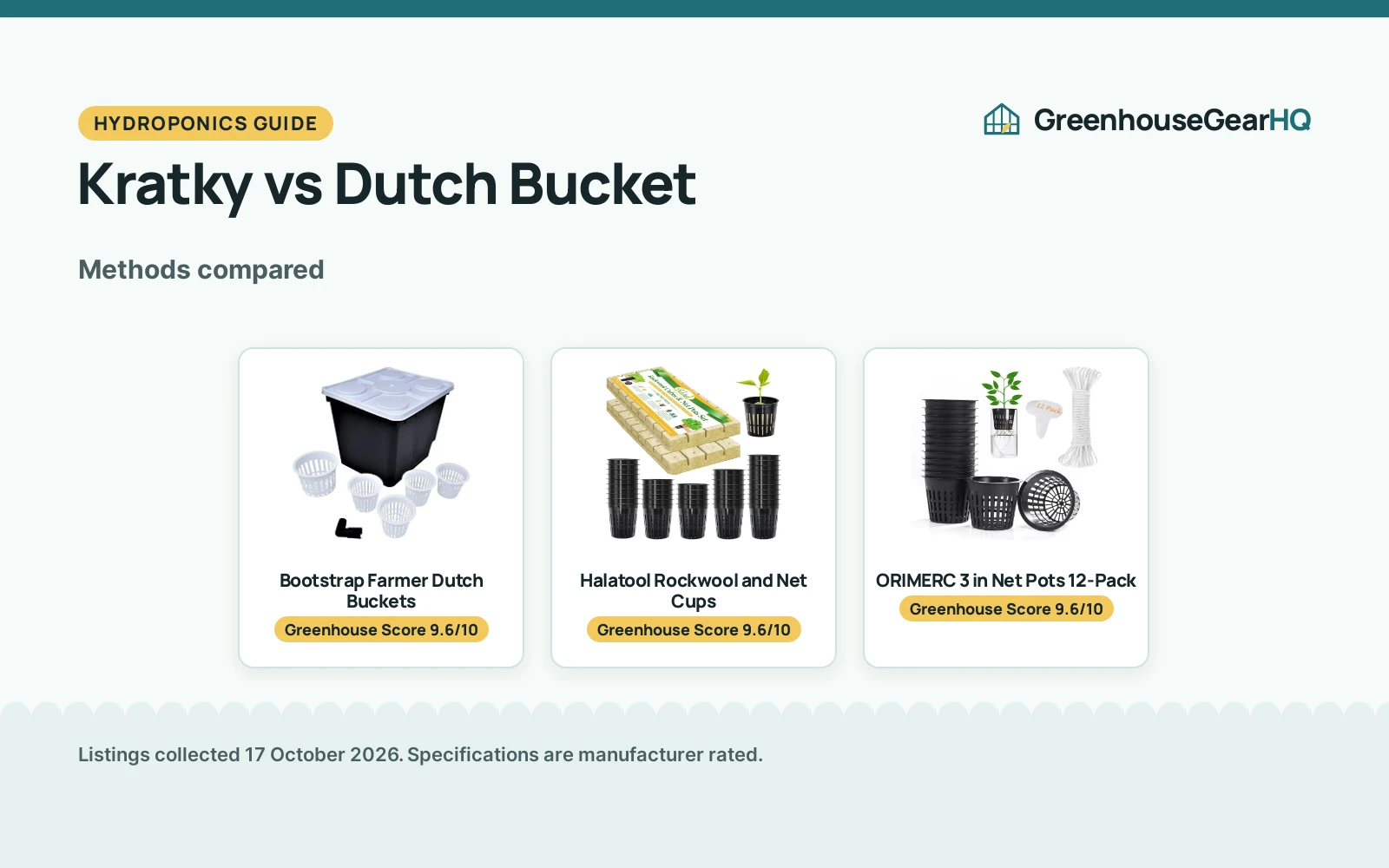
The kratky vs dutch bucket choice comes down to how the nutrient solution reaches the roots: still in a jar or bucket, or pumped through a row of buckets. Kratky is a passive method where the plant sits in a reservoir and the roots grow down as the level drops. A dutch bucket system is an active method where a pump feeds solution to each bucket and drains it back to a central tank. We compared three listings that show the difference: two kratky-side starter sets from ORIMERC and Halatool, and a Bootstrap Farmer dutch bucket set.
GreenhouseGearHQ earns a commission when you buy through links on this page, at no extra cost to you. As an Amazon Associate I earn from qualifying purchases. Affiliate disclosure.
Quick verdict: choose kratky if you want a no-pump, no-power setup for small plants like herbs and lettuce, using net pots in jars or buckets. Choose a dutch bucket system if you want to grow bigger plants like tomatoes in many buckets at once, and you accept a pump, a reservoir and the power they need. The Bootstrap Farmer example includes a built-in reservoir so plants survive a power outage; neither kratky listing needs power at all.
Three examples
| # | Product | Greenhouse Score | Buy |
|---|---|---|---|
| 1 | Bootstrap Farmer Dutch Buckets | 9.6/10 | Buy on Amazon |
| 2 | Halatool Rockwool and Net Cups | 9.6/10 | Buy on Amazon |
| 3 | ORIMERC 3 in Net Pots 12-Pack | 9.6/10 | Buy on Amazon |
Bootstrap Farmer Dutch Buckets
Bootstrap Farmer dutch bucket set: 10 buckets with elbows, lids and 50 net pots, 10 by 10 by 12 in, built-in outage reservoir.
Pros
- 10 buckets with elbows, lids and 50 net pots
- Built-in reservoir for plant survival in power outages
- Suits tomatoes and eggplant in individual buckets
- Black buckets with white lids suit indoor grows
Cons
- No pump, reservoir tank or tubing is stated as included
- Indoor use only, per the spec table
- No warranty term is stated
- 10-pound set needs a sturdy bench or floor spot

Halatool Rockwool and Net Cups
Halatool kratky starter set: 72 1.2-inch rockwool cubes and 56 2-inch net cups for seedlings, cuttings and clones.
Pros
- 72 rockwool cubes and 56 net cups, a full starter kit
- Rockwool holds moisture with strong air permeability
- Suits seedlings, cuttings and clones for soilless starts
- Net cups are reusable after the plant moves on
Cons
- Rockwool needs gloves and mask to handle
- Net cups are reusable but rockwool cubes are not
- No warranty term is stated
- Soak cubes briefly to adjust EC and pH before sowing

ORIMERC 3 in Net Pots 12-Pack
ORIMERC kratky 12-pack: 3-inch net pots, 12-foot capillary wick cord and 12 plant labels, polypropylene.
Pros
- Net pots with slotted mesh for air circulation
- 12-foot capillary wick cord for self-watering
- Extra wide 3.2 in lip fits pre-drilled holes
- Suits jars, 5-gallon buckets and aquaponics tanks
Cons
- No warranty term is stated
- 16 oz weight for the 12-pack is light for heavy use
As an Amazon Associate I earn from qualifying purchases.
Other options worth a look
 Rubber Grommets Water Seal Hydroponics Dutch Bucket for useCheck price on Amazon
 Vinyl Downspout End caps Size 3x4- N.F.T System/Kratky MethodCheck price on Amazon
Kratky vs dutch bucket: side by side
| Example | Greenhouse Score | Side | Kit | Power | Amazon |
|---|---|---|---|---|---|
| Bootstrap Farmer Dutch Buckets | 9.6/10 | Dutch bucket | 10 buckets + 50 net pots | Pump needed | View on Amazon |
| Halatool Rockwool and Net Cups | 9.6/10 | Kratky | 72 rockwool + 56 cups | None | View on Amazon |
| ORIMERC 3 in Net Pots 12-Pack | 9.6/10 | Kratky | 12 pots + 12 ft wick | None | View on Amazon |
We reproduce the maker’s listed specs without adjustment (collected 17 October 2026).
How each method feeds the roots
Kratky is passive: the ORIMERC example pairs 3-inch net pots with a 12-foot capillary wick cord for self-watering, so the plant draws solution up without a pump. The Halatool example pairs 72 rockwool starter cubes with 56 net cups for seedlings that later move into a kratky jar or bucket. A dutch bucket system is active: the Bootstrap Farmer example gives 10 buckets with elbows, lids and 50 net pots, where a pump (not included) feeds each bucket and solution drains back to a reservoir.
Power and moving parts
Kratky needs no power and no pump, which is its whole appeal: the ORIMERC and Halatool listings describe self-watering and soilless setups with no electrical parts. A dutch bucket system needs a pump and a timer, and the Bootstrap Farmer listing’s built-in reservoir is a backup so plants survive when the power goes out. If your grow has no outlet nearby, kratky wins; if you have power and want many plants, the buckets scale.
Plant size and crop fit
The kratky examples suit small plants: the ORIMERC listing names herbs, lettuce, basil, strawberries and carnivorous plants, and the Halatool listing names seedlings, cuttings and clones. The Bootstrap Farmer dutch bucket example names tomatoes and eggplant, bigger plants that drink more and suit individual buckets with net pots. Do not call a side better on crop size unless the listings state it: here they do, with tomatoes and eggplant only on the bucket side.
Listing gaps to check
The ORIMERC spec table contradicts its title: the title says 12 net pots, 12 feet of wick and 12 labels, while the spec table says 30 net pots, 30 feet of wick and 30 labels, and lists size as 2 inch against 3-inch pots. The Halatool listing advises wearing gloves and a mask when handling rockwool, since the fibers irritate skin and lungs. The Bootstrap Farmer set includes buckets, elbows, lids and net pots, but no pump, reservoir tank or tubing is stated, so budget for those. None of the three listings states a warranty term.
Which should you choose?
Pick kratky if you want the simplest start: a jar or bucket, net pots and no power. The ORIMERC example adds a wick cord for self-watering, and the Halatool example covers the seedling stage with rockwool and net cups. Pick a dutch bucket system if you want a row of buckets for big plants and you have power for a pump; the Bootstrap Farmer example’s built-in reservoir covers outages, but you still need the pump and tank. For more comparisons, see our DWC vs NFT and ebb and flow vs DWC.
In the Greenhouse
- Start seedlings in the Halatool rockwool cubes, then move rooted plants into kratky net pots.
- Wear gloves and a mask when handling rockwool, per the Halatool warm tips.
- Count the net pots before ordering: the ORIMERC title and spec table disagree on 12 versus 30.
- Plan the pump and reservoir before buying the Bootstrap Farmer buckets, since neither is included.
Scoring notes
The Greenhouse Score weighs performance (fit for the method, kit completeness and build), build, value, safety and warranty. The Bootstrap Farmer dutch bucket set leads on completeness with 10 buckets and 50 net pots. For hydroponics, safety would mean a stated food-safe material, and none of the three listings names one, so no safety points were given. None of the three listings states a warranty term.
FAQ for growers
Does a kratky setup need a pump?
No. Kratky is passive: the ORIMERC and Halatool examples need no pump or power, unlike a dutch bucket system.
What can I grow with a dutch bucket system?
The Bootstrap Farmer listing names tomatoes and eggplant, bigger plants suited to individual buckets.
Do the kratky examples include wicks?
The ORIMERC example includes a 12-foot capillary wick cord for self-watering, though its spec table says 30 feet.
Is there a warranty on these kits?
None of the three listings states a warranty term, so buy with that in mind and check the listing at purchase time.
Keep reading
See every hydroponic systems guide and all indoor growing guides. Also see our best hydroponic kit for herbs.
More picks: DWC vs NFT, ebb and flow vs DWC, hydroponic kits for lettuce and pumps for small hydroponic systems.