On this page
Top picks at a glance
As an Amazon Associate I earn from qualifying purchases.
- 1
 Bootstrap Farmer Dutch Bucket Set 10-Pack9.6/10View on Amazon
- 2
 DPROOTS 36 Sites NFT Hydroponic Growing System with Grow9.6/10View on Amazon
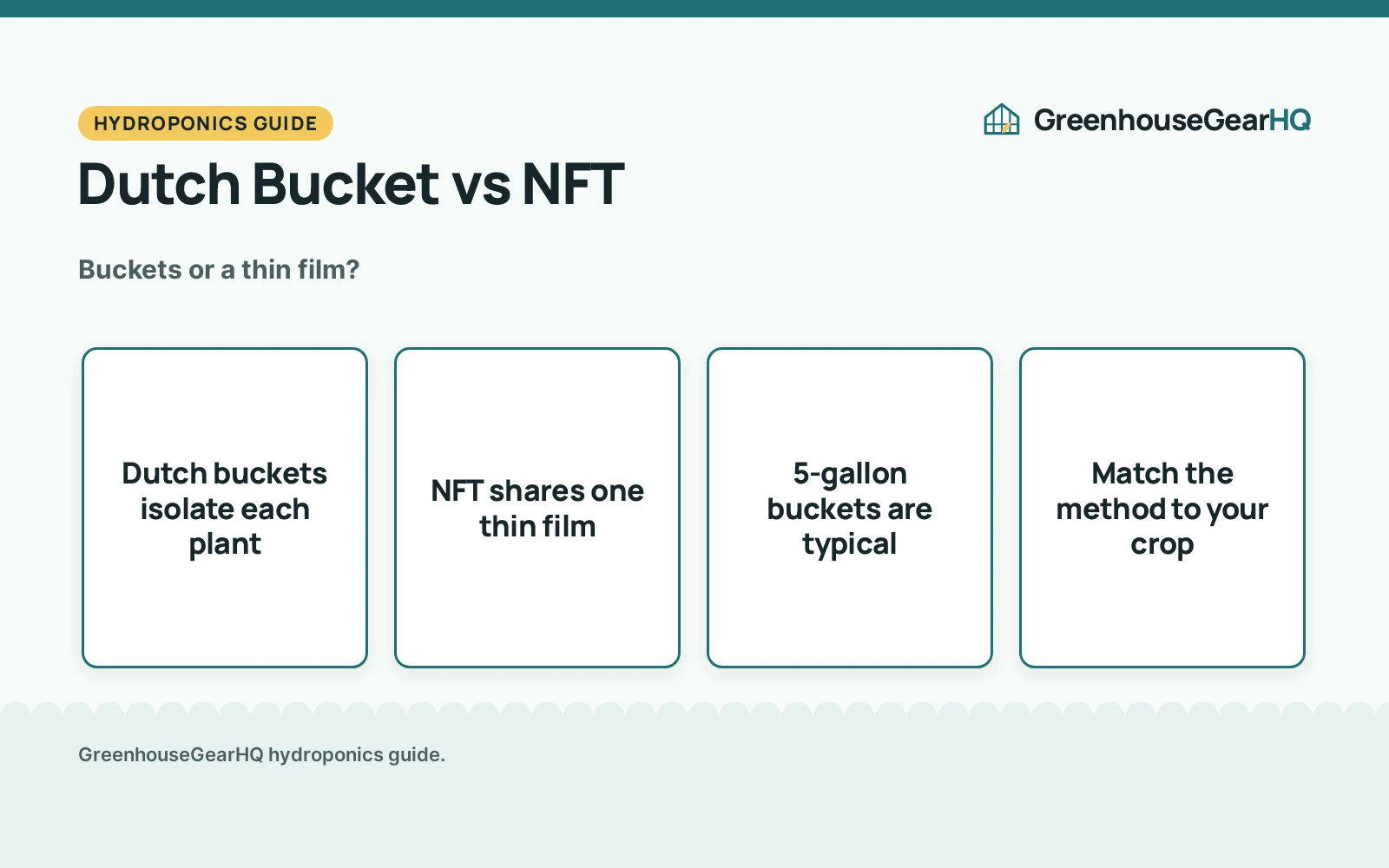
Dutch bucket vs NFT comes down to where the roots live: dutch buckets give each plant its own bucket of growing medium with a drip emitter on top, while NFT runs a thin film of nutrient solution through channels that the roots sit in. Pick dutch buckets for large, thirsty plants like tomatoes that need root room, and pick NFT for leafy greens in a compact, level setup. Where a number appears below, it comes from a product listing we compared.
GreenhouseGearHQ earns a commission when you buy through links on this page, at no extra cost to you. As an Amazon Associate I earn from qualifying purchases. Affiliate disclosure.
Dutch bucket vs NFT: the core difference
A dutch bucket system is a row of individual containers, each holding one plant in growing medium, fed by drip emitters from a shared reservoir, with excess draining back. NFT, or nutrient film technique, skips the containers: plants sit in net pots in sloped channels, and a pump sends a shallow, constant film of nutrient solution past the bare roots. Buckets isolate each plant; channels share one stream.
| Aspect | Dutch bucket | NFT |
|---|---|---|
| Root zone | Individual bucket of medium | Bare roots in a channel |
| Water delivery | Drip emitter per plant | Constant thin film |
| Suits | Large fruiting plants | Leafy greens and herbs |
| If the pump stops | Medium holds moisture | Film stops at once |
| Container in our data | 5-gallon buckets | No channel figures listed |
How dutch buckets behave
Each bucket is its own growing site. A 5-gallon bucket listing we compared measures 11.9 inches across and 14.56 inches high in 90 mil HDPE, a typical container scale for a single large plant. Drip emitters on a timer feed each bucket from above, and the drain returns solution to the reservoir. Because plants are isolated, one sick plant does not share its water with the rest, and you can add or remove buckets without rebuilding the system. The tradeoff is plumbing per bucket: every emitter and drain line is one more part to check.
How NFT behaves
NFT is the minimalist option: sloped channels, a reservoir, and a pump running a constant thin film. Roots dangle in the film and take what they need. That suits lettuce and herbs that like steady feeding, and the setup uses little growing medium. The tradeoff is fragility: if the pump stops, the film stops with it, and bare roots dry quickly. Channels must also stay level side to side so the film covers every root zone evenly.
Size and scale
Dutch buckets scale by count: more plants means more buckets, each around the 5-gallon size in our data. A 6-pack of 5-gallon buckets weighs 6.72 kg in the listing, which hints at the storage footprint of a multi-bucket build. NFT scales by channel length instead, keeping one reservoir and one pump for the whole run. For aeration figures at bucket scale, the VEVOR DWC listing runs an 8W air pump at 110V/60Hz pushing 4 x 4L/min through 4 air stones in 5-gallon buckets, with a 6m air hose and 4 check valves in the kit.
Which should you choose?
Choose dutch buckets if you grow large plants and want each one isolated in its own container with its own emitter. The 5-gallon bucket scale in our data fits that job. Choose NFT if you grow leafy greens and want the simplest plumbing: one pump, one film, no medium to buy. For the bucket version of recirculating deep water, see our RDWC vs DWC guide, and for NFT against another bucket method, DWC vs NFT hydroponics. Growers comparing drip-fed buckets with misted roots should read dutch bucket vs aeroponics.
FAQ for growers
What is a dutch bucket system?
Individual buckets, usually around 5 gallons, each holding one plant in growing medium with a drip emitter on top and a drain back to the reservoir.
What does NFT stand for?
Nutrient film technique: a shallow, constant film of nutrient solution flows through channels past the plants’ roots.
Which is better for tomatoes?
Dutch buckets. Large fruiting plants want the root room a bucket gives; the 5-gallon bucket listing in our data measures 11.9 by 14.56 inches, a typical container for a single large plant.
Which uses less growing medium?
NFT. The roots sit in the film with little or no medium, while each dutch bucket must be filled.
Keep reading
See every hydroponic system guide and all indoor growing guides.
More picks: RDWC vs NFT, Kratky vs dutch bucket and pump for small hydroponic system.