On this page
Top picks at a glance
As an Amazon Associate I earn from qualifying purchases.
- 1
 PROTOPIA CMH 315W 4000K Grow Light Bulb9.6/10View on Amazon
- 2
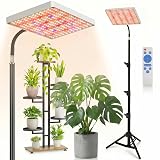 2026 LED Grow Lights with Stand9.6/10View on Amazon
- 3
 LBW Grow Lights for Indoor Plants9.6/10View on Amazon
- 4
 yadoker Plant Grow LightView on Amazon
- 5
 3-Pack Rechargeable Grow Light for Indoor PlantsView on Amazon
- 6
 GooingTop Grow LightView on Amazon
- 7
 LORDEM Bamboo Grow Light for Indoor PlantsView on Amazon
- 8
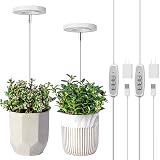 LORDEM Grow Light for Indoor PlantsView on Amazon
- 9
 LORDEM Full Spectrum LED Grow Light for Indoor Plants HeightView on Amazon
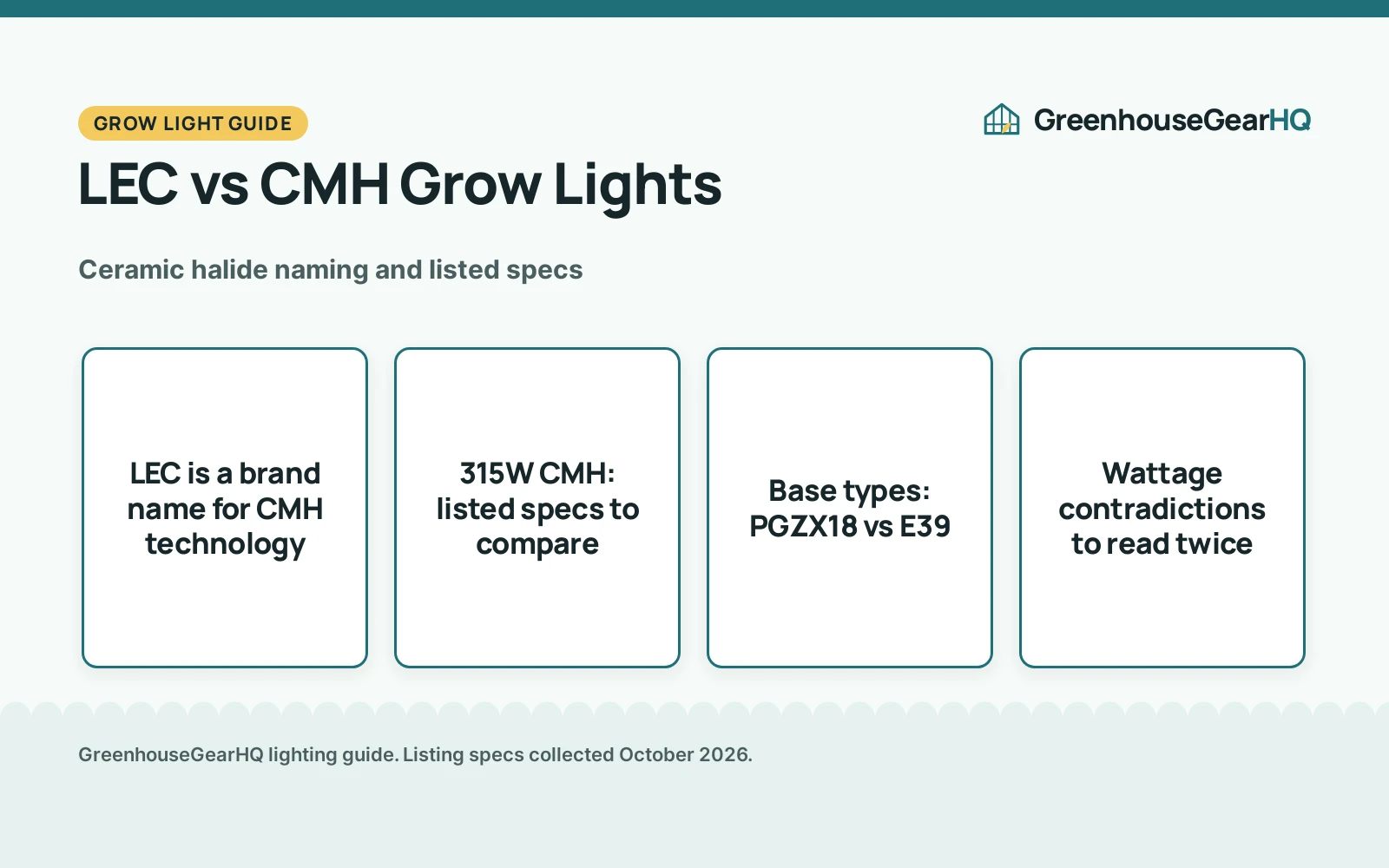
In October, when the greenhouse starts needing supplemental light by late afternoon, the catalog names get confusing fast. The lec vs cmh grow lights question has a twist: LEC and CMH are the same bulb technology. CMH stands for ceramic metal halide; LEC, light emitting ceramic, is a brand name for that same ceramic halide technology. We compared listings to explain the naming, the listed specs and what to check before you buy. Every number below comes from a product listing; where a listing gives no figure, we say so.
Other options worth a look
 yadoker Plant Grow LightCheck price on Amazon
 3-Pack Rechargeable Grow Light for Indoor PlantsCheck price on Amazon
 GooingTop Grow LightCheck price on Amazon
 LORDEM Bamboo Grow Light for Indoor PlantsCheck price on Amazon
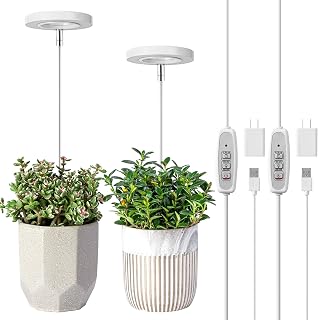 LORDEM Grow Light for Indoor PlantsCheck price on Amazon
 LORDEM Full Spectrum LED Grow Light for Indoor Plants HeightCheck price on Amazon
GreenhouseGearHQ earns a commission when you buy through links on this page, at no extra cost to you. As an Amazon Associate I earn from qualifying purchases. Affiliate disclosure.
Lec vs cmh grow lights: the short answer
There is no technology to choose between: LEC is a trademarked name for CMH bulbs, so compare individual bulbs on watts, color temperature and listed life. The GRUOTVSZAK CMH listing gives 315 watts with 590 μmol/s at 4200K and 625 μmol/s at 3000K, a PGZX18 base and over 20,000 hours of life. If you would rather compare light types, our LED vs HPS grow lights guide covers the bigger choice.
What CMH is
Ceramic metal halide is a high-intensity discharge technology: a ceramic arc tube runs hotter and more stable than the quartz tube in older metal halide bulbs, which gives a fuller spectrum. The listings show the shape of the market: the GRUOTVSZAK CMH bulbs list 315 watts in 3000K and 4200K versions, sold as a pack of 2, with a 5-minute warm-up and a 7-minute cool-down after use. For comparison, the Vegelumax 600W metal halide lists 55,000 lumens, 810 μmol/s photon flux and a 12,000-hour rated life on an E39 base.
What LEC is
LEC, light emitting ceramic, is a brand name, not a separate technology: it labels CMH bulbs sold under that trademark. When a listing says LEC, read it as CMH and compare the same figures: watts, color temperature in kelvin, base type and rated life. A 315W CMH bulb is a 315W LEC bulb; the name on the box does not change the arc tube inside. Watch the ballast too: the GRUOTVSZAK listing says low frequency ballasts are recommended for its PGZX18 bulbs.
LEC vs CMH at a glance
| Name | What it is | Listed wattage here | What to compare |
|---|---|---|---|
| CMH | Ceramic metal halide, the generic technology | 315W | Kelvin, μmol/s, base, life |
| LEC | Brand name for CMH bulbs | Same as CMH | Same figures, ignore the label |
| MH (for reference) | Older quartz metal halide | 600W | 55,000 lumens, 12,000-hour life |
Which should you buy?
Buy the bulb, not the acronym. Compare 315W CMH listings on color temperature, listed μmol/s and rated life: the GRUOTVSZAK pack lists 590 μmol/s at 4200K and over 20,000 hours. Confirm the base matches your fixture: PGZX18 for the listed CMH bulbs, E39 for the metal halide. Then check ballast compatibility before you order.
Read our full spectrum vs blurple grow lights guide for the LED side of the choice.
Read the listing twice
Grow light listings contradict themselves on watts and output:
- GRUOTVSZAK CMH: the title says 590 and 625 μmol/s while the spec table lists a “1150μmol PPF” feature.
- GLOWRIUM: the title says 48W while the spec table lists 24 watts.
- Barrina OG11A2: the title says 22W while the spec table lists 11 watts.
Trust the title and bullets over the spec table, and confirm the base type in the listing: it must match your fixture.
What this guide does not cover
This guide covers bulb naming only. It does not cover ballast wiring, hanging height or light schedules, which depend on the fixture and the crop. The ballast maker’s manual gives those figures, and your local extension office can advise on timing for your area.
FAQ for growers
Is LEC better than CMH?
Neither is better: they are the same ceramic metal halide technology under two names. Compare bulbs on watts, kelvin, μmol/s and rated life instead.
What wattage are CMH bulbs?
The listings here show 315W CMH bulbs; the older metal halide listing shows 600W. Wattage varies by bulb, so check the listing.
How long do CMH bulbs last?
The GRUOTVSZAK CMH listing claims over 20,000 hours of life with 90% output maintenance for 10,000 hours. The Vegelumax metal halide lists a 12,000-hour rated life.
Do CMH bulbs need a special ballast?
The GRUOTVSZAK listing says its bulbs fit PGZX18 fixtures and recommends low frequency ballasts. Match the ballast to the bulb’s stated requirements.
Keep reading
See every grow light guide and all light and heat guides.
More picks: LED vs HPS grow lights, full spectrum vs blurple grow lights and UV vs IR grow lights.