On this page
Top picks at a glance
As an Amazon Associate I earn from qualifying purchases.
- 1
 VIVOSUN Digital pH Meter with 3-in-1 TDS/EC/Temperature Meter9.3/10View on Amazon
- 2
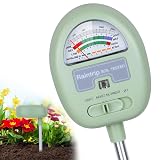 Raintrip Soil Moisture Meter9.3/10View on Amazon
- 3
 EKOOTIMO 4-in-1 TDS EC Temperature Meter9.7/10View on Amazon
- 4
 Quantum PAR Meter Full-Spectrum High Precision PPFD TesterView on Amazon
- 5
 PARView on Amazon
- 6
 PAR Meter for LED Grow LightsView on Amazon
- 7
 PAR Meter for Grow LightsView on Amazon
- 8
 PHOTOBIO Advanced Quantum PAR MeterView on Amazon
- 9
 Apogee Instruments MQ-500 Full-Spectrum Quantum PAR Meter &View on Amazon
Late winter seed trays sit under grow lights while frost still holds the garden outside, and the question soon follows the first pale seedlings: is the light strong enough where the leaves sit. Light meter cost is the first thing most growers check before they buy a meter, and the answer depends on the kind of meter, the range it reads and the features it carries. This guide explains each meter type, what drives its price, and how to match a meter to the lights over your trays and benches.
Other options worth a look
 Quantum PAR Meter Full-Spectrum High Precision PPFD TesterCheck price on Amazon
 PARCheck price on Amazon
 PAR Meter for LED Grow LightsCheck price on Amazon
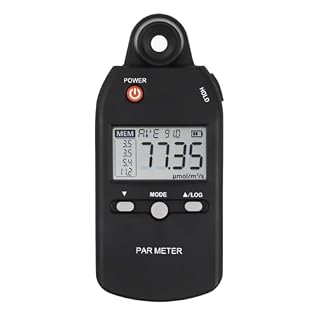 PAR Meter for Grow LightsCheck price on Amazon
 PHOTOBIO Advanced Quantum PAR MeterCheck price on Amazon
 Apogee Instruments MQ-500 Full-Spectrum Quantum PAR Meter &Check price on Amazon
GreenhouseGearHQ earns a commission when you buy through links on this page, at no extra cost to you. As an Amazon Associate I earn from qualifying purchases. Affiliate disclosure.
What decides light meter cost
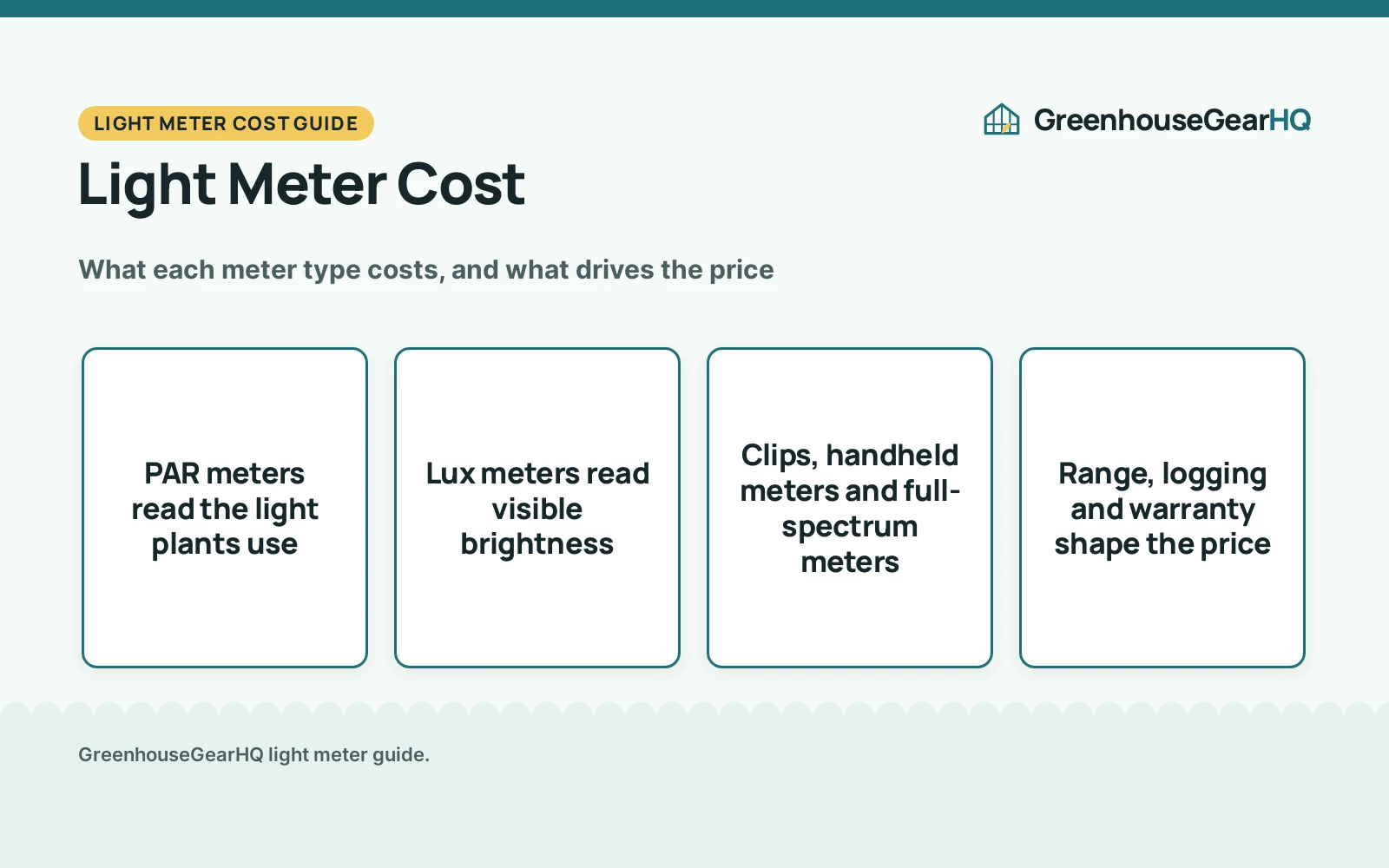
Meter type sets the shape of the price. A clip that turns a phone into a PAR meter, a handheld lux meter and a full-spectrum PAR meter with a remote sensor are different tools, and each one carries a different set of parts. The EvoDevice clip (on Amazon) works with its companion PAR app on an iPhone and reads PPFD from grow lights, while handheld meters carry their own sensor, screen and batteries. A handheld lux meter such as the CEILSTES model reads visible brightness from 0 to 400,000 Lux, and a PAR meter such as the Landtek model reads from 0 to 5000 μmol/m²/sec across 400 to 700 nm.
Range and features push the price up or down. A wider range, a remote sensor on a cable, data logging and a longer stated warranty each add parts or work to the meter. The PHOTOBIO meter (on Amazon) lists a remote sensor with two connection cables, a short-coiled cable and a 12’ long-straight cable, and storage for up to 99 readings. The DANOPLUS DP-530 reads PPFD, UVA and IR across 320 to 800 nm and stores up to 30 measurements. The Apogee MQ-500 bundle lists a telescopic wand that extends up to 36.25” (92cm) and a four-year warranty.
| Meter type | What it measures | Stated range or feature |
|---|---|---|
| Phone clip (EvoDevice) | PPFD from grow lights | Full Spectrum + 660 nm profiles, iOS 17 or later |
| Handheld lux meter (CEILSTES) | Visible brightness, temperature, humidity | 0 to 400,000 Lux, 1-year warranty |
| Handheld PAR meter (Landtek) | PPFD and lux | 0 to 5000 μmol/m²/sec, 400 to 700 nm, 100-point log |
| Full-spectrum PAR meter (Apogee) | PPFD from any light source | 400 to 700 nm, wand to 36.25” (92cm), four-year warranty |
How to match a meter to your lights
Step 1: Decide between PAR and lux
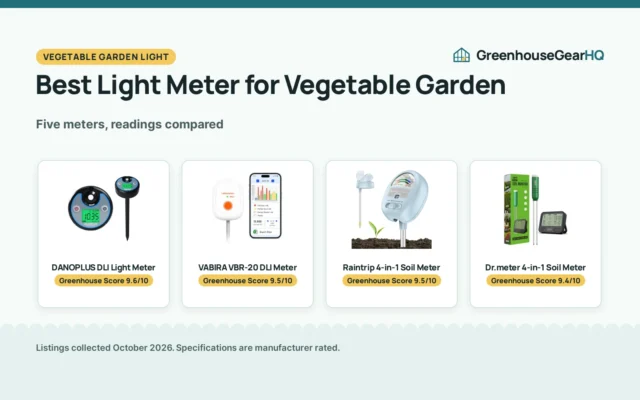
A PAR meter reads the light plants use for photosynthesis, in the 400 to 700 nm band, while a lux meter reads visible brightness in lux. If you want to set light height and dimmer levels for seedlings, a PAR meter that reads PPFD fits the job. If you want a general brightness reading across a bench, a lux meter that reads from 0 to 200,000 Lux, such as the Rckskaya model, or from 0 to 400,000 Lux, such as the CEILSTES model, covers the range. Our best light meter for vegetable garden picks compare handheld meters side by side.
Step 2: Check the stated range
Match the range to the lights you own. The Elaphodus meter (on Amazon) reads from 0 to 4,000 µmol/m²s and the Landtek meter (on Amazon) from 0 to 5000 μmol/m²/sec, so both cover the PPFD band growers check at canopy height. The Mcbazel lux meter (on Amazon) reads from 0 to 200,000 Lux (20,000 FC) with an accuracy of ±(3%+5 Lux) under incandescent light and ±(6%+5 Lux) under other visible light sources including LED. A meter that stops short of your strongest light leaves you guessing at the top of its range.
Step 3: Look at logging, sensor and mount
Logging and a remote sensor change how you use the meter. The DANOPLUS DP355 stores up to 100 measured values and shows the last four recorded data on screen, the Landtek meter logs 100 points in 4 sets x 25 readings with min, max and avg auto-calculated, and the PHOTOBIO meter stores up to 99 readings. A remote sensor on a 12’ cable reaches across a canopy without moving the light, and a 1/4 inch thread on the Landtek meter fits a tripod or selfie stick mount. The DANOPLUS DP355 also lists a tripod socket.
Step 4: Check power, auto-off and warranty
Power and warranty shape the running cost and the cover you get. The CEILSTES meter runs on Type-C power or 3 AA batteries and lists a 1-year full warranty, the Mcbazel meter runs on 3 x AAA batteries for approx. 20 hours of continuous measurement and lists a 1 Year warranty, and the Rckskaya meter lists a 2 Year Manufacturer warranty. The Mcbazel meter switches off after a 10-minute Auto-Off, which can be disabled for long monitoring, and the Landtek meter switches off after 3 minutes. The Apogee meter lists a four-year warranty and a US-based support team.
Where a meter earns its keep in the greenhouse
A meter earns its keep when lights change through the season. In late winter, seed trays move under lights while days stay short, and a reading at canopy height shows whether the light reaches the leaves. In summer heat, a meter shows how much light reaches shaded benches under shade cloth. On frost nights, when trays move inside and lights run longer, a reading before lights-out shows the setup is even across the bench. Our grow light set up guide covers hanging and spacing, and our types of grow lights guide explains the light sources a meter reads.
FAQ for growers
Do I need a PAR meter or a lux meter for grow lights?
A PAR meter fits plant light: it reads PPFD in the 400 to 700 nm band, which is the band the listings link to photosynthesis. A lux meter reads visible brightness in lux, which suits a general check of bench brightness. If you grow under LED lights and want to set height and dimmer levels, a PAR meter is the direct tool.
What range should a light meter cover for a greenhouse?
Cover the strongest light you own. Handheld PAR meters in the listings read from 0 to 5000 μmol/m²/sec, and handheld lux meters read from 0 to 200,000 Lux or 0 to 400,000 Lux. Check the stated range against your lights before you buy, since a meter that stops short leaves the top of your range unread.
Can a phone clip replace a handheld PAR meter?
A clip can work if you already carry the phone it needs. The EvoDevice clip works with its companion PAR app on iPhone devices running iOS 17 or later, and Android devices are not supported. A handheld meter works on its own, stores readings, and needs no phone: the DANOPLUS DP355 stores up to 100 values and the Elaphodus meter stores 99.
Does a longer warranty mean a meter costs more?
Not on its own. Warranty is one feature among several: the Apogee meter lists a four-year warranty, the Rckskaya meter lists a 2 Year Manufacturer warranty, and the CEILSTES and Mcbazel meters list a 1 Year warranty. Weigh warranty with range, logging and sensor type, and read the stated term in the listing before you buy.
Keep reading
See every Indoor Growing guide and all Light and Heat guides. Also see our best light meter for vegetable garden picks. Also see our best indoor grow light roundup. Also see our plant grow light color chart.
More picks: types of grow lights, best indoor grow light, best soil moisture meter and what is the best grow light.