On this page
Top picks at a glance
As an Amazon Associate I earn from qualifying purchases.
- 1
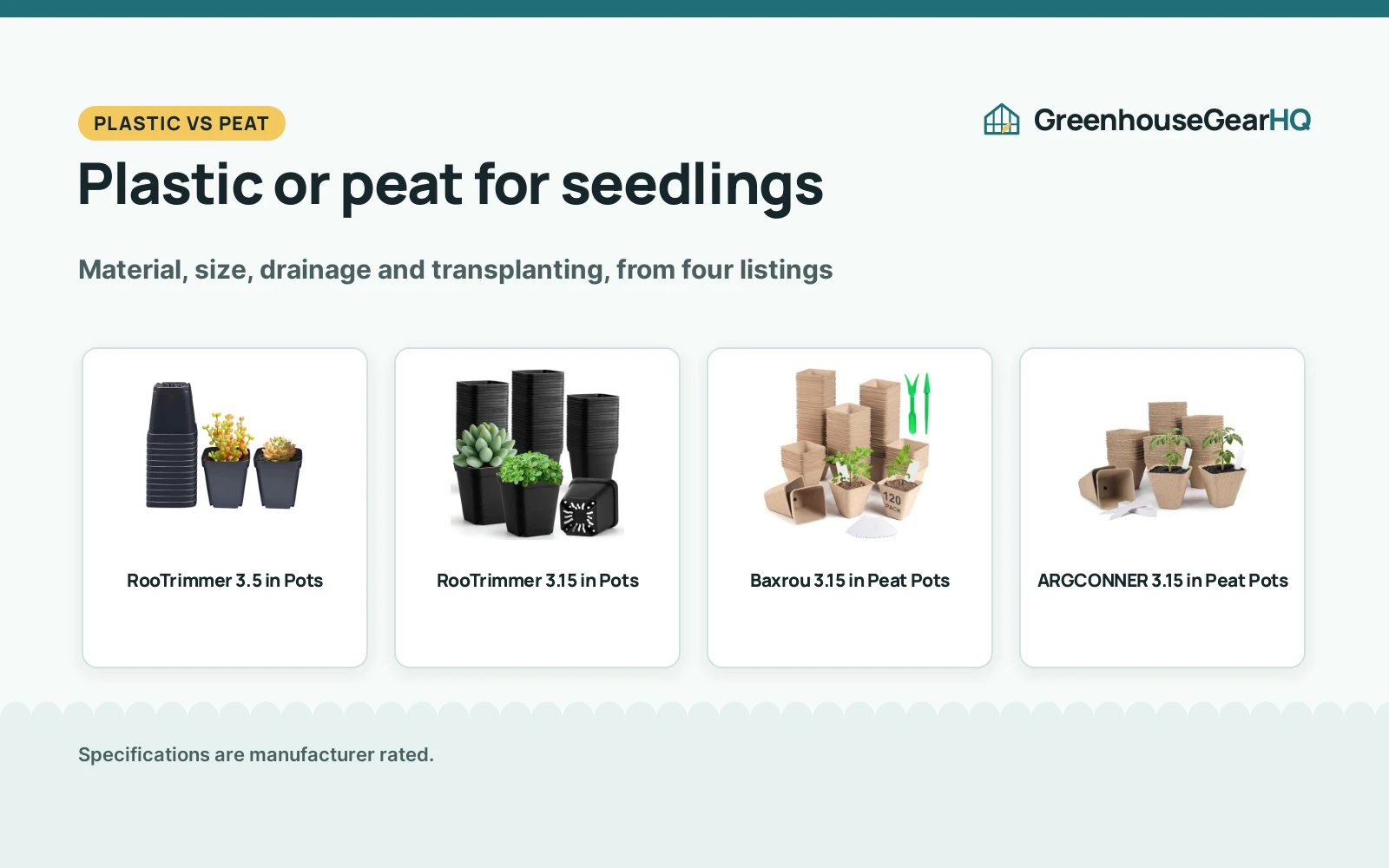
 RooTrimmer 3.5 in Pots9.6/10View on Amazon
- 2
 RooTrimmer 3.15 in Pots9.6/10View on Amazon
- 3
 Baxrou 3.15 in Peat Pots9.6/10View on Amazon
- 4
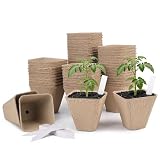 ARGCONNER 3.15 in Peat Pots9.6/10View on Amazon
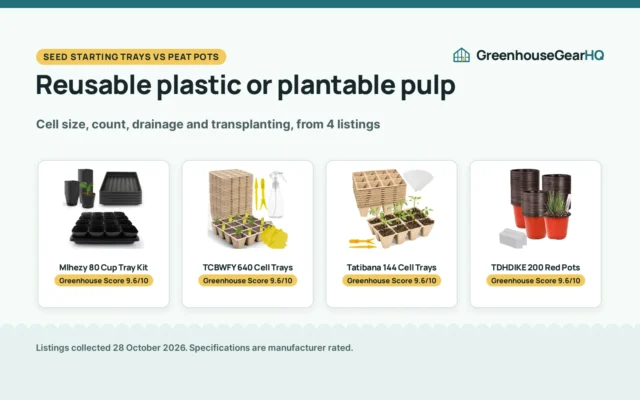
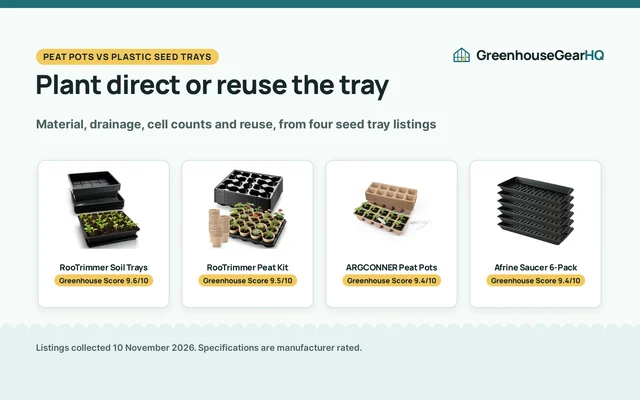
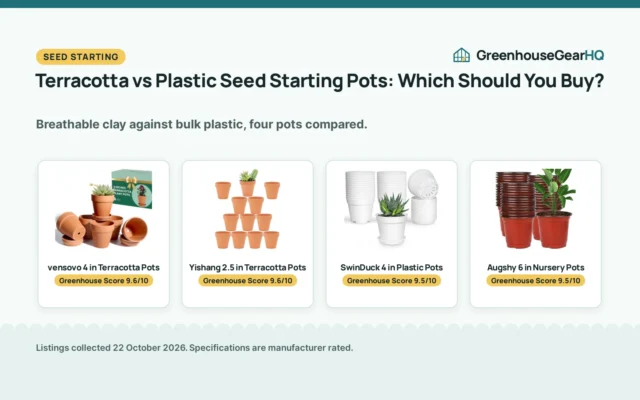
Late winter brings seed trays to the windowsill, and the plastic vs peat seed starting pots choice decides how seedlings leave the tray: lifted out of a reusable pot, or planted pot and all. This guide compares plastic and peat pots side by side, to show where they differ.
GreenhouseGearHQ earns a commission when you buy through links on this page, at no extra cost to you. As an Amazon Associate I earn from qualifying purchases. Affiliate disclosure.
Quick verdict: choose plastic if you want pots that last season after season, lift out cleanly, and fit standard trays. Choose peat if you want to plant pot and all, with roots growing through the wall and less transplant shock.
Two examples
| # | Product | Greenhouse Score | Buy |
|---|---|---|---|
| 1 | RooTrimmer 3.5 in Pots | 9.6/10 | Buy on Amazon |
| 2 | RooTrimmer 3.15 in Pots | 9.6/10 | Buy on Amazon |
| 3 | Baxrou 3.15 in Peat Pots | 9.6/10 | Buy on Amazon |
| 4 | ARGCONNER 3.15 in Peat Pots | 9.6/10 | Buy on Amazon |

RooTrimmer 3.5 in Pots
90 square plastic nursery pots at 3.5 inches, with a tall 4-inch design for 1020 trays.
Pros
- Tall 4-inch design, 30% more soil capacity
- Square pots fit standard 1020 trays
- Small drainage holes promote airflow
- Reusable plastic resists cracking
Cons
- Seedlings must be lifted out
- Reusable pots need storage space
- No plant labels or tools included
- No warranty term is stated

RooTrimmer 3.15 in Pots
100 square plastic nursery pots at 3.15 inches, with flexible walls, fitting 12 per 1015 seed tray.
Pros
- Flexible walls squeeze for root ball removal
- Fits 12 per 1015 seed tray
- Bottom drainage holes for airflow
- PP reuses season after season
Cons
- Seedlings must be lifted out
- 3.15 inch pots suit small seedlings
- No plant labels or tools included
- Plastic pots need storage space

Baxrou 3.15 in Peat Pots
120 square peat pots at 3.15 inches, made of recycled pulp, with 30 labels and 2 tools.
Pros
- Plant pot and all into the soil
- Roots extend through the pulp wall
- 120 pots plus 30 labels and 2 tools
- Drainage holes with moisture retention
Cons
- Single-use pots, planted with the seedling
- Requires more water than plastic pots
- 3.15 inch size suits small seedlings
- 120-pack suits heavy use, not small batches
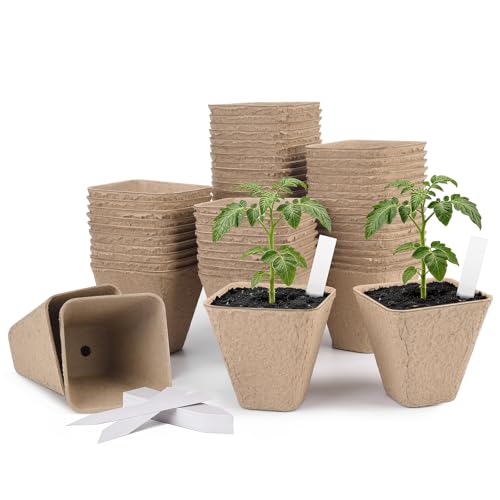
ARGCONNER 3.15 in Peat Pots
60 square peat pots at 3.15 inches, made of molded pulp, with 30 plant labels.
Pros
- Plant pot and all, minimal handling
- Molded pulp with bottom drainage
- 60 pots plus 30 plant labels
- Square shape maximizes tray space
Cons
- Single-use pots, planted with the seedling
- 60 pots is the smallest count here
- No transplant tools included, only labels
- No warranty term is stated
As an Amazon Associate I earn from qualifying purchases.
Plastic vs peat seed starting pots: side by side
| Pot | Greenhouse Score | Material | Size | Count | Transplant | Extras | Amazon |
|---|---|---|---|---|---|---|---|
| RooTrimmer 3.5 in Pots | 9.6/10 | Plastic | 3.5 x 3.5 x 4.0 in | 90 | Lift out | Not stated | View on Amazon |
| RooTrimmer 3.15 in Pots | 9.6/10 | PP plastic | 3.15 x 3.58 in | 100 | Lift out | Not stated | View on Amazon |
| Baxrou 3.15 in Peat Pots | 9.6/10 | Recycled pulp | 3.15 in | 120 | Plant pot and all | 30 labels, 2 tools | View on Amazon |
| ARGCONNER 3.15 in Peat Pots | 9.6/10 | Molded pulp | 3.15 in | 60 | Plant pot and all | 30 labels | View on Amazon |
Size and build specs are the manufacturer’s ratings as published on each listing, gathered 26 November 2026.
Material and reuse
Plastic pots are built to last: the RooTrimmer listings describe sturdy plastic that resists cracking, and the 100-pack uses flexible PP that the maker says withstands years of use without losing shape. Peat pots are made to disappear into the bed: Baxrou uses natural recycled pulp paper, ARGCONNER uses molded pulp, and both say the seedling moves with the pot.
Transplanting
With plastic, the seedling comes out: the 100-pack has flexible walls that squeeze for root ball removal, keeping roots intact. With peat, the pot goes into the ground with the seedling, and Baxrou says roots extend out of the pulp cup, which reduces transplant shock. ARGCONNER says the same in plainer terms, with minimal handling and roots that keep developing after transplanting.
Size, drainage and extras
Size is the one spec both sides state clearly: the plastic side offers a 3.5 inch pot in the 90-pack and a 3.15 inch pot in the 100-pack, while both peat listings are 3.15 inch square pots. The 90-pack fits standard 1020 trays, and the 100-pack fits 12 per 1015 seed tray. Every listing names drainage holes. The peat side bundles more: Baxrou holds 120 pots with 30 labels and 2 tools, and ARGCONNER holds 60 pots with 30 labels, while the plastic side is pots only. For more trays, see the seed starting trays guide.
Which should you choose?
Choose plastic seed starting pots if you start trays every season and want pots that wash, store and reuse, with flexible walls for clean transplanting.
Choose peat seed starting pots if you want the simplest move to the bed, planting pot and all with less root disturbance. The Baxrou kit suits heavy use with 120 pots, labels and tools, while the ARGCONNER kit suits a smaller batch with 60 pots and labels. For peat options by crop, see the peat pots for vegetables picks.
In the Greenhouse
- Set the 90-pack in 1020 trays and the 100-pack at 12 per 1015 tray.
- Squeeze the flexible walls of the plastic pots to free the root ball.
- Plant peat pots whole and water well.
- Keep labels with each tray so varieties stay straight from sowing to planting out.
Scoring notes
| Product | Greenhouse Score | Perf. /35 | Build /25 | Value /25 | Safety /10 | Warranty /5 |
|---|---|---|---|---|---|---|
| RooTrimmer 3.5 in Pots | 9.6 | 30 | 21 | 21 | n/a | 0 |
| RooTrimmer 3.15 in Pots | 9.6 | 29 | 21 | 21 | n/a | 0 |
| Baxrou 3.15 in Peat Pots | 9.6 | 29 | 20 | 21 | n/a | 0 |
| ARGCONNER 3.15 in Peat Pots | 9.6 | 28 | 20 | 20 | n/a | 0 |
Greenhouse Scores use 9.2 as the lowest value and 9.8 as the highest, with weighted points placed between them in proportion. More points always earns more score. An unpowered frame or shelf with no listed safety features is scored without safety, across the other 90 points.
The Greenhouse Score weighs performance, build, value, safety and warranty, as explained on our How we pick page. For seed starting pots, safety would mean a stated non-toxic material, and none of the four listings names one, so no safety points were given. Plastic scores on reuse and tray fit, peat on transplant ease and bundled extras. None of the four listings states a warranty term.
FAQ for growers
Can peat pots go straight into the soil?
Yes. Both peat listings say the seedling moves with the pot into the soil, and Baxrou says roots extend out of the pulp cup.
Do plastic seed starting pots last more than one season?
The RooTrimmer listings call the pots reusable, and the 100-pack uses PP that the maker says withstands years of use without cracking.
What size are these seed starting pots?
The plastic side lists 3.5 inch and 3.15 inch pots, and both peat listings are 3.15 inch square pots.
Which pots fit standard seed trays?
The 90-pack fits standard 1020 trays, and the 100-pack fits 12 per 1015 seed tray.
Keep reading
See every seed starting trays guide and all seed starting guides.
More picks: peat pots vs soil blocks, peat pots for vegetables, seed starting trays and coco coir seed starter.