On this page
Top picks at a glance
As an Amazon Associate I earn from qualifying purchases.
- 1
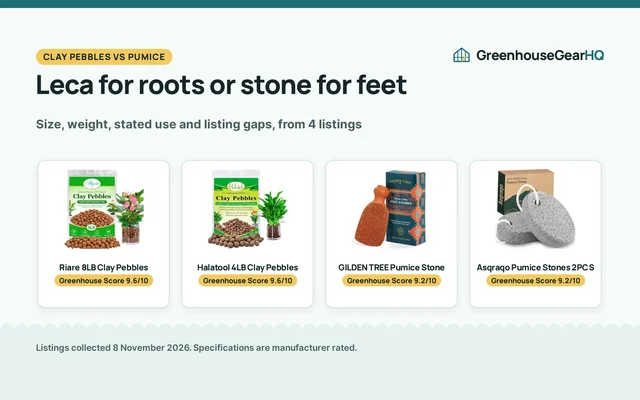
 GILDEN TREE Pumice Stone for Feet9.2/10View on Amazon
- 2
 Legigo 20 Quarts Organic Perlite for Plants Indoor9.7/10View on Amazon
- 3
 Tinyroots Horticultural Pumice for PlantsView on Amazon
- 4
 Sukh Horticultural Pumice StoneView on Amazon
- 5
 20QT Horticultural Pumice for Plants Professional SiftedView on Amazon
- 6
 Horticultural Pumice for Plants Professional SiftedView on Amazon
- 7
 Pumice Stone Grow MediaView on Amazon
- 8
 Horticultural PumiceView on Amazon
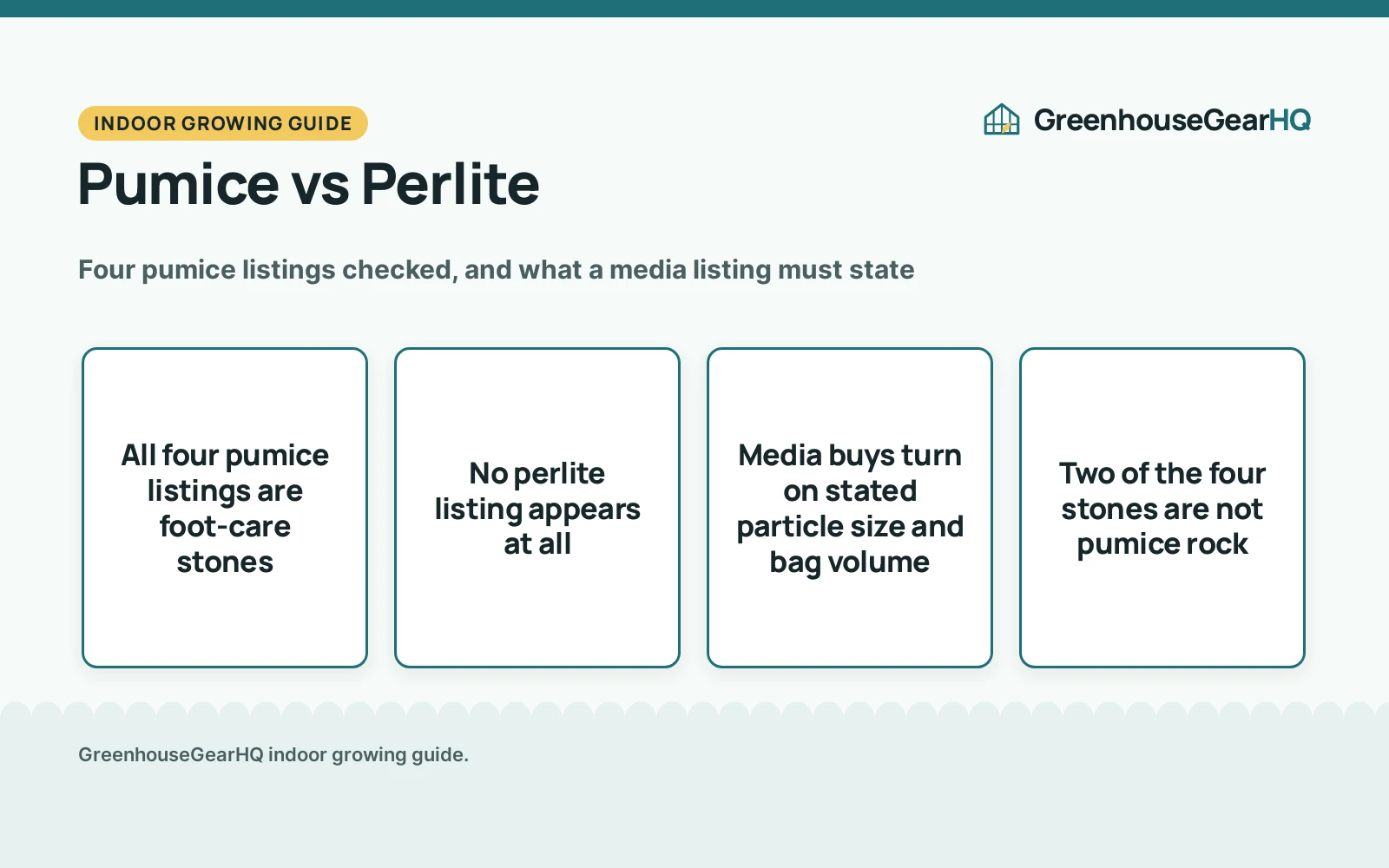
Short answer: on the listings collected for this guide, pumice vs perlite is not a contest either product can win, because neither side is here in its growing-media form. Every one of the four pumice listings below is a foot-care pumice stone sold to scrub calluses from heels, and there is no perlite listing at all. So this guide does two things: it compares the four pumice stones exactly as their listings describe them, and it sets out what a genuine horticultural pumice listing needs to state before a pumice vs perlite choice can be made from listings at all.
Other options worth a look
 Tinyroots Horticultural Pumice for PlantsCheck price on Amazon
 Sukh Horticultural Pumice StoneCheck price on Amazon
 20QT Horticultural Pumice for Plants Professional SiftedCheck price on Amazon
 Horticultural Pumice for Plants Professional SiftedCheck price on Amazon
 Pumice Stone Grow MediaCheck price on Amazon
 Horticultural PumiceCheck price on Amazon
GreenhouseGearHQ earns a commission when you buy through links on this page, at no extra cost to you. As an Amazon Associate I earn from qualifying purchases. Affiliate disclosure.
Pumice vs perlite: what the listings actually show
The word pumice covers two different products. One is a bagged mineral sold by volume as a soil and hydroponic medium, which is the product the pumice vs perlite question is about. The other is a hand-held stone sold for pedicures. All four listings collected here are the second kind: their titles, bullets and spec tables describe removing calluses, hard skin and dead skin from feet and hands, in packs sized for a bathroom, not a potting bench. None of them states a bag volume, a particle size for a mix, or any use with plants. Perlite does not appear in any listing, in any form.
That mismatch matters because the two products are bought on different figures. A growing medium is chosen on stated particle size, bag volume and what the mix needs. A foot stone is chosen on grit, shape and how long it lasts. Comparing the four stones below on media figures would mean inventing numbers none of them states, so the comparison uses the figures they do state.
The gear: the four pumice listings, ranked
Ranked by how completely each listing specifies the stone and how long it states the stone lasts, the four run as follows. The Gilden Tree stone leads: it is natural terra-cotta, states that it lasts 5+ years without crumbling or wearing out, and gives two working surfaces, a rough side to scrub and a smooth side to polish, at 5.5 x 2.25 x 1.25 inches. The Mr. Pumice Pumi Bar follows: a medium grit bar with ridged and flat sides, in a pack of 4, made of a frothed polyurethane synthetic pumice whose self-chipping surface is stated to rinse clean under hot water. The Maryton set is a pack of 4 double-sided stones with 2 levels of coarseness, sized 5 x 2 x 4 inches to fit the palm. The Asqraqo pair closes the list: 2 natural lava stones with rope rings for hanging to dry, used on moist skin.
| Pumice listing | Stated material | Pack | Stated life or grit |
|---|---|---|---|
| Gilden Tree Pumice Stone | Natural terra-cotta | 1 | Lasts 5+ years |
| Mr. Pumice Pumi Bar | Frothed polyurethane | 4 | Medium grit |
| Maryton Foot Pumice Stone | Pumice stone | 4 | 2 levels of coarseness |
| Asqraqo Natural Pumice Stone | Natural lava stone | 2 | Mildly abrasive |
Two of the four are natural stone and two are not what a media buyer means by pumice at all in one case: the Mr. Pumice bar is a synthetic polyurethane product that borrows the name, and the Gilden Tree stone is terra-cotta. Only the Maryton and Asqraqo listings describe their material as pumice stone or lava. None of that makes any of them a growing medium; it underlines that the name on the listing is not enough to go on.
What a growing-media pumice listing needs to state
Before ordering pumice for a mix, check that the listing states the figures a media purchase turns on. It should state a particle size or grade, so the stone can be matched to the mix and the pot size. It should state a bag volume or weight, so quantities can be planned across a bench of pots. It should describe the use as a soil or hydroponic medium, not only name the mineral. And it should be possible to compare it against a perlite listing stating the same figures, because the pumice vs perlite decision is made on those stated grades and volumes, side by side. If a listing states none of these, as the four above state none of them, it is not being sold as a growing medium whatever its title says. Our indoor growing guides cover the systems these media are bought for.
FAQ for growers
Is the pumice in these listings for plants or for feet?
For feet. All four listings describe removing calluses and hard or dead skin from feet and hands, and none states a use with plants, soil or hydroponics.
Is there a perlite listing to compare against?
No. No perlite product appears in the listings collected for this guide, in bagged or any other form, so no side-by-side figure comparison is possible from them.
Can a foot pumice stone be crushed into a potting mix?
None of the four listings states that use, and two of the stones are not pumice rock at all: one is terra-cotta and one is synthetic polyurethane. Buy a product whose listing states a particle size and a growing use instead.
What should I check first on a horticultural pumice listing?
The stated particle size and the bag volume. Those two figures decide how much to order and whether the grade suits the mix, and a listing that omits both is not specified well enough to compare with perlite.
Keep reading
See every indoor growing guide and all seed starting guides.
More picks: browse seed starting trays for succulents and soil thermometers for raised beds.