On this page
Top picks at a glance
As an Amazon Associate I earn from qualifying purchases.
- 1
 T5 Grow Lights for Indoor Plants 1FT9.7/10View on Amazon
- 2
 Kingplus 4 Pack 1FT Grow Light for Indoor Plants9.4/10View on Amazon
- 3
 iPower 20W LED Grow Light Strips for Indoor Plants9.4/10View on Amazon
- 4
 Grow Lights for Indoor PlantsView on Amazon
- 5
 VIVOSUN LumaRay LED Grow Light Bars 16”View on Amazon
- 6
 Spider Farmer GlowR40 LED Plant Grow LightView on Amazon
- 7
 Barrina TX-S60 4FT Grow LightView on Amazon
- 8
 Spider Farmer SUPP-UV30 & IR16 LED Grow Light Bars Set 23.6"View on Amazon
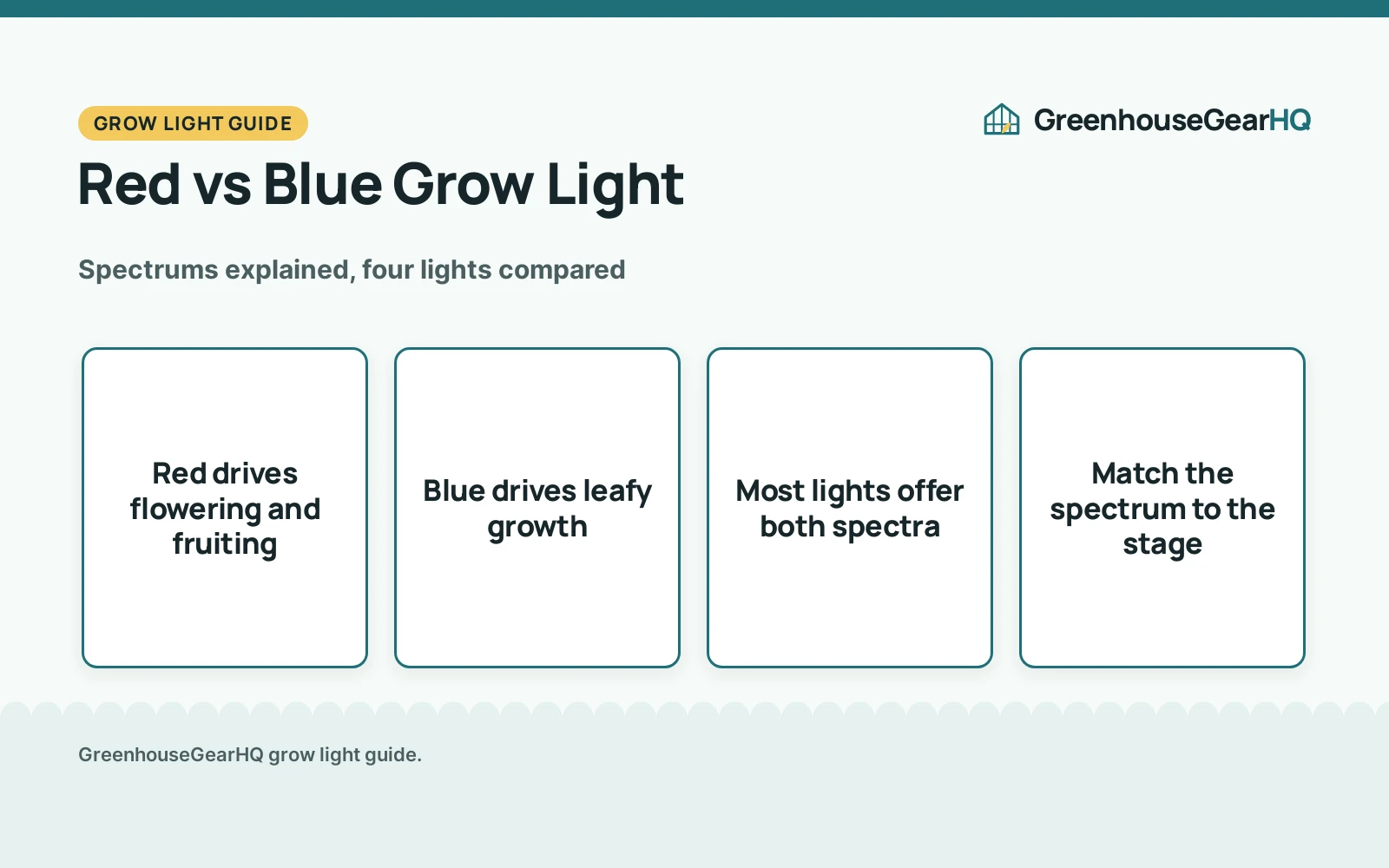
Red light drives flowering and fruiting; blue light drives leafy vegetative growth. That is the short answer to red vs blue grow light: neither wins outright, because plants use both at different stages. A red-heavy spectrum suits blooming plants, a blue-heavy spectrum suits leafy greens and seedlings, and most indoor growers end up with a light that offers both.
Other options worth a look
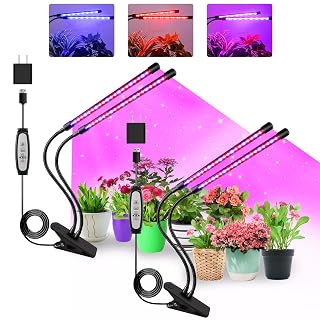 Grow Lights for Indoor PlantsCheck price on Amazon
 VIVOSUN LumaRay LED Grow Light Bars 16”Check price on Amazon
 Maygrove T5 Grow Lights for Indoor Plants 1FTCheck price on Amazon
 Spider Farmer GlowR40 LED Plant Grow LightCheck price on Amazon
 Barrina TX-S60 4FT Grow LightCheck price on Amazon
 Spider Farmer SUPP-UV30 & IR16 LED Grow Light Bars Set 23.6"Check price on Amazon
GreenhouseGearHQ earns a commission when you buy through links on this page, at no extra cost to you. As an Amazon Associate I earn from qualifying purchases. Affiliate disclosure.
What red light does: red vs blue grow light
Red light, around the 660nm deep red band, is the main driver of photosynthesis during flowering and fruiting. The HIGROW listing describes its 660nm red LEDs as the key spectrum for the flowering and fruiting stage. Red light also promotes germination and stem elongation. Too much red without blue produces leggy, stretched plants, which is why red-only bulbs suit supplementation rather than sole-source lighting.
What blue light does
Blue light drives chlorophyll synthesis and compact vegetative growth. The SDOVUERC listing notes that blue light helps plants take in more energy through chlorophyll synthesis for germination and leafy growth. Seedlings and leafy greens want more blue; the HOPLOM T5 lists blue at 400 to 520nm for growth and red at 610 to 720nm for sprouting and flowering. Blue-heavy light keeps plants short and stocky.
Why most lights offer both
Three of the four lights we compared offer red and blue together. The SDOVUERC dual-head clip light offers three color modes (purple, red, blue) so the grower can shift the spectrum by stage. The Otryad clip light offers three lighting modes (red, blue, red and blue). The HOPLOM T5 fixes the ratio at 3 parts red to 1 part blue, which suits flowering ornamentals and leafy vegetables. Only the HIGROW is red-only, designed as spectrum enhancement alongside a main light.
Gear: four lights that cover the spectrum
Ranked from most versatile to most specialized. The SDOVUERC dual-head clip light leads: a 2-pack with 160 LEDs, three spectra, ten brightness levels and a 3/9/12H timer with memory, plus a 2-year manufacturer warranty. It clips to a shelf or pot and the goosenecks rotate for aiming.
Next, the Otryad 20-LED clip light: three lighting modes, nine dimmable levels and a 3/9/12H timer in a single-head clip design, with a 1-year manufacturer warranty. A simpler, smaller option for one shelf of seedlings.
Third, the HIGROW 660nm red bulb: an 18W (36W equivalent) E26 bulb with deep red 660nm LEDs and an aluminum heat sink, carrying a 12-month warranty. Buy it to add red to an existing setup, not as the only light.
Last, the HOPLOM T5 linkable bar: a 1-foot LED tube with a fixed 3:1 red-to-blue ratio, linkable with connectors for longer runs. No warranty term is stated on the listing, which costs it against the others.
How to pick your spectrum
Match the spectrum to the stage. Seedlings and herbs want blue-heavy light; flowering houseplants and fruiting vegetables want red-heavy light. If the shelf holds mixed plants, a switchable light like the SDOVUERC or Otryad covers both without swapping fixtures. If the goal is boosting blooms under an existing white light, the HIGROW red bulb adds red without replacing the main fixture. Check the timer before buying: the SDOVUERC and Otryad both include 3/9/12H timers with memory, while the HIGROW and HOPLOM listings state no timer, so those need an outlet timer for a steady schedule.
What this guide does not cover
We do not give light hours or hanging heights, because they depend on the crop, the light and the room. The light manuals give those figures, and your local extension office can advise on timing for your area. We also do not cover nutrients or pest products; follow the product label.
FAQ for growers
Is red or blue light better for plants?
Neither. Red drives flowering and fruiting; blue drives leafy vegetative growth. Most growers use both.
Can I use only a red grow light?
Red-only suits flowering supplementation. For sole-source lighting, pick a light with both spectra, like the SDOVUERC or Otryad.
What does the 3:1 ratio mean?
The HOPLOM T5 lists 3 parts red to 1 part blue, a fixed ratio for flowering ornamentals and leafy vegetables.
Do these lights include a timer?
The SDOVUERC and Otryad list 3/9/12H timers with memory. The HIGROW and HOPLOM listings state no timer.
Can I mix red and blue lights on one shelf?
Yes. Many growers run a blue-heavy light for seedlings beside a red-heavy light for blooming plants on the same shelf.
Which light has the longest warranty?
The SDOVUERC lists a 2-year manufacturer warranty; the Otryad a 1-year warranty; the HIGROW a 12-month warranty. The HOPLOM states none.
Keep reading
See every grow lights guide and all greenhouse climate guides. Also see our best grow lights for pothos. Also see our best clip-on grow lights.
More picks: grow lights, seedling heat mats and greenhouse heaters.