On this page
Top picks at a glance
As an Amazon Associate I earn from qualifying purchases.
- 1
 MistyJungle 20W Full Spectrum Standing Grow Light with Remote9.6/10View on Amazon
- 2
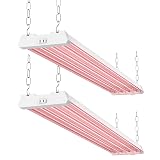 Sunco 2 Pack 4FT Full Spectrum LED Grow Lights 80W9.8/10View on Amazon
In late winter, when the seed trays go under the lights and the tent warms up by midday, the last thing you want is extra heat hanging over the seedlings. The question of remote ballast vs built in ballast LED comes down to where the driver lives: a remote ballast mounts outside the fixture or tent, while a built-in ballast sits inside the light itself. We compared listings for remote-mount ballasts and ballast-bypass LED tubes to explain what each layout does and which grows each suits. Every number below comes from a product listing; where a listing gives no figure, we say so.
GreenhouseGearHQ earns a commission when you buy through links on this page, at no extra cost to you. As an Amazon Associate I earn from qualifying purchases. Affiliate disclosure.
Remote ballast vs built in ballast LED: the short answer
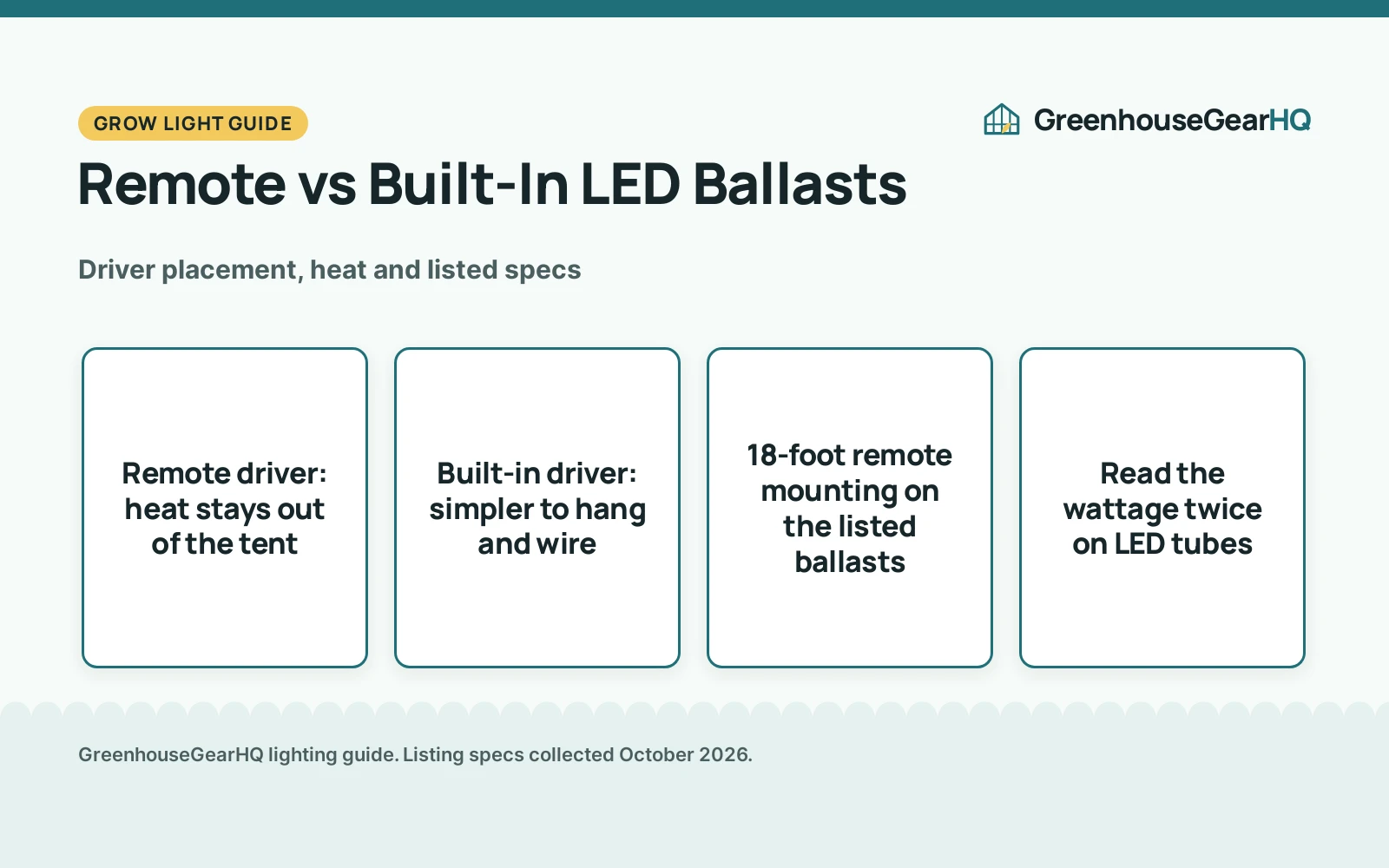
Choose a remote ballast when heat at the fixture is your problem: moving the driver outside the tent keeps its warmth away from the canopy and makes a failed driver a swap rather than a whole-light replacement. Choose a built-in ballast when simplicity wins: one fixture to hang, one cord to plug in, nothing extra to mount. If you would rather go straight to the products, our best grow lights for seedlings roundup scores five lights on these points.
What a remote ballast is
A remote ballast, usually called a driver on LED fixtures, is the power supply mounted apart from the light. The Robertson listings we compared are built for this: two of them state remote mounting up to 18 feet with 18 AWG leads, so the ballast can sit on a wall or shelf while the lamps hang over the plants. Those listings cover 1 to 4 T8 fluorescent lamps between 17W and 32W at 120V, and they carry UL and cUL listings.
Remote mounting helps in two ways. First, the driver’s heat stays out of the growing space, which matters in a small tent in summer. Second, when a driver fails, you replace the box on the wall, not the whole fixture over the plants. The tradeoff is wiring: you run leads between the driver and the fixture, and you need a place to mount the box.
What a built-in ballast is
A built-in ballast puts the driver inside the fixture housing, so the light is a single unit: hang it, plug it in, done. Most LED shop lights and panels sold for home growing use this layout. The LIGHEART 8 ft LED tube in these listings takes the idea one step further: it is a ballast-bypass type, and the listing says to remove or bypass the ballast before installation, so the tube wires straight to mains power.
Built-in drivers keep installation simple and the parts count low. The tradeoff is heat and service: the driver’s warmth stays at the fixture, and if the driver dies, the whole light usually goes with it. That matters less over a seed shelf in a cool basement and more in a sealed tent in July.
Remote vs built-in at a glance
| Layout | Driver location | Suits | Watch for |
|---|---|---|---|
| Remote ballast | Outside the fixture or tent, up to 18 ft on the listed Robertson units | Small tents, summer grows, easy driver swaps | Extra wiring and a place to mount the box |
| Built-in ballast | Inside the fixture housing | Seed shelves, simple one-light setups | Driver heat stays at the light; a failure can mean a new fixture |
| Ballast bypass (LIGHEART tube) | No ballast; tube wires direct | Retrofitting old fluorescent fixtures | Listing says to remove or bypass the ballast first |
Which layout should you buy?
Match the layout to the space. In a grow tent where summer heat already pushes the thermometer, a remote driver keeps one more heat source out of the tent; the Robertson listings allow up to 18 feet of separation. Over a seed-starting shelf in a cool room, a built-in driver is simpler and the extra warmth at the fixture rarely matters. If you are retrofitting old 8 ft fluorescent fixtures, the LIGHEART tube’s ballast-bypass design skips the ballast question entirely: its 6000K tube lists 5000 lumens and replaces a 110W fluorescent, with no driver to place at all.
Check voltage the same way. The Robertson ballasts list 120V single-voltage operation, while the GE T8 UltraMax lists 120 to 277V and a minimum starting temperature of -22°F, and its intended use includes T8 LED tubes. Read our T5 vs LED grow lights guide and passive vs active cooling explainer before you decide.
Read the listing twice
Lighting listings contradict themselves, and the conflicts cluster around wattage and quantity:
- LIGHEART 8 ft LED tube: the spec table lists 90W in one field but 45 watts in the power consumption and light source wattage fields, and the length field says 6-pack while the count fields say 4.
- GE T8 UltraMax: the bullets describe a fluorescent ballast, but the intended use field adds T8 LED tubes, so confirm which lamp type you are buying for.
- Robertson ISU232T8120: the spec table lists a G5 bulb base, but the title and bullets describe T8 lamps, so trust the title and bullets.
For ballast questions, trust the title and bullets over the spec table, and confirm the mounting distance: only some listings state remote mounting at all.
What this guide does not cover
This guide covers driver placement only. It does not cover light spectrum, hanging height or daily light hours, which depend on the crop and the fixture. Your seed packet and the light maker’s manual give those figures, and your local extension office can advise on timing for your area.
FAQ for growers
Can I mount the ballast outside the grow tent?
Some ballasts are made for it. Two Robertson listings state remote mounting up to 18 feet with 18 AWG leads. If a listing does not state remote mounting, keep the driver where the maker puts it.
Do LED tubes need a ballast?
It depends on the tube. The LIGHEART 8 ft LED tube is a ballast-bypass type, and its listing says to remove or bypass the ballast before installation. The GE T8 UltraMax ballast lists T8 LED tubes in its intended use, so some tubes still use one. Check the tube listing.
Which layout runs cooler inside the tent?
A remote driver runs cooler inside the tent because its heat stays outside with the driver. A built-in driver keeps its warmth at the fixture. Neither listing gives a temperature figure for the driver itself.
What voltage do these ballasts list?
The Robertson ballasts list 120V single-voltage operation, and the GE T8 UltraMax lists 120 to 277V with a minimum starting temperature of -22°F.
Keep reading
See every grow light guide and all light and heat guides.
More picks: grow lights for seedlings, LED vs HPS grow lights, T5 vs LED grow lights and passive vs active cooling.