On this page
Top picks at a glance
As an Amazon Associate I earn from qualifying purchases.
- 1
 Tatuo 6 Pack 4 x 2 ft Polycarbonate Greenhouse Panels9.6/10View on Amazon
- 2
 KASTLITE 1×1' Twin Wall Polycarbonate Greenhouse PanelView on Amazon
- 3
 iLivingView on Amazon
- 4
 Storystore Twin-Wall Polycarbonate PanelsView on Amazon
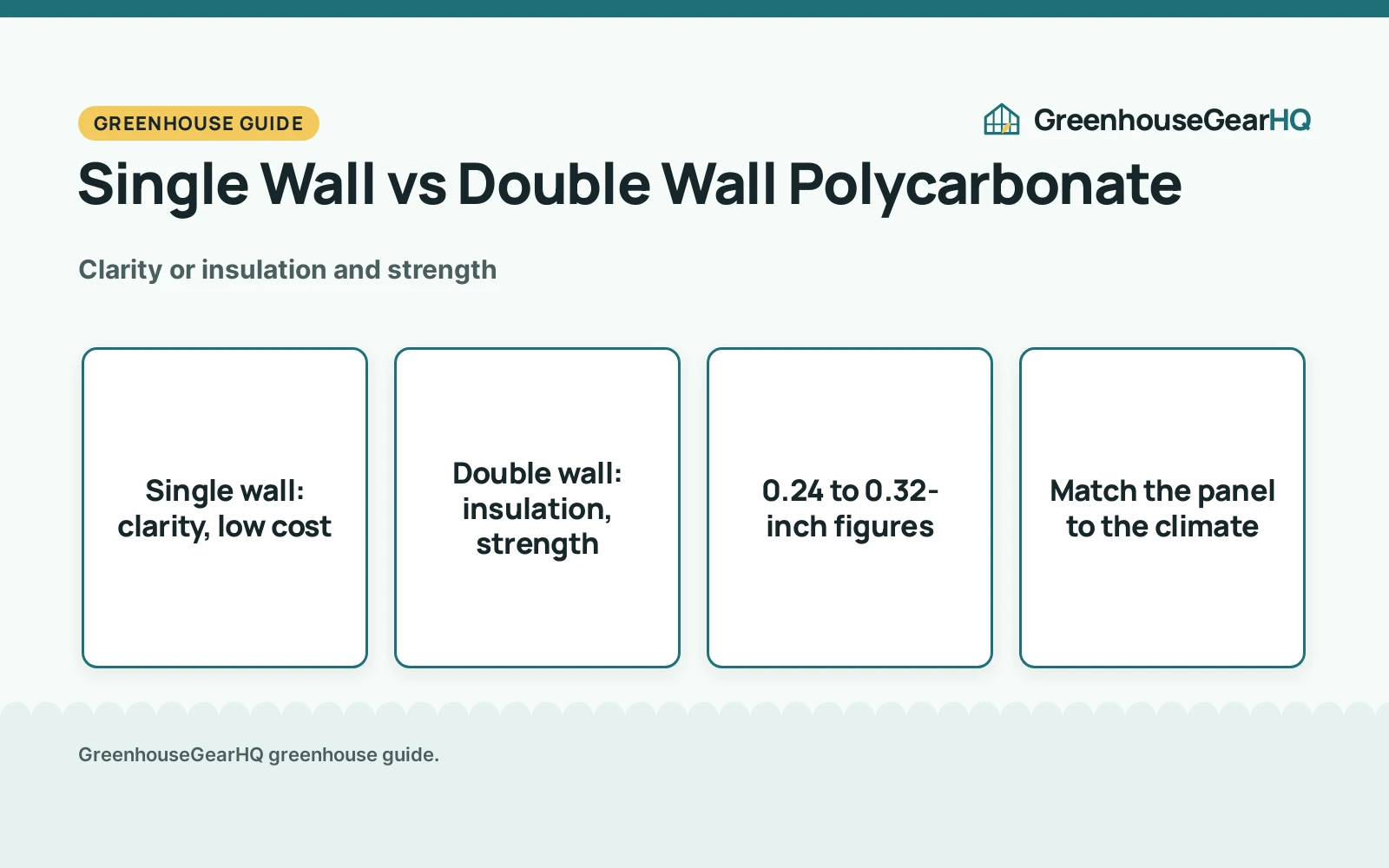
Single wall vs double wall polycarbonate: the short answer is that single-wall sheets are one solid layer with the best clarity, while double-wall, or twin-wall, panels have two faces with air channels that insulate and add strength. One is cheaper and clearer; the other holds heat and shrugs off hail. The reference listings show double-wall panels in detail; the single-wall side is explained without figures where none are stated.
Other options worth a look
 KASTLITE 1×1' Twin Wall Polycarbonate Greenhouse PanelCheck price on Amazon
 iLivingCheck price on Amazon
 Storystore Twin-Wall Polycarbonate PanelsCheck price on Amazon
GreenhouseGearHQ earns a commission when you buy through links on this page, at no extra cost to you. As an Amazon Associate I earn from qualifying purchases. Affiliate disclosure.
Single wall vs double wall polycarbonate: how they differ
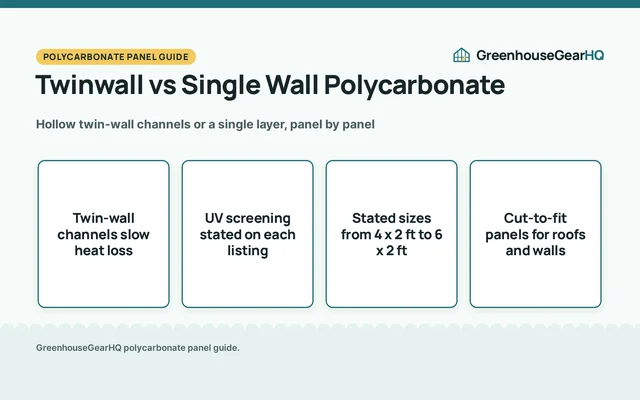
The difference is the cross-section. A single-wall sheet is one solid layer of polycarbonate, like a window pane. A double-wall sheet is two faces joined by ribs, with air channels between them: the twin-wall construction. The air channels are what insulate, and the ribbed structure is what resists impact.
Single wall: clarity and low cost
Single-wall suits growers who want the clearest view and the lowest price. One solid layer transmits light with the least haze and costs less per sheet than twin-wall. The trade is insulation: a single layer holds almost no air, so it loses heat fast at night, and it dents and cracks more easily under hail. No single-wall panels appear in these listings, so check each listing for the sheet type before buying; single-wall suits mild climates, cold frames and glazing where insulation does not matter.
Double wall: insulation and impact strength
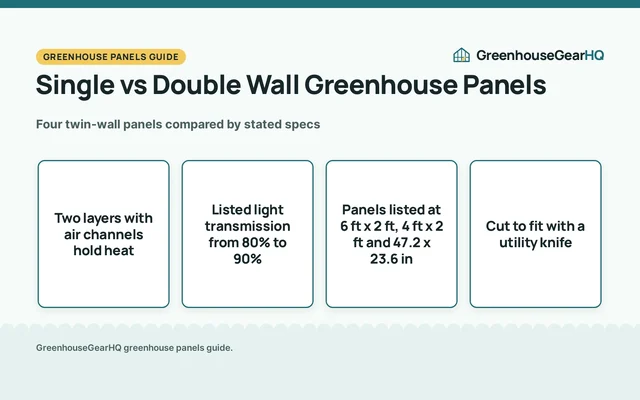
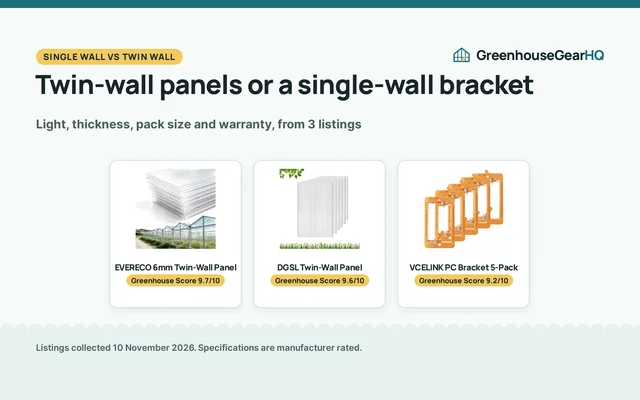
Double-wall is the workhorse glazing of greenhouse kits. The listings show the range: the DGSL 14-pack of 4 by 2-foot, 0.32-inch twin-wall sheets; the FAHKNS and VOYAR 6-packs of 4 by 2-foot, 0.32-inch twin-wall panels with 99% UV block; the Sinimaka 15-pack of 4 by 2-foot, 0.24-inch twin-wall panels at 6mm and 22 lbs; the UMIG 6-pack of 6 by 2-foot, 0.32-inch panels; the EVERECO 6-pack of 8 by 4-foot, 0.24-inch sheets at 40.9 lbs with a 99% UV block; and the Silk Road 8mm twin-wall panels with a 10-year warranty. The OWLHAUS listing adds 6-8mm H-connectors for joining panels. Twin-wall costs more and transmits slightly less light, but it insulates and survives hail.
How to decide: climate, light and budget
Start with the climate. Cold nights and hail favor double-wall: the 0.24 to 0.32-inch twin-wall sheets here, at 6 to 8mm, insulate and resist impact. Mild climates where nights stay warm favor single-wall for its clarity and price. Then weigh light: twin-wall diffuses and slightly reduces transmission, which most plants prefer, while single-wall gives the sharpest light. Finally, match the connectors: the OWLHAUS 6-8mm H-connectors fit the 6 to 8mm panels in these listings, so buy connectors to the panel thickness.
Buying advice: thickness, connectors and UV
Buy thickness for the climate. The listings here span 0.2-inch panels (the BPS 62 by 38-inch 6-pack), 0.24-inch twin-wall (Sinimaka 4 by 2-foot and 8 by 4-foot packs), 0.32-inch twin-wall (DGSL 14-pack and UMIG 6 by 2-foot panels) and 8mm twin-wall sheets. Thicker twin-wall insulates better and resists hail; in mild climates the thinner sheets save money. The 0.24-inch Sinimaka listings state 99.9% UV block, and other listings state 99%, so UV protection is standard on the twin-wall side; check single-wall sheets for it explicitly.
Match connectors to the panel. The OWLHAUS listing describes 6-8mm H-connectors in a 4-foot, 10-pack for joining twin-wall panels. Buy connectors in the listing’s stated thickness range; a 6mm connector will not hold an 8mm panel. Light figures run 80% transmission on the DGSL and 6-pack listings, 89% on one 0.32-inch listing and 90% on an 8 by 4-foot listing, so brighter is not automatically thicker.
Which one should you choose?
| Type | Construction | Example figure | Suits |
|---|---|---|---|
| Single wall | One solid layer | Not stated | Clarity, low cost, mild climates |
| Double wall | Two faces, air channels | 0.32-inch, 99% UV block | Insulation, hail, cold nights |
| Double wall | Two faces, air channels | 8mm, 10-year warranty | Long-term builds |
Match the panel to the climate. Cold and hail lean double-wall: see our polycarbonate greenhouse guide for kit examples. Mild climates lean single-wall; browse every greenhouse film and tape guide for glazing options.
FAQ for growers
Does double-wall polycarbonate insulate better?
Yes. The air channels between the two faces trap air, which insulates far better than a single solid layer. That is the main reason greenhouse kits use twin-wall.
What thickness suits hail country?
The listings show 0.24-inch and 0.32-inch twin-wall sheets at 6 to 8mm; thicker sheets resist impact better. The Silk Road 8mm twin-wall listing states a 10-year warranty.
Which transmits more light?
Single-wall: one solid layer means the least haze. The double-wall listings here state 99% UV block coatings, which protect the panels while letting growing light through.
What connectors fit twin-wall panels?
The OWLHAUS listing describes 6-8mm H-connectors in a 10-pack for joining panels. Buy connectors matched to the panel thickness in the listing.
Keep reading
See every greenhouse film and tape guide and all greenhouse guides.
More picks: polycarbonate greenhouse, greenhouse plastic for cold climates, greenhouse fans.