On this page
Top picks at a glance
As an Amazon Associate I earn from qualifying purchases.
- 1
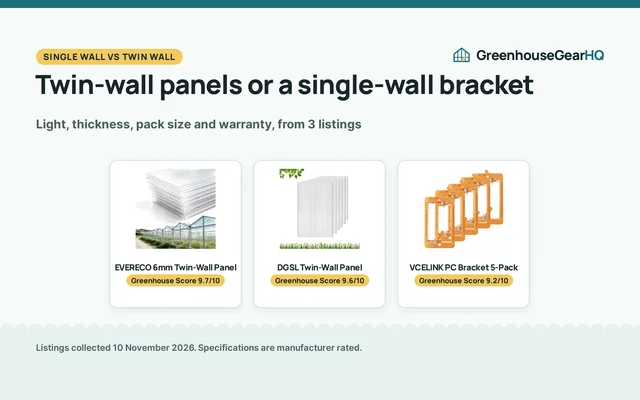
 EVERECO Twin-Wall Polycarbonate Panels9.7/10View on Amazon
- 2
 DGSL Twin-Wall Polycarbonate Greenhouse Panels9.6/10View on Amazon
- 3
 VCELINK Low Voltage Mounting Bracket 5-Pack9.2/10View on Amazon
- 4
 Storystore Twin-Wall Polycarbonate PanelsView on Amazon
- 5
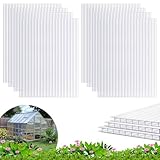 Polycarbonate Greenhouse PanelsView on Amazon
- 6
 14 PCS Twin-Wall Polycarbonate Greenhouse Panels 48×24×0.24inView on Amazon
- 7
 6 Pack Polycarbonate Greenhouse PanelsView on Amazon
- 8
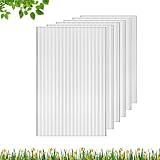 14 Pcs Polycarbonate Greenhouse PanelsView on Amazon
- 9
 OWLHAUS Polycarbonate Greenhouse Panel ConnectorsView on Amazon
A cold snap in late winter can leave a greenhouse chilly by morning, and the panels on the frame decide how much of the day’s warmth stays inside, so twinwall vs single wall polycarbonate is the choice to settle before glazing or re-glazing a roof or a wall. This guide compares twin-wall polycarbonate panel listings, each with stated size, thickness, UV screening and pack size, and sets the twin-wall choice beside the single-wall option. Where a number appears, it comes from a product listing named in the guide.
Other options worth a look
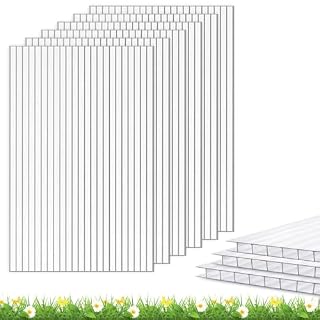 Storystore Twin-Wall Polycarbonate PanelsCheck price on Amazon
 Polycarbonate Greenhouse PanelsCheck price on Amazon
 14 PCS Twin-Wall Polycarbonate Greenhouse Panels 48×24×0.24inCheck price on Amazon
 6 Pack Polycarbonate Greenhouse PanelsCheck price on Amazon
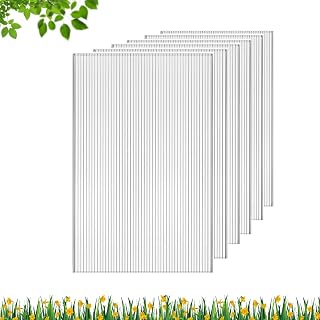 14 Pcs Polycarbonate Greenhouse PanelsCheck price on Amazon
 OWLHAUS Polycarbonate Greenhouse Panel ConnectorsCheck price on Amazon
GreenhouseGearHQ earns a commission when you buy through links on this page, at no extra cost to you. As an Amazon Associate I earn from qualifying purchases. Affiliate disclosure.
What twin-wall and single-wall panels are
A twin-wall panel holds a pair of polycarbonate layers joined by hollow channels; the listings call that build a cellular multi-layer structure, a double-layer structure, and twin-wall channels. A single-wall sheet is a single layer of polycarbonate with no channels inside. The channels in a twin-wall panel slow heat transfer, which is the main difference between the builds.
- Twin-wall: a pair of layers with hollow channels; the listings describe heat insulation, UV screening and impact resistance.
- Single-wall: a single layer of polycarbonate with no channels inside.
Twinwall vs single wall polycarbonate: how the panels compare
The 4 listings in this guide are all twin-wall panels, so the table below compares the twin-wall side of the choice in detail. A single-wall sheet has no channels, so it gives none of the insulation the channels add, and the rest of the guide weighs that gap against the simpler build.
| Panel listing | Stated size | Stated thickness | Stated UV screening |
|---|---|---|---|
| XISOCO 6-pack twin-wall panels | 4 x 2 ft | 0.32 in | 99.5% UV protection |
| Sinimaka 15-pack twin-wall panels | 4 x 2 ft | 0.16 in | 99.9% of UV, 89% light transmission |
| RITOLLO 6-pack twin-wall panels | 6 x 2 ft | 0.24 in, 6 mm | UV-protected material |
| Sinimaka 10-pack twin-wall panels | 4 x 2 ft | 0.16 in, 4 mm | Single-side UV coating |
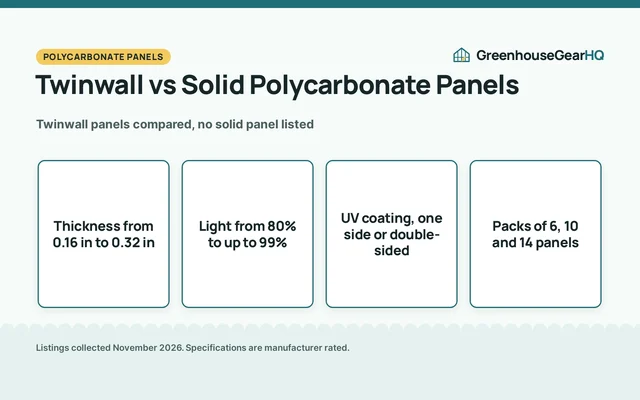
Thickness runs from 0.16 in to 0.32 in across the listings, and pack size runs from 6 panels to 15 panels. The XISOCO listing carries the only stated warranty here, a 10-year limited warranty; the other listings state no warranty term.
The 4 twin-wall panels in this guide
Each panel below is ranked by its stated specs, with the strongest listing first.
XISOCO 6-pack twin-wall panels
The XISOCO listing covers 6 panels at 4 x 2 ft and 0.32 in thick, the thickest panels in this guide, with 99.5% UV protection from an integrated UV-resistant co-extruded layer and a 10-year limited warranty. The maker describes a flame-retardant material, a cellular multi-layer structure that reduces heating costs in winter, and a coating on the bottom side that eliminates condensation dripping. The set lists an item weight of 15.8 pounds and a cutting tolerance of +/- 0.19 inch, with UV protection on a single side only and the protective film marking the outward face. Note the spec table lists the panel depth as 2.15 inches, which conflicts with the 0.32 in thickness in the title; the title and bullets govern here.
Sinimaka 15-pack twin-wall panels
The Sinimaka 15-pack lists 15 panels at 4 x 2 ft and 0.16 in thick, with a stated temperature range from -40°C to 120°C and a UV-resistant coating that screens 99.9% of UV while allowing 89% light transmission. The maker describes impact resistance against hail and falling objects, easy cutting without cracking, and cold-bending for curved roofs. The set lists an item weight of 17.0 pounds. No warranty term is stated.
RITOLLO 6-pack twin-wall panels
The RITOLLO listing covers 6 panels at 6 x 2 ft and 0.24 in, 6 mm thick, the longest panels in this guide, with UV-protected material that resists yellowing, brittleness and outdoor aging. Hollow twin-wall sheets help reduce heat loss while staying lightweight and easy to handle, and the maker lists use for greenhouse roofs, wall repair, cold frames and raised beds. The listing advises measuring carefully and wearing gloves and eye protection during cutting and installation. No warranty term is stated, and no item weight is stated.
Sinimaka 10-pack twin-wall panels
The Sinimaka 10-pack lists 10 panels at 4 x 2 ft and 0.16 in, 4 mm thick, covering up to 80 sq. ft. before trimming, with a UV-coated side that maintains high light transmission while screening harmful UV rays. Twin-wall channels help slow heat transfer, and the maker describes a flame-resistant material, easy cutting and drilling, and cold-bending for gently curved roofs. The listing notes the marked UV side faces the sun, and that proper framing and support spacing are required. No warranty term is stated. Note the spec table lists the panel depth as 0.14 inches, which conflicts with the 0.16 in thickness in the title and bullets; the title and bullets govern here.
How to choose twinwall vs single wall polycarbonate for your greenhouse
Match the panel to the cold season
For a greenhouse that holds plants through frost nights, twin-wall channels slow heat transfer, so the RITOLLO and Sinimaka 10-pack listings suit a roof or wall where steady warmth matters. For a mild-season shelter or a cold frame that opens by day, a single-wall sheet keeps the build to a single layer. See the single wall vs twin wall polycarbonate comparison for the same choice framed the other way.
Check thickness and pack size together
Thickness and pack size decide how far a single order goes. The XISOCO panels list 0.32 in thickness in a 6-pack, the RITOLLO panels list 0.24 in in a 6-pack at 6 x 2 ft, and the Sinimaka packs list 0.16 in, in 15-panel and 10-panel packs, the 10-panel pack covering up to 80 sq. ft. before trimming. Compare the stated panel count against the roof or wall area before ordering. For the thickness choice in finer steps, see the 4mm vs 6mm polycarbonate comparison.
Plan the cut and the UV side
The XISOCO and Sinimaka 10-pack listings note a single-side UV coating, so mark the UV face before cutting and set it outward. The XISOCO listing notes a cutting tolerance of +/- 0.19 inch, and the RITOLLO listing advises gloves and eye protection during cutting and installation. For a curved roof, the Sinimaka listings describe cold-bending. See the twinwall vs solid polycarbonate greenhouse guide for how twin-wall compares with a solid sheet.
What this guide does not cover
This guide does not cover framing, fasteners or sealants, because the listings state panel size and thickness but not the frame parts. It does not give light hours or growing temperatures, because those depend on the crop and the season. For the frame and the covering choice together, see the PVC greenhouse vs polycarbonate greenhouse comparison.
FAQ for growers
Which panel suits a greenhouse that stays planted through winter?
A twin-wall panel suits that use, because the hollow channels slow heat transfer. The RITOLLO listing describes twin-wall sheets that help reduce heat loss.
How thick are the twin-wall panels in this guide?
The XISOCO panels list 0.32 in, the RITOLLO panels list 0.24 in, 6 mm, and each Sinimaka pack lists 0.16 in, 4 mm. Check the stated thickness beside the panel size before ordering.
Do these panels screen UV?
Yes, each listing states UV screening in some form. The XISOCO panels list 99.5% UV protection, the Sinimaka 15-pack lists 99.9% of UV screened with 89% light transmission, the RITOLLO panels list UV-protected material, and the Sinimaka 10-pack lists a single-side UV coating with the marked side facing the sun.
Can twin-wall panels bend for a curved roof?
Yes, the Sinimaka listings describe cold-bending. The 15-pack lists cold-bending for curved roofs, and the 10-pack lists cold-bending for gently curved roofs, with cutting and drilling by common tools.
Keep reading
See every polycarbonate greenhouses guide and all greenhouses guides. Also see the aluminum vs polycarbonate greenhouse comparison. Also see the best double wall greenhouse panels picks. Also see the 6mm vs 8mm twinwall polycarbonate comparison.
More picks: twinwall vs solid polycarbonate, aluminum vs polycarbonate, PVC vs polycarbonate and mini greenhouses.