On this page
Top picks at a glance
As an Amazon Associate I earn from qualifying purchases.
- 1
 Tellegloww Compost Thermometer 39.4 Inch Soil Probe9.5/10View on Amazon
- 2
 SONKIR MS02 3-in-1 Soil Moisture/Light/pH Meter9.4/10View on Amazon
Late winter seed trays sit on the bench while the ground outside stays cold, and the calendar alone cannot say whether seeds will sprout. Soil temperature is the warmth of the ground where seeds sit and roots grow, and it decides when sowing and transplanting make sense. This guide explains what soil temperature means, how to measure it with a probe thermometer, and how to read the result for beds, pots and compost.
GreenhouseGearHQ earns a commission when you buy through links on this page, at no extra cost to you. As an Amazon Associate I earn from qualifying purchases. Affiliate disclosure.
What soil temperature means for planting
Soil temperature is the warmth of the soil itself, measured below the surface where roots live, not the warmth of the air above the bed. Air can feel mild while the ground stays cold, and a warm afternoon can heat the top layer while the soil deeper down stays cool. That gap is why a thermometer reading beats a guess from the weather: the probe reports the ground at the depth where seeds sit.
Seeds sprout and roots grow when the ground holds steady warmth, and cold ground can leave seeds sitting without sprouting. The right moment to sow depends on the crop, so the seed packet gives the figure to aim for, and the thermometer shows whether the ground has reached it. A reading also helps with transplanting: seedlings moved into cold ground can stall, while ground that has warmed through the root zone gives them a steadier start.
How to measure soil temperature, step by step
Step 1: Pick a probe that reaches the root zone
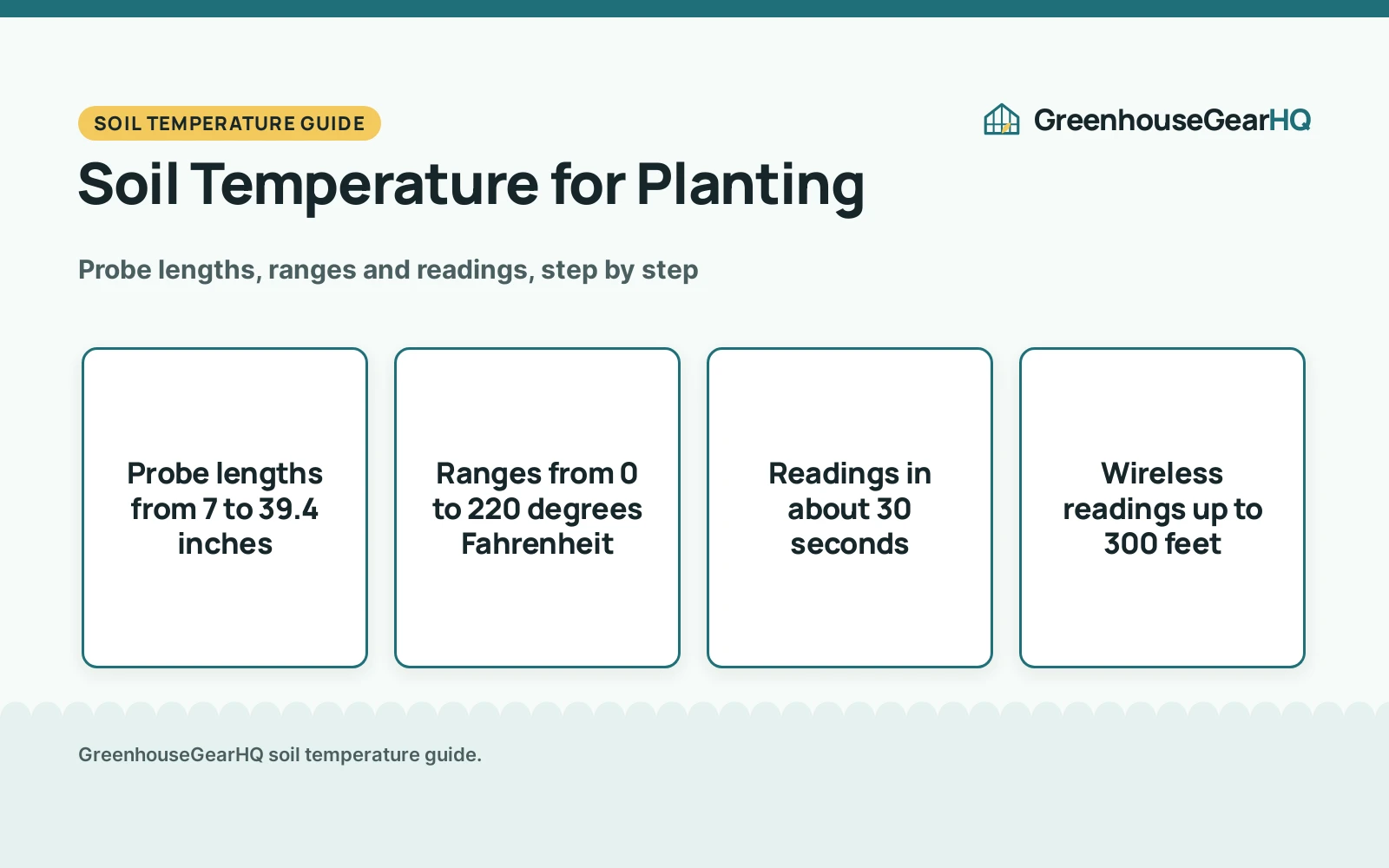
Probe length decides how deep the reading goes. The AcuRite 00661 (on Amazon) lists a 7-inch stem, and the Copkim pair lists a 7.5-inch stem with a 1.8-inch dial. The Terpovery lists a 20-inch stem, the General Tools T300-36 (on Amazon) lists a 36-inch probe, and the Tellegloww compost thermometer (on Amazon) lists a 39.4-inch stem. The ECOWITT WN34BS (on Amazon) lists an 11.8-inch probe, and the Joewuzun probe lists a 10-inch length. Match the stem to the depth you want to read: a short stem suits pots and shallow beds, while a long stem reaches deep into a compost pile or a raised bed.
Step 2: Push the probe into the soil
Push the probe into the ground where you plan to sow, away from the edge of the bed, and leave it in place until the reading steadies. The Tellegloww lists readings in about 30 seconds. The Joewuzun probe needs no batteries or electricity, and the Terpovery also lists no need for batteries. The ECOWITT WN34BS sends readings every 77 seconds to a receiver, so a reading taken from the house still reflects the ground outside.
Step 3: Read the dial or the display
Analog soil thermometers show the result on a dial. The AcuRite 00661, the Copkim pair and the Tellegloww list a range from 0 to 220 degrees Fahrenheit, and the Tellegloww and the General Tools T300-36 also list Celsius scales, with the General Tools listing -18 to 104 degrees Celsius. The ECOWITT WN34BS shows the result on an LCD display and lists an IP65 code, so the probe can sit in damp ground. Read the scale in the unit your seed packet uses.
Step 4: Check more than one spot
A single reading describes a single spot. Sun, shade, mulch and moisture change the ground across a bed, so take readings in several places before you sow. The ECOWITT WN34BS supports up to 8 channels, so one receiver can track temperature at up to 8 locations with extra sensors. Compare the readings and sow where the ground holds the warmth your crop needs.
| Thermometer | Stated stem length | Stated range | Reading |
|---|---|---|---|
| AcuRite 00661 | 7-inch stem | 0 to 220 degrees Fahrenheit | Dial |
| Copkim pair | 7.5-inch stem | 0 to 220 degrees Fahrenheit | Dial |
| Terpovery | 20-inch stem | Fahrenheit and Celsius | Dial |
| General Tools T300-36 | 36-inch probe | 0 to 220 degrees Fahrenheit | 3-inch dial |
| Tellegloww | 39.4-inch stem | 0 to 220 degrees Fahrenheit | 2-inch dial |
| ECOWITT WN34BS | 11.8-inch probe | LCD display | Digital |
Soil temperature in a compost pile
A compost pile runs warm while it breaks down, and a long probe reads the heat deep inside the pile. The Tellegloww lists a 39.4-inch stem and a range from 0 to 220 degrees Fahrenheit, with readings in about 30 seconds, and the General Tools T300-36 lists a 36-inch probe with the same 0 to 220 degree Fahrenheit range. Push the probe into the middle of the pile and leave it in place until the dial steadies. The Tellegloww lists a sealed glass dial surface to keep out fog and moisture, and its stem lists 0.16-inch thick stainless steel.
Tools that do not measure soil temperature
Not every probe in a garden drawer reads soil temperature. The SONKIR MS02 (on Amazon) lists 3 functions in one meter: soil moisture, soil pH value and sunlight level, with no battery needed. It reads moisture, acidity and light, not temperature, so use it for those three readings and reach for a thermometer for ground warmth. The Xuhal kitchen thermometer lists a 5-inch stem and a 1-inch dial, and its bullets describe cooking uses such as milk, coffee, drinks and meat. Its 6-piece pack suits a kitchen, not a garden bed.
What this guide does not cover
This guide does not give target temperatures for crops, because they differ by seed and by variety. The seed packet gives the figure for the crop, and the local extension office can advise on timing for an area. Fertilizer and pest products are outside this guide; follow the product label.
FAQ for growers
How deep should a soil thermometer probe go?
Match the stem to the depth you want to read. The AcuRite 00661 lists a 7-inch stem, the Copkim pair a 7.5-inch stem, the Terpovery a 20-inch stem, the General Tools T300-36 a 36-inch probe, and the Tellegloww a 39.4-inch stem. A short stem suits pots and shallow beds.
What temperature range does a soil thermometer cover?
The AcuRite 00661, the Copkim pair, the Tellegloww and the General Tools T300-36 list a range from 0 to 220 degrees Fahrenheit. The Tellegloww also lists -10 to 100 degrees Celsius, and the General Tools lists -18 to 104 degrees Celsius.
Do soil thermometers need batteries?
Several listed models need no batteries: the SONKIR MS02, the Terpovery and the Joewuzun probe all list no need for batteries. The ECOWITT WN34BS shows battery level on the app, so it runs on a battery.
How can soil temperature be read from inside the house?
Yes, with a wireless sensor. The ECOWITT WN34BS sends readings every 77 seconds over a range of up to 300 feet in open areas, and it supports up to 8 channels, so one receiver can track up to 8 locations. The sensor pairs with a GW1100 Wi-Fi gateway, sold separately, for live data on the app.
Keep reading
See every greenhouse thermometers guide and all greenhouse climate guides. Also see the best garden soil thermometer picks. Also see the best seedling heat mat picks.
More picks: garden soil thermometers, compost bins, seedling heat mats and greenhouse climate controllers.