On this page
Top picks at a glance
As an Amazon Associate I earn from qualifying purchases.
- 1
 Mr. Heater 99.7/10View on Amazon
- 2
 Avenger 189.7/10View on Amazon
- 3
 Mr. Heater 1259.7/10View on Amazon
- 4
 GarveeTech Greenhouse HeaterView on Amazon
- 5
 Fanspex 1500W Integrated Digital Thermostat Heater forView on Amazon
- 6
 lesotc Smart Greenhouse Heater for Plants VegetableView on Amazon
- 7
 Mr. Heater 3View on Amazon
- 8
 Mr. Heater Golf Cart 4View on Amazon
- 9
 Mr. Heater Original 540-Degree 45View on Amazon
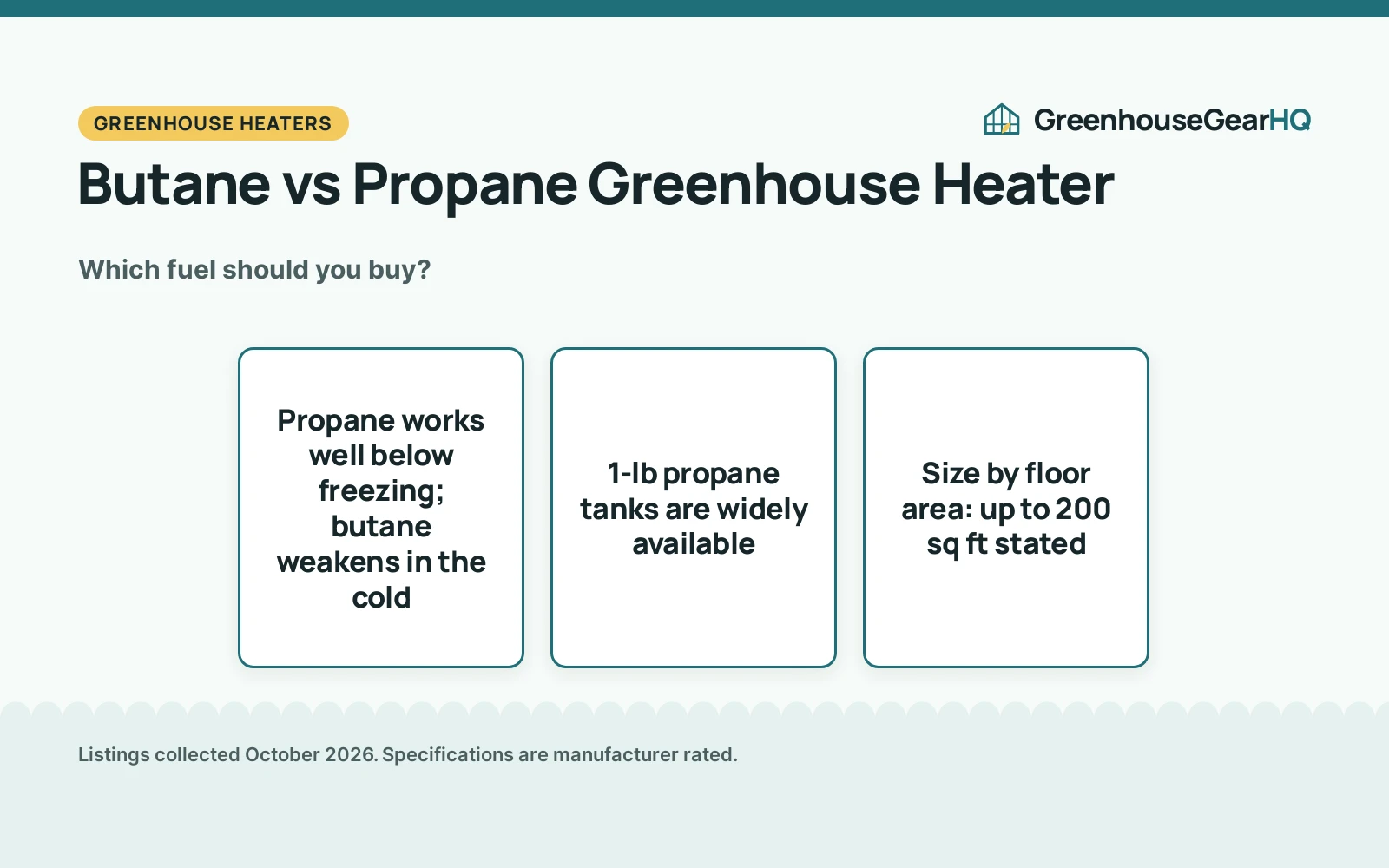
Butane vs propane greenhouse heater: which should you buy? Propane wins for most greenhouses, because 1-lb propane tanks are easy to find and portable propane heaters cover up to 200 square feet. Butane suits small, mild-climate setups where portability matters more than raw heat. If you need serious winter warmth, propane is the practical pick.
Other options worth a look
 GarveeTech Greenhouse HeaterCheck price on Amazon
 Fanspex 1500W Integrated Digital Thermostat Heater forCheck price on Amazon
 lesotc Smart Greenhouse Heater for Plants VegetableCheck price on Amazon
 Mr. Heater 3Check price on Amazon
 Mr. Heater Golf Cart 4Check price on Amazon
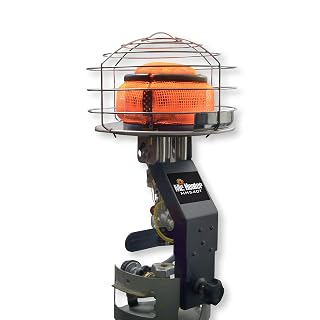 Mr. Heater Original 540-Degree 45Check price on Amazon
GreenhouseGearHQ earns a commission when you buy through links on this page, at no extra cost to you. As an Amazon Associate I earn from qualifying purchases. Affiliate disclosure.
Butane vs propane greenhouse heater: the short answer
Both are portable gas fuels, but they behave differently in the cold. Propane keeps vaporizing well below freezing, while butane struggles as temperatures drop, which matters in an unheated greenhouse on a frosty night. Propane canisters are also the standard for portable heaters in the US, so refills are easier to find. Butane has its place: compact canisters, clean burning and fine performance in mild weather.
| Factor | Butane | Propane |
|---|---|---|
| Cold performance | Weakens in the cold | Works well below freezing |
| Fuel availability | Specialty canisters | 1-lb tanks widely sold |
| Coverage | Small spaces | Up to 200 square feet stated |
| Best for | Mild climates, small tents | Winter greenhouses |
Propane: the workhorse
The GasCalorix portable propane heater in the listings heats up to 200 square feet of radiant heat with two adjustable heating modes, running on standard 1-lb propane cylinders with no electricity needed. It includes a protective front grill, a foldable tank holder and a brass CGA600 connector against gas leaks. That combination, heat plus safety hardware, is why propane dominates portable greenhouse heating. For a budget angle, see our propane heater under 150 guide.
Butane: the mild-weather option
Butane burns clean and its canisters are compact, which suits small grow tents and mild climates where nights rarely freeze. The trade-off is cold-weather performance: as the temperature falls, butane vaporizes poorly and output drops, exactly when a greenhouse needs heat most. If your winters are gentle and your space is small, butane works; if frost is routine, propane is the safer bet. Our greenhouse heater vs space heater guide compares gas with electric options.
Sizing the heater
Match output to floor area. One listing states 5120 BTU of heating capacity for spaces up to 160 sq ft, a useful benchmark for small greenhouses. The GasCalorix propane heater states up to 200 square feet. Electric alternatives in the listings run 1500W with digital thermostats, PTC fast heating and overheat protection, plus 3 heat settings on some models. Whatever the fuel, a thermostat beats manual knobs for holding a steady night temperature. For efficiency, see our most efficient heater for greenhouse guide.
Fuel logistics: what propane costs you in practice
The GasCalorix runs on standard 1-lb propane cylinders, tanks not included, with two adjustable heating modes and no electricity needed, which makes it a true off-grid heater. It heats up to 200 square feet per the listing, with a listed 6200 BTU heat output, and the maker offers 1-year quality support. Plan your winter around cylinder supply: a heater is only as reliable as the fuel shelf at your local store, and 1-lb cylinders are the common US standard, so stock up before a cold snap. Two modes let you drop to gentle warmth on mild nights and save fuel.
Safety hardware to check before you buy
Gas heaters need ventilation: the GasCalorix listing says to use it in well-ventilated areas, and it backs that with a protective front grill, a sturdy cylinder stand and a brass CGA600 connector against leaks. Electric models show what good safety hardware looks like: overheat protection that cuts power appears on nearly every electric listing here, the GarveeTech adds tilt protection that shuts the unit off past 45 degrees or above 144 degrees F, and the Noarixa, LHUKSGF and VEVOR models are IPX4 rated for damp greenhouse air. The ORAVIONA and AIRNVJONN are ETL listed. Whatever fuel you choose, buy the safety features, not just the heat.
Thermostat control saves fuel
A thermostat is the difference between steady warmth and a heater that runs all night. The Air Choice offers a digital thermostat from 40 to 108 degrees F with a waterproof probe; the Noarixa and LHUKSGF cycle automatically between 5 and 42 degrees C (41 to 108 degrees F); the GarveeTech sets 50 to 95 degrees F across cool air, 750W and 1500W modes. The AIRNVJONN pauses when the set temperature is reached and resumes when it drops. Manual two-mode gas knobs, like the GasCalorix control, work fine for spot heating but cannot hold a night temperature on their own.
FAQ for growers
Can I use a propane heater in a greenhouse?
Yes, with ventilation: the GasCalorix listing says to use it in well-ventilated areas, and it includes a protective grill and leak-proof connector.
Why does butane perform poorly in the cold?
Butane vaporizes poorly as temperatures drop, so heat output falls on frosty nights when the greenhouse needs it most.
What size heater do I need?
The listings state 5120 BTU for up to 160 sq ft and propane coverage up to 200 square feet; match the rating to your floor area.
Keep reading
See every greenhouse heater guide and all greenhouse climate guides.
More picks: infrared vs oil filled heater, heat pump vs electric heater and heater for cold frame.