On this page
Top picks at a glance
As an Amazon Associate I earn from qualifying purchases.
- 1
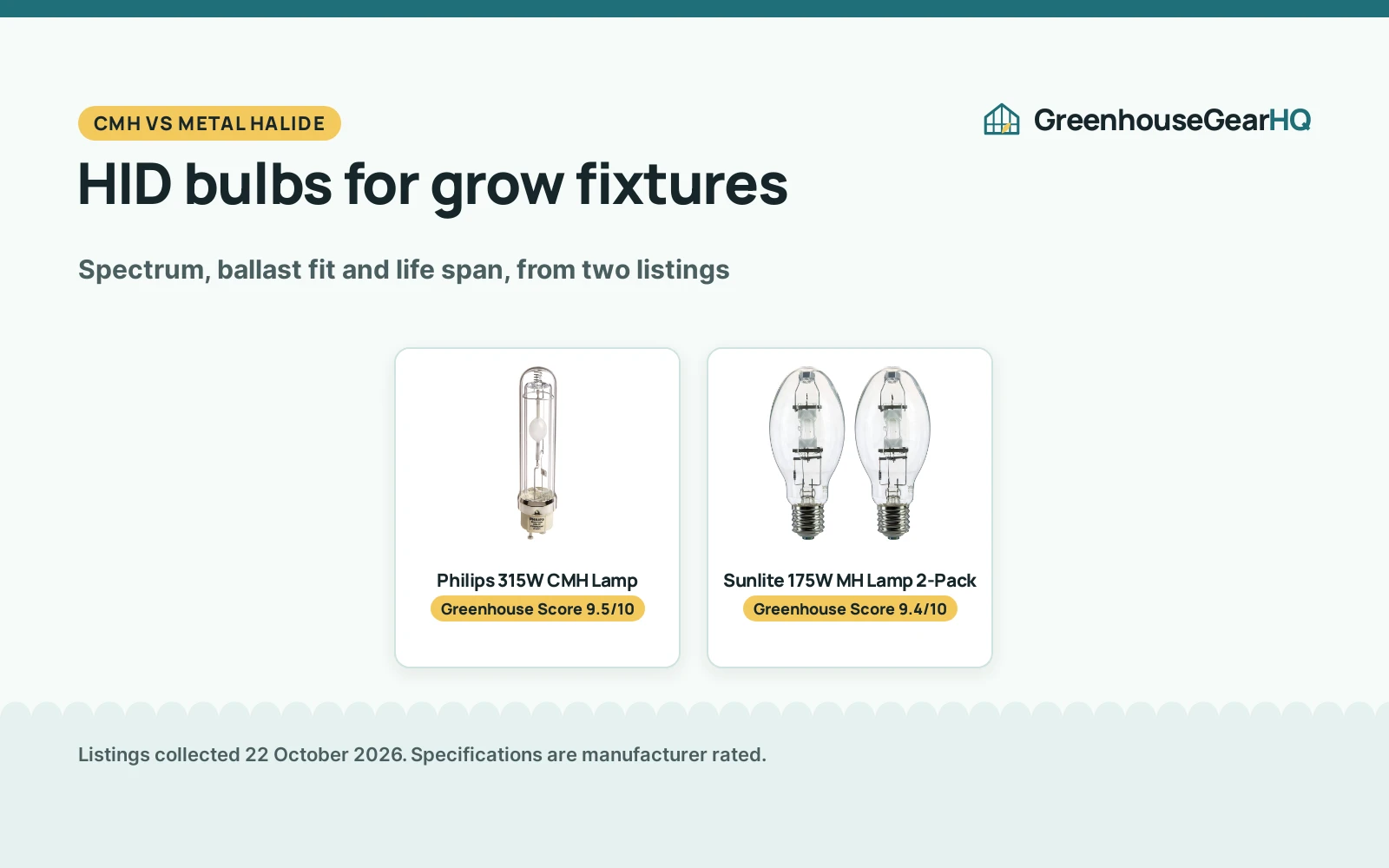
 Philips 315W CMH Lamp9.5/10View on Amazon
- 2
 Sunlite 175W MH Lamp 2-Pack9.4/10View on Amazon
The cmh vs metal halide choice comes up when a grow fixture needs a new bulb: both are HID lamps, but the two listings we compared are built for very different jobs. One is a Philips CMH lamp listed for plant growing; the other is a Sunlite metal halide 2-pack listed for commercial and outdoor lighting. This guide compares the two listings figure by figure, so the bulb matches the fixture and the job.
GreenhouseGearHQ earns a commission when you buy through links on this page, at no extra cost to you. As an Amazon Associate I earn from qualifying purchases. Affiliate disclosure.
Quick verdict: choose the CMH lamp if the fixture runs on a low-frequency square-wave ballast and the goal is plant growing, as the Philips listing describes. Choose the metal halide 2-pack if the fixture is an M57 ballast fixture used for general, commercial or outdoor lighting, as the Sunlite listing describes. The two sides differ on spectrum, ballast fit and stated life, not just wattage.
Two examples

Philips 315W CMH Lamp
A 315 watt CMH lamp for plant growing with 33,000 initial lumens, 3100K color and 92 CRI, built for low-frequency square-wave ballasts.
Pros
- 33,000 initial lumens at 105 lumens per watt
- 92 CRI and 3100K color temperature
- 90% lumen maintenance stated at 8,000 hours
- 1 year manufacturer warranty stated
Cons
- Must run on a low-frequency square-wave ballast, per the listing
- Bulb only; ballast and fixture are not included
- 1.5 minute run-up to 90% output
- Indoor use only, per the spec table

Sunlite 175W MH Lamp 2-Pack
A 2-pack of 175 watt metal halide lamps with 14,000 lumens each, 4000K color and a 10,000 hour life span, for M57 ballast fixtures.
Pros
- 14,000 lumens from 175 watts
- 10,000 hour life span stated
- 2-pack; a spare bulb is included
- ANSI M57 code stated for ballast matching
Cons
- Warranty says see packaging for details; no concrete term stated
- 65 CRI, below the Philips example's stated 92
- Listed for commercial and outdoor lighting, not plant growing
As an Amazon Associate I earn from qualifying purchases.
Other options worth a look
 Horticulture Ceramic Metal HalideCheck price on Amazon
 Sunlite MH250/U/MOG M58 Metal Halide LampCheck price on Amazon
 Sunlite 03640-SU MH70/U/MED M98 Metal Halide LampCheck price on Amazon
 Sunlite M102/O Protected Metal Halide Lamp 150W ClearCheck price on Amazon
CMH vs metal halide: side by side
| Bulb | Greenhouse Score | Wattage | Lumens | Color temp | CRI | Warranty |
|---|---|---|---|---|---|---|
| Philips 315W CMH Lamp | 9.5/10 | 315 W | 33,000 | 3100K | 92 | 1 year |
| Sunlite 175W MH Lamp 2-Pack | 9.4/10 | 175 W | 14,000 | 4000K | 65 | Not stated |
Each figure is the brand’s own rating, taken from its product page on 22 October 2026.
Light output and spectrum
The Philips CMH lamp lists 33,000 initial lumens from 315 watts, which the listing also expresses as 105 lumens per watt, with a 3100K color temperature and 92 CRI. It states 1.95 PPF per watt per second, which is the figure growers watch for plant-usable light. The Sunlite metal halide lamp lists 14,000 lumens from 175 watts, a 4000K color temperature and 65 CRI. Both listings state lumens, color temperature and CRI, so the spectrum comparison is direct: the CMH example publishes the warmer color, the higher CRI and a stated PPF figure, while the metal halide example publishes a cooler color and no PPF figure.
Ballast and fixture fit
This is where a wrong buy gets expensive. The Philips listing warns that the bulb must be used in a low frequency ballast, and cites the ANSI requirement for a low-frequency square-wave ballast with starting current limits of 4.1 to 5.3 amps RMS. The Sunlite listing says its bulb is for use in M57 ballast fixtures and advises confirming the ANSI code to match the bulb to the fixture. The bases differ too: the Philips is a T-12 tubular lamp at 1.75 by 7.75 inches, while the Sunlite is an ED28 with a mogul E39 base, its diameter and height given in the bullets. Check the ballast code and the socket before ordering either.
Life span and warm-up
The two listings measure life differently. Philips states 90% lumen maintenance at 8,000 hours and 85% PPF maintenance at 20,000 hours, plus a run-up time of 1.5 minutes to 90% output. Sunlite states a 10,000 hour average life span for its probe-start bulbs. Because one listing gives maintenance percentages and the other gives an average life span, the figures do not compare directly; treat them as two different ways of describing longevity. Neither lamp is instant-on: the Philips run-up figure is stated, and HID lamps in general need a warm-up period.
Listing gaps to check
The Philips spec table lists the bulb base as B22 alongside a T-12 shape, an odd pairing worth confirming with the seller before buying a fixture for it. The Sunlite spec table lists dimensions of 545 inches wide by 8.18 inches high, which does not match the diameter and height in the bullets; trust the bullets. The Sunlite warranty line reads “see packaging for details,” which is not a concrete term, while the Philips lists a 1 year manufacturer warranty.
Which should you choose?
Choose the CMH lamp if the fixture has a low-frequency square-wave ballast and the job is plant growing: the Philips example publishes 3100K, 92 CRI and a stated PPF figure for that purpose.
Choose the metal halide lamp if the fixture is an M57 mogul-base fixture for general lighting: the Sunlite example gives a 2-pack of 175 watt, 4000K bulbs with a stated 10,000 hour life span. For other lamp types, see our grow lights under 40 picks and the T5 vs CFL grow lights comparison.
In the Greenhouse
- Match the ballast first: the Philips needs a low-frequency square-wave ballast with 4.1 to 5.3 amp starting limits; the Sunlite needs an M57 fixture.
- The Philips is listed for indoor use only; the Sunlite lists indoor commercial and outdoor use, so only the Sunlite example suits an outdoor fixture.
- Check socket and clearance: the Sunlite bullets give the diameter and height with a mogul E39 base; the Philips gives 1.75 by 7.75 inches as a T-12 tube.
- Allow for warm-up: the Philips states 1.5 minutes to 90% output, so plan the light schedule around it, not instant-on switching.
Scoring notes
| Product | Greenhouse Score | Perf. /35 | Build /25 | Value /25 | Safety /10 | Warranty /5 |
|---|---|---|---|---|---|---|
| Philips 315W CMH Lamp | 9.5 | 32 | 21 | 20 | 0 | 2 |
| Sunlite 175W MH Lamp 2-Pack | 9.4 | 28 | 20 | 21 | 0 | 0 |
We rescale the weighted total onto a range that ends at 9.2 and 9.8; nothing in the conversion can reorder two picks.
The Greenhouse Score weighs performance, build, value, safety and warranty. For grow lamps, safety reflects stated electrical or photobiological certifications; neither listing states one, so neither earns safety points. The Philips scores higher on performance for its stated lumens per watt, CRI and PPF figures, and earns warranty points for its stated 1 year term. The Sunlite earns value points for the 2-pack but loses them for the dimension-table mismatch and the non-specific warranty line. How we pick explains the weights.
FAQ for growers
Can a CMH bulb run in a standard metal halide fixture?
Not according to the Philips listing, which warns the bulb must run on a low-frequency square-wave ballast with starting current limits of 4.1 to 5.3 amps RMS. The Sunlite example is built for M57 ballast fixtures. Confirm the ballast code before swapping bulb types.
Which bulb suits plant growing?
The Philips CMH lamp: its listing names plant growing as the specific use and publishes 3100K, 92 CRI and 1.95 PPF per watt per second. The Sunlite listing names commercial interiors, outdoor and perimeter lighting instead.
How long do these bulbs last?
The listings measure it differently. Philips states 90% lumen maintenance at 8,000 hours and 85% PPF maintenance at 20,000 hours; Sunlite states a 10,000 hour average life span. The figures describe different things, so they do not compare directly.
Does the Sunlite 2-pack include two bulbs?
Yes. The listing’s included components are 2 metal halide bulbs, while the Philips listing includes a single bulb.
Keep reading
See every grow lights guide and all greenhouse climate guides.
More picks: grow lights under 40, T5 vs CFL grow lights and grow light vs windowsill for seedlings.