On this page
Top picks at a glance
As an Amazon Associate I earn from qualifying purchases.
- 1
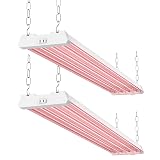 Sunco 2 Pack 4FT Full Spectrum LED Grow Lights 80W9.8/10View on Amazon
- 2
 VIVOSUN LumaLight 100W LED Grow Light9.7/10View on Amazon
- 3
 Spider Farmer SF1000 LED Grow Light9.7/10View on Amazon
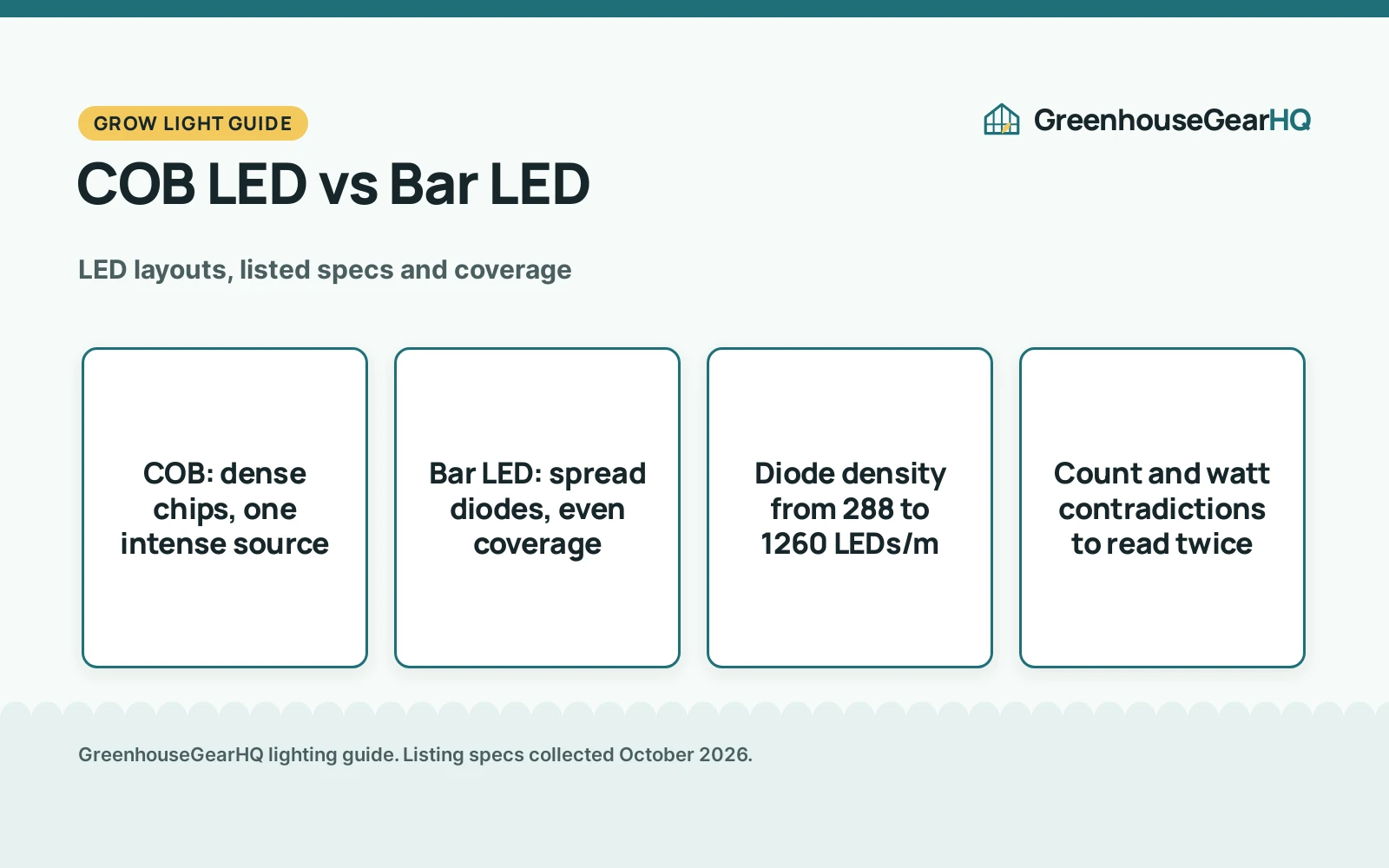
When the greenhouse lights go on in October and stay on into the evening, the shape of the fixture decides where the light lands. The cob led vs bar led question comes down to this: COB packs many diode chips into one intense point source, while bar-style LEDs spread diodes across several bars for even coverage. We compared COB LED listings to explain what each layout does and which grows each suits. Every number below comes from a product listing; where a listing gives no figure, we say so.
GreenhouseGearHQ earns a commission when you buy through links on this page, at no extra cost to you. As an Amazon Associate I earn from qualifying purchases. Affiliate disclosure.
Cob led vs bar led: the short answer
Choose COB when you want intense light from a compact fixture: chip-on-board packs hundreds of diodes per meter into a uniform, spotless beam, with the PAUTIX listing giving 480 LEDs/m at 24V and a 180-degree beam angle. Choose bar-style when you want even canopy coverage: distributed bars spread the light so no single hotspot forms. If you would rather compare light types, our LED vs HPS grow lights guide covers the bigger choice.
What COB LED is
COB, chip on board, mounts many small diode chips directly on one circuit board instead of packaging each diode separately. The result is a dense, dotless light source: the Govee listings give 1260 LEDs/m in a silicone sleeve for continuous spotless light, and the PAUTIX and BTF-LIGHTING listings give 480 LEDs/m with CRI 93+ and 90+ respectively. For growers, that density means one intense point source: strong light straight down, with intensity falling off toward the edges. COB fixtures run hot at the chip, so they need real heat sinking: the PAUTIX listing notes a double-layer copper PCB for heat dissipation, and the CHANZON chip listing rates its 3W emitters for under 60C (140F) with a heat sink.
What bar LED is
Bar-style LED grow lights take the opposite approach: instead of one dense chip, they spread diodes across several slim bars over the canopy. None of these listings is a bar-style grow light, so we give no bar figures here: the layout tradeoffs are qualitative. Distributed bars even out the light: each point of the canopy sits near a diode, which cuts hotspots and lets the fixture hang closer. The cost is size: a bar fixture spans the tent, with more wiring and mounting than a single compact head. For even, close-canopy coverage, bars win; for a compact punch of light, COB wins.
COB vs bar LED at a glance
| Layout | How it works | Suits | Watch for |
|---|---|---|---|
| COB LED | Dense chips on one board, one point source | Compact fixtures, deep light | Hotspot in the center; heat sinking needed |
| Bar LED | Diodes spread across bars | Even canopy coverage, close hanging | Bigger fixture; no bar figures in these listings |
Which should you buy?
Match the layout to the canopy. A small tent with one plant under the light points to COB: one intense source covers the footprint. A wide canopy or a rack of trays points to bars: even light across the whole area beats one hotspot. Check the beam angle and diode density on the listing: the PAUTIX COB gives 480 LEDs/m over a 180-degree beam, and wider beams suit closer hanging. Then read our full spectrum vs blurple grow lights guide for the spectrum side of the choice.
Read the listing twice
COB strip listings contradict themselves on diode counts and watts:
- Govee 9.8ft COB: the bullets say 1260 LEDs/m, but the spec table lists only 150 light sources.
- UVTaoYuan 5W strip: the title says 5W, but the bullets require a 10W 5V power supply.
- EMITEVER 32.8ft: the title says 3W/ft, but the spec table lists 76 watts for the 32.8-foot reel.
Trust the title and bullets over the spec table, and confirm the voltage: 12V and 24V strips need matching power supplies.
What this guide does not cover
This guide covers LED layouts only. It does not cover hanging height, light schedules or spectrum recipes, which depend on the crop and the fixture. The fixture maker’s manual gives those figures, and your local extension office can advise on timing for your area.
FAQ for growers
Is COB better than bar LED for growing?
Neither is better in general: COB gives an intense point source from a compact fixture, while bars give even coverage across a wide canopy. Match the layout to your grow space.
Do COB LEDs run hotter than bar LEDs?
The listings point that way: COB concentrates chips in one spot, so the PAUTIX listing builds in a double-layer copper PCB for heat dissipation and the CHANZON chips need a heat sink to stay under 60C (140F). Distributed bars spread the same heat over a larger area.
What does 480 LEDs/m mean?
It means 480 diode chips per meter of strip, as the PAUTIX and BTF-LIGHTING listings state. Higher density gives a more uniform, spotless light with no dark spots.
Can I cut COB LED strips to length?
The listings say yes, at marked points: the Govee strips cut every 8cm, the PAUTIX every 50mm, and the Samsion every 50cm. Cut only at the marks.
Keep reading
See every grow light guide and all light and heat guides.
More picks: LED vs HPS grow lights, full spectrum vs blurple grow lights and UV vs IR grow lights.