On this page
Top picks at a glance
As an Amazon Associate I earn from qualifying purchases.
- 1
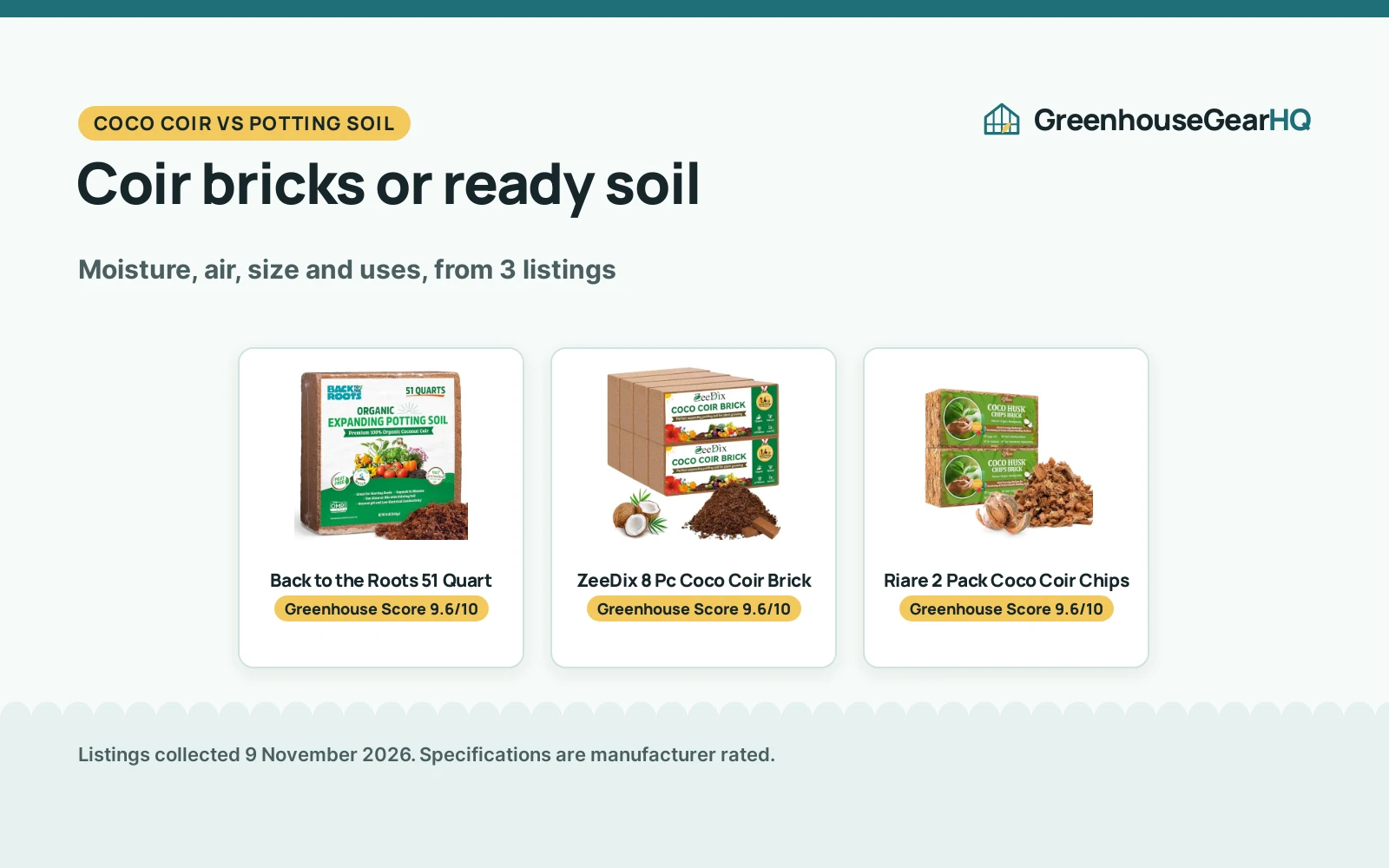
 Back to the Roots 51 Quart9.6/10View on Amazon
- 2
 ZeeDix 8 Pc Coco Coir Brick9.6/10View on Amazon
- 3
 Riare 2 Pack Coco Coir Chips9.6/10View on Amazon
The coco coir vs potting soil choice starts at the seed bench in late winter, when trays are filled and every scoop has to hold moisture. Coco coir is the fibrous husk of the coconut, sold as compressed bricks that expand in water, while potting soil is the ready-to-use mix that fills pots straight from the bag.
GreenhouseGearHQ earns a commission when you buy through links on this page, at no extra cost to you. As an Amazon Associate I earn from qualifying purchases. Affiliate disclosure.
Quick verdict: choose coco coir if you want compact bricks that store small, expand in water, and suit seed starting, orchids, and mulch, with low EC and balanced pH stated on both listings. Choose potting soil if you want a ready mix, though the Back to the Roots listing here is itself coir that expands to 51 quarts.
Three examples
| # | Product | Greenhouse Score | Buy |
|---|---|---|---|
| 1 | Back to the Roots 51 Quart | 9.6/10 | Buy on Amazon |
| 2 | ZeeDix 8 Pc Coco Coir Brick | 9.6/10 | Buy on Amazon |
| 3 | Riare 2 Pack Coco Coir Chips | 9.6/10 | Buy on Amazon |

Back to the Roots 51 Quart
A 10-pound compressed coir that expands to 51 quarts of potting soil, with a balanced pH, peat-free makeup and OMRI Listed status.
Pros
- Expands to 51 quarts from a 10-pound compressed coir
- Balanced pH, listed as all-purpose for pots and ground beds
- OMRI Listed, assuring organic production, handling, and processing
- Suits vegetables, flowers, herbs, and starting seeds
Cons
- No warranty term is stated
- Sold as potting soil, yet the listing describes coconut coir
- No smaller pack size is listed
- No drainage or aeration detail is stated beyond the balanced pH claim
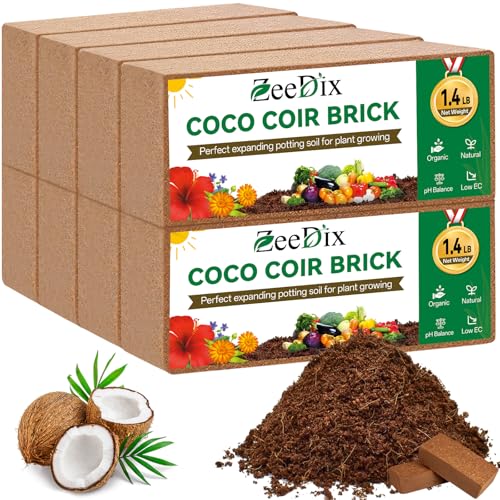
ZeeDix 8 Pc Coco Coir Brick
An 8-brick set of 100% coconut husk coir that expands to 16.8 gallons, with low EC and balanced pH for seed starting and beds.
Pros
- 8 bricks expand to 16.8 gallons of coir soil
- Low EC and balanced pH, stated for seed starting
- 100% coconut husk, listed as a renewable peat moss alternative
- Fibrous structure holds moisture and lets air reach roots
Cons
- Each brick needs soaking and fluffing before planting
- No nutrient content is stated
- No warranty term is stated

Riare 2 Pack Coco Coir Chips
A 2-pack of coconut husk chip bricks, each 1.1-pound brick expanding to 7 quarts, with low EC and pH balance for orchids, mulch, and soil mixes.
Pros
- Chip form drains well and resists root saturation
- Low EC and pH balanced, listed for healthy root growth
- Each 1.1-pound brick expands to 7 quarts after soaking
- Works alone or mixed with perlite, charcoal, and soil
Cons
- No total expanded volume for the pack is stated, only 7 quarts per brick
- No warranty term is stated
- No nutrient content is stated
As an Amazon Associate I earn from qualifying purchases.
Other options worth a look
 Coco BlissCheck price on Amazon
 Riare 2pcs Organic Coco Coir BricksCheck price on Amazon
 Organic Coco Coir 1 Pcs Compressed Coconut Coir Brick CoconutCheck price on Amazon
 Coco Bliss Coco Coir 650gm BricksCheck price on Amazon
 Buffered Coco BlissCheck price on Amazon
 VIVOSUN 3 Pcs Coco Coir BrickCheck price on Amazon
Coco coir vs potting soil: side by side
| Growing Medium | Greenhouse Score | Form | Expanded volume | Item weight | Warranty | Amazon |
|---|---|---|---|---|---|---|
| Back to the Roots 51 Quart | 9.6/10 | Compressed coir | 51 quarts | 10.0 pounds | Not stated | View on Amazon |
| ZeeDix 8 Pc Coco Coir Brick | 9.6/10 | 8 compressed bricks | 2.1 gallons per brick | 11.2 pounds | Not stated | View on Amazon |
| Riare 2 Pack Coco Coir Chips | 9.6/10 | 2 compressed chip bricks | 7 quarts per brick | 2.2 pounds | Not stated | View on Amazon |
We reproduce the maker’s listed specs without adjustment (collected 9 November 2026).
Moisture and air
The coir side leans on fiber. ZeeDix describes a fibrous structure that holds moisture while letting air reach roots, and Riare describes chips that drain well, hold moisture in the pot, and let air reach roots. Both coir listings state low EC and balanced pH. Back to the Roots states a balanced pH, but no drainage or aeration detail.
Form and volume
All 3 listings arrive compressed and expand in water. ZeeDix lists 8 bricks that expand to 16.8 gallons, with each 1.4-pound brick expanding to 2.1 gallons. Riare lists 2 chip bricks, with each 1.1-pound brick expanding to 7 quarts. Back to the Roots lists a 10-pound compressed coir that expands to 51 quarts of potting soil. None of the 3 arrives ready to use.
Uses around the greenhouse
ZeeDix suits seed starter mix, raised bed filler, and veggies, succulents, and orchids. Riare suits orchid cultivation, mulching, landscaping, and mixing with perlite, charcoal, and soil. Back to the Roots suits vegetables, flowers, herbs, and starting seeds, in pots or in the ground.
Listing gaps to check
ZeeDix contradicts itself on brick size: the bullets say 8 x 4 x 2 inches, the spec table lists 3.94 x 5.91 x 3.15 inches. Riare does the same: the bullets say 8 x 4 x 1.8 inches, the spec table lists 7.87 x 1.97 x 4.13 inches. Back to the Roots blurs the sides, since it is sold as potting soil yet describes coconut coir that expands to soil.
How to choose the best coco coir vs potting soil
Pick the form for the job
Fine fiber suits seed starting and raised beds, while chips suit orchids and mulch. ZeeDix lists fine fiber for seed starter mix, and Riare lists chips for orchid cultivation and mulching. Our peat moss vs perlite guide compares more amendments for airy mixes.
Count the volume you need
Check the expanded volume before ordering. ZeeDix expands to 16.8 gallons across 8 bricks, Riare expands to 7 quarts per brick, and Back to the Roots expands to 51 quarts. Our seed starting mix vs garden soil guide compares more mixes.
Plan the soaking step
All 3 listings expand in water, so set out a tub of warm water before planting day. ZeeDix lists a soak, fluff, and plant routine, and Riare lists soaking each brick before use.
In the Greenhouse
- Soak ZeeDix bricks in a tub with warm water, then fluff before filling trays.
- Set Riare chips out as mulch, or mix them with perlite, charcoal, and soil for orchid pots.
- Fill seed trays with the Back to the Roots mix in late winter.
Scoring notes
| Product | Greenhouse Score | Perf. /35 | Build /25 | Value /25 | Safety /10 | Warranty /5 |
|---|---|---|---|---|---|---|
| Back to the Roots 51 Quart | 9.6 | 30 | 21 | 21 | n/a | 0 |
| ZeeDix 8 Pc Coco Coir Brick | 9.6 | 29 | 21 | 21 | n/a | 0 |
| Riare 2 Pack Coco Coir Chips | 9.6 | 28 | 20 | 20 | n/a | 0 |
Every score falls within 9.2 and 9.8, and a pick moves toward the top end only by earning more weighted points. Safety applies only to powered equipment or to listings that name safety features; for other items the scale is 90 points.
The Greenhouse Score weighs performance, build, value, safety and warranty. For growing media, safety means a stated safety-relevant feature; no listing here states a safety-relevant feature. Back to the Roots scores highest for its all-purpose range and OMRI Listed status. ZeeDix follows for its 16.8-gallon set, and Riare scores lower for its small 2-pack. None of the 3 states a warranty term, and How we pick explains the weights.
FAQ for growers
Is coco coir better than potting soil for seed starting?
Both coir listings state low EC and balanced pH. ZeeDix lists seed starter mix, and Back to the Roots lists starting seeds.
How much soil does a coir brick make?
Each ZeeDix brick expands to 2.1 gallons, each Riare brick expands to 7 quarts, and the Back to the Roots compressed coir expands to 51 quarts.
Can coco coir replace potting soil?
The Back to the Roots listing sells coir as potting soil, and both coir listings list use alone or mixed with soil.
Keep reading
See every seed starting tray guide and all seed starting guides.
More picks: self-watering seedling trays, shallow seedling trays, clear seedling trays and seed starting mix vs garden soil.