On this page
Top picks at a glance
As an Amazon Associate I earn from qualifying purchases.
- 1
 Robosource Polycarbonate Sheet 12 x 24 x 1/8 Inch9.6/10View on Amazon
- 2
 EVERECO 6-Pack Polycarbonate Sheets9.6/10View on Amazon
- 3
 XISOCO 12-Pack Twin-Wall Polycarbonate Panels9.7/10View on Amazon
A greenhouse roof that needs new panels starts with a question, and the cost of polycarbonate sheet depends on thickness, size and pack count more than on anything else. This guide walks through what sets the cost, step by step, using the sizes and figures the listings state, so you can measure your frame and buy the right panels the first time.
GreenhouseGearHQ earns a commission when you buy through links on this page, at no extra cost to you. As an Amazon Associate I earn from qualifying purchases. Affiliate disclosure.
What sets the cost of a polycarbonate sheet
A polycarbonate sheet is priced by how much material it holds and how it is made, so the figures that move the cost are the ones the listings print first: thickness, size and pack count. The listings here show 2 thicknesses, 0.16 inch and 0.24 inch, and the thicker sheet holds more material in every square foot of panel. Twin-wall construction adds insulating air channels between 2 walls, which also adds material against a flat sheet.
Size works the same way. The listings run from 47.2 by 23.6 inch panels and 4 by 2 foot panels up to 8 by 4 foot panels, and a bigger sheet covers more of a roof or wall with fewer seams. Pack count matters too: the listings offer packs of 6, 10, 12 and 14 panels, and a bigger pack suits a whole roof while a small pack suits a repair or a cold frame.
Coatings and light figures also shape what you pay. The Sinimaka listing blocks 99.9% of UV while allowing 89% light transmission, the FAHKNS listing allows 80% light transmission, and the Bezseller listing transmits up to 99% of natural light. A UV-protected side, like the one LUXGOLD lists, must face outward toward the sun, and that coating is part of what the sheet is made to do.
Cost of polycarbonate sheet, step by step
Work through the steps in order, and measure before cutting.
Step 1: Measure the frame
Measure each opening in the frame, then match the sheet size to it. The listings offer 47.2 by 23.6 inch panels, 5 by 2 foot panels, 4 by 2 foot panels and 8 by 4 foot panels, so a small cold frame and a large greenhouse roof need different sheets. Write each opening down before ordering, and check the size on the listing against the opening it must cover.
Step 2: Pick a thickness
Thickness is the main cost driver after size. The listings show 0.16 inch and 0.24 inch twin-wall sheets, and the 0.24 inch sheet is near 1/4 inch thick. The Sinimaka listing states its 0.24 inch panels withstand hail and falling objects without cracking, and the FAHKNS listing calls its 0.24 inch panels shatterproof and highly resistant to impact. Pick the thicker sheet where hail or falling objects are a risk, and the thinner sheet where the frame is sheltered.
Step 3: Count the panels
Count the openings, then count the sheets. The Storystore listings offer 6 and 14 panels of the same 47.2 by 23.6 inch size, the Sinimaka listing offers 10 panels of 8 by 4 feet, the Bezseller listing offers 12 panels of 5 by 2 feet, the LUXGOLD listing offers 6 panels of 4 by 8 feet, and the FAHKNS listing offers 14 panels of 4 by 2 feet. Large 8 by 4 foot sheets cover a roof with fewer seams, while small packs suit a repair or a cold frame.
Step 4: Check light and UV
Light transmission decides how bright the growing space stays. The Sinimaka listing allows 89% light transmission while blocking 99.9% of UV, the FAHKNS listing allows 80% light transmission, and the Bezseller listing transmits up to 99% of natural light. The LUXGOLD listing states the UV-protected side must face outward toward the sun, so check which side is printed before fitting. A bright panel suits seedlings and leafy crops, while a lower transmission suits plants that like shade.
Step 5: Check temperature, cutting and fitting
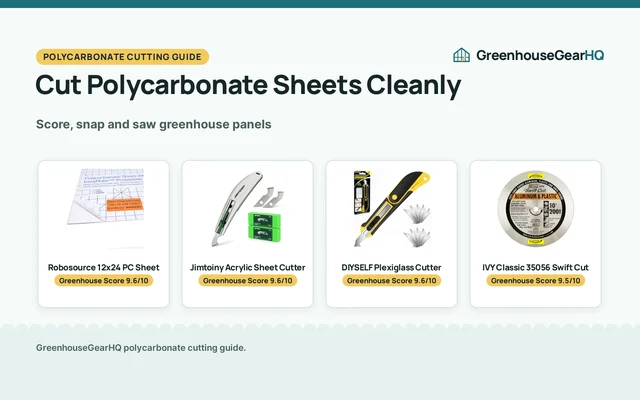
Polycarbonate handles a wide temperature range. The Sinimaka listing states a working range from -40°C to 120°C, and the FAHKNS listing states a range from -44°C to 120°C. The sheets cut with a utility knife, scissors or a saw without cracking or splintering, and the Sinimaka listing states they can be cold-bent for curved roofs. Peel off the protective film on both sides before use, and note that the LUXGOLD listing states connectors are not included and mounting hardware is not included, so allow for those parts as well.
| Panel listing | Stated size | Thickness | Pack | Light transmission |
|---|---|---|---|---|
| Storystore twin-wall panels, 6 pack | 47.2 by 23.6 inches | 0.16 inch | 6 | Not stated |
| Storystore twin-wall panels, 14 pack | 47.2 by 23.6 inches | 0.16 inch | 14 | Not stated |
| Sinimaka twin-wall panels | 8 by 4 feet | 0.24 inch | 10 | 89% |
| Bezseller twin-wall panels | 5 by 2 feet | 0.16 inch | 12 | Up to 99% |
| LUXGOLD twin-wall panels | 4 by 8 feet | 0.24 inch | 6 | Not stated |
| FAHKNS twin-wall panels | 4 by 2 feet | 0.24 inch | 14 | 80% |
What the listings do not tell you
The listings state sizes, thicknesses and light figures, but they do not state a price per sheet, so compare the figures above and ask the seller for the delivered cost of the pack you need. For cutting, see our polycarbonate sheets how to cut guide.
Check the frame material too. Our aluminum vs polycarbonate greenhouse comparison covers frames that take these panels, and our best clear polycarbonate tape picks cover sealing the joints.
FAQ for growers
How thick should polycarbonate greenhouse panels be?
The listings show 0.16 inch and 0.24 inch twin-wall sheets, and the 0.24 inch sheet is near 1/4 inch thick. Pick 0.24 inch where hail or falling objects are a risk; the Sinimaka listing states its 0.24 inch panels withstand hail without cracking.
What size polycarbonate sheets do greenhouses use?
The listings offer 47.2 by 23.6 inch panels, 5 by 2 foot panels, 4 by 2 foot panels and 8 by 4 foot panels. Measure each opening, then match the sheet to it.
How much light do polycarbonate panels let through?
It varies by listing. Sinimaka allows 89% light transmission while blocking 99.9% of UV, FAHKNS allows 80%, and Bezseller transmits up to 99% of natural light.
Can polycarbonate sheets handle cold winters?
Yes. The Sinimaka listing states a working range from -40°C to 120°C, and the FAHKNS listing states a range from -44°C to 120°C.
Keep reading
See every polycarbonate greenhouses guide and all greenhouses guides. Also see our glass vs wood cold frame comparison. Also see our best greenhouse for overwintering plants picks.
More picks: greenhouse for overwintering plants, clear polycarbonate tape and glass vs wood cold frame.