On this page
Top picks at a glance
As an Amazon Associate I earn from qualifying purchases.
- 1
 Robosource 12x24 PC Sheet9.6/10View on Amazon
- 2
 Jimtoiny Acrylic Sheet Cutter9.6/10View on Amazon
- 3
 DIYSELF Plexiglass Cutter9.6/10View on Amazon
- 4
 IVY Classic 35056 Swift Cut9.5/10View on Amazon
With a cold snap on the way, the spare panel for the greenhouse door still needs trimming, and polycarbonate sheets how to cut cleanly is the question that decides whether the edge comes out smooth or cracked. The answer is simple: score thin sheets and snap them along the groove, and saw thicker panels with a fine-tooth blade, keeping the protective film on until the cut is done.
GreenhouseGearHQ earns a commission when you buy through links on this page, at no extra cost to you. As an Amazon Associate I earn from qualifying purchases. Affiliate disclosure.
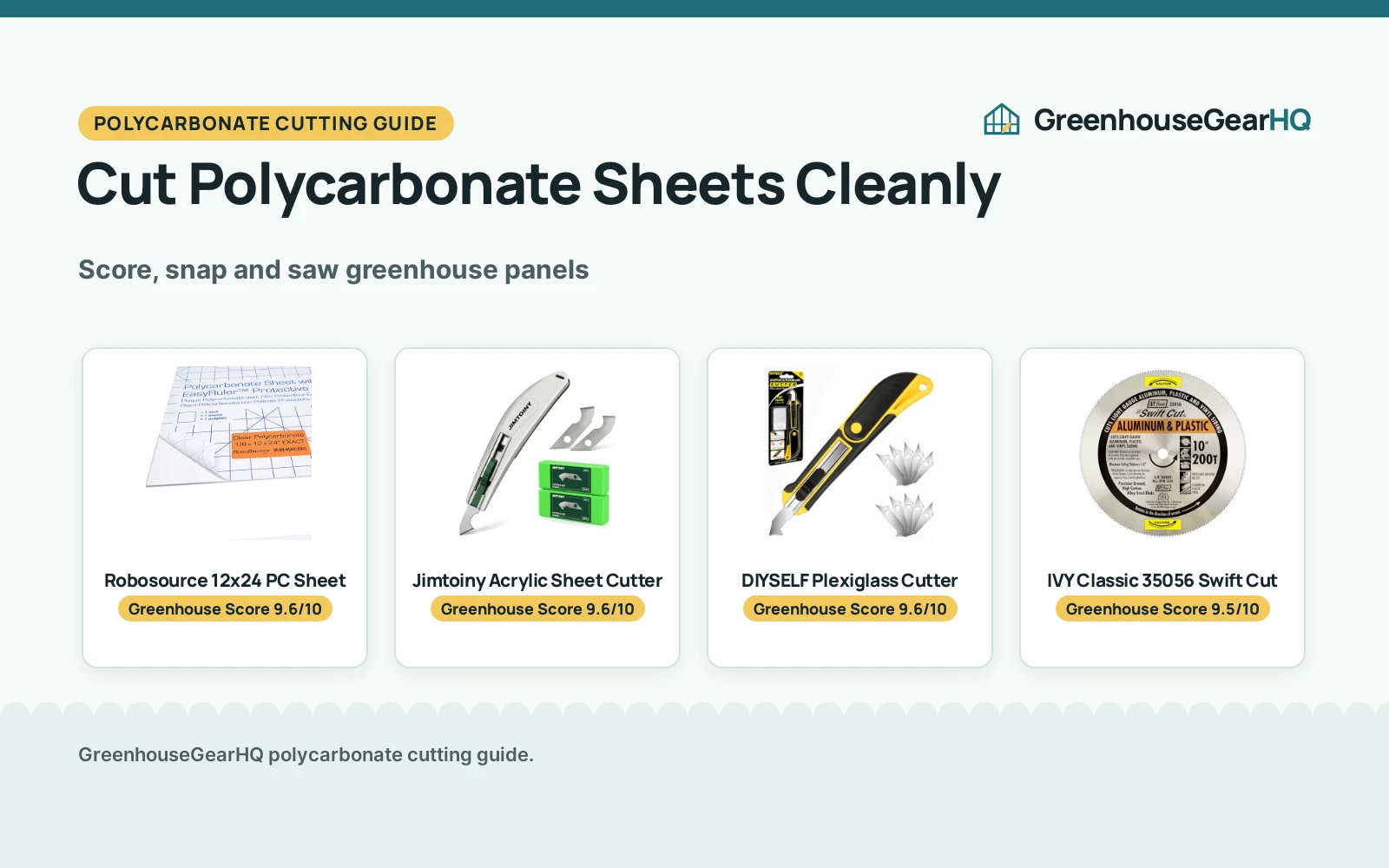
| # | Product | Greenhouse Score | Buy |
|---|---|---|---|
| 1 | Robosource 12x24 PC Sheet | 9.6/10 | Buy on Amazon |
| 2 | Jimtoiny Acrylic Sheet Cutter | 9.6/10 | Buy on Amazon |
| 3 | DIYSELF Plexiglass Cutter | 9.6/10 | Buy on Amazon |
| 4 | IVY Classic 35056 Swift Cut | 9.5/10 | Buy on Amazon |

Robosource 12x24 PC Sheet
A clear 12 x 24 inch polycarbonate sheet at 1/8 inch thick that cuts without cracking and is UV stabilized for moderate sun.
Pros
- Exact 12 x 24 inch size, not a nominal cut
- Shatter resistant and easy to cut without cracking
- UV stabilized for moderate sunlight exposure
Cons
- Single sheet in the package
- Maker recommends UV coated sheets for significant direct sun
- No warranty term is stated

Jimtoiny Acrylic Sheet Cutter
A score-and-snap cutter with 23 blades that the maker lists as best for 1-3mm sheets, with a blade lock and on-tool blade storage.
Pros
- 23 blades included, with on-tool storage and 2 refill packs
- Honest thickness guide: best for 1-3mm sheets
- Blade lock and included case for storage
Cons
- Not recommended for sheets 5mm and thicker
- Blade does not retract, and the listing warns it can cause serious injury if left loose
- No warranty term is stated

DIYSELF Plexiglass Cutter
A scoring cutter with 10 SK5 steel blades and a non-slip grip for straight score-and-snap cuts in thin to medium plastic sheets.
Pros
- 10 SK5 steel blades included
- Push-and-release blade change needs no tools
- Non-slip TPR grip for steadier scoring
Cons
- Suits thin to medium materials, not especially thick material
- No thickness range in numbers is stated
- No warranty term is stated

IVY Classic 35056 Swift Cut
A 10 inch, 200-tooth circular saw blade for cutting plastic and light gauge aluminum up to 1/8 inch thick.
Pros
- 200 teeth with no set for smooth, accurate cuts
- High carbon-alloy steel blade
- Cuts plastic and light gauge aluminum up to 1/8 inch thick
Cons
- For material thicker than 1/8 inch, the maker points to a different blade
- Single blade per card
- No warranty term is stated
As an Amazon Associate I earn from qualifying purchases.
Other options worth a look
 Clear Polycarbonate Sheet 48" x 96"Check price on Amazon
 Clear Polycarbonate Sheet 24" x 48"Check price on Amazon
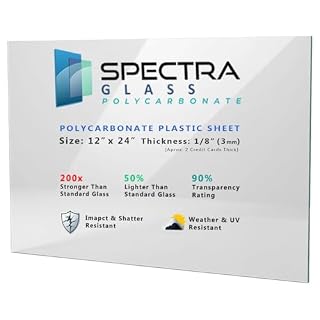 Clear Polycarbonate Sheet 12" x 24"Check price on Amazon
 Clear Polycarbonate Sheet 24" x 24"Check price on Amazon
 Beeveer Polycarbonate Clear Plastic SheetCheck price on Amazon
 1 Pcs Polycarbonate Clear Plastic SheetCheck price on Amazon
Polycarbonate sheets how to cut: the short answer
Score thin sheets with a hooked scoring cutter, then snap them along the groove. The Jimtoiny cutter (on Amazon) lists 5-8 passes for 1-3mm sheets before the snap, and 10 or more passes on both sides for 4mm sheets. For panels the scoring cutter cannot handle, the IVY Classic blade cuts plastic up to 1/8 inch thick on a circular saw. Keep the protective film on while you work: the Jimtoiny listing says to keep film on, and the Robosource sheet (on Amazon) ships with EasyRuler film that peels off after the cut.
What cutting a sheet needs
Match the tool to the sheet thickness. A scoring cutter suits thin panels: the Jimtoiny cutter is listed as best for 1-3mm sheets, and the DIYSELF cutter (on Amazon) suits thin to medium materials. A saw blade suits panels that need power behind the cut: the IVY Classic blade (on Amazon) is a 10 inch, 200-tooth blade with a 5/8 inch arbor for plastic up to 1/8 inch thick.
How to cut polycarbonate sheets, step by step
Step 1: Mark the panel
Measure the opening the panel must fill, then mark the cut line on the film, not on the bare sheet. The Robosource sheet is listed at exactly 12 x 24 inches, so check the marked size against the sheet before cutting. Leave the film in place while you work: it guards the surface from scratches.
Step 2: Score thin sheets and snap
Hold the scoring cutter at 15 degrees, using the tip, and score lightly along the line. The Jimtoiny listing calls for 5-8 passes on 1-3mm sheets, then a snap along the groove for a clean break. The DIYSELF cutter works the same way: score a line with the SK5 blade, then snap the sheet along the groove. For 4mm sheets, score 10 or more times on both sides. The Jimtoiny listing warns against using the cutter on sheets 5mm and thicker, and points to a saw instead.
Step 3: Saw panels the cutter cannot handle
Fit the IVY Classic blade to the saw, with the blade turning in the direction of the arrows marked on the blade. The blade is a 10 inch, 200-tooth steel blade that cuts plastic up to 1/8 inch thick, with precision ground teeth and no set for smooth cuts. Feed the sheet steadily and let the teeth do the work.
Step 4: Clean the edge
After the snap or the saw cut, clear burrs from the edge. The Jimtoiny listing says to use the hollow curve of the tool to scrape burrs, with no sandpaper. Peel the film off only when the cut is done and the panel is ready to fit.
| Tool | Stated thickness | Method | Amazon |
|---|---|---|---|
| Jimtoiny scoring cutter | 1-3mm | Score 5-8 times, then snap | |
| DIYSELF scoring cutter | Thin to medium | Score, then snap | |
| IVY Classic saw blade | Up to 1/8 inch | Saw cut |
The gear
The sheet sets the size, the scoring cutters handle thin panels, and the saw blade handles panels up to 1/8 inch thick.
In the greenhouse or on the bench?
Cut on a flat bench where the sheet lies still, not on a lap or a soft surface. A bench cut keeps the score line straight and the snap clean. The Robosource sheet is UV stabilized for moderate sunlight exposure, so a panel cut for a greenhouse door or a cold frame keeps its clear surface outdoors. For a panel that will face significant direct sun over extended periods, the listing recommends UV coated sheets instead. Our polycarbonate greenhouses guide covers panels in place, and our single wall vs twin wall polycarbonate guide compares sheet types.
What this guide does not cover
This guide covers cutting only. The Robosource listing states the sheet can also be drilled, bent and thermoformed, and that simple tools like snips or hacksaws can cut it, but this guide does not give drilling or bending steps. For the structure itself, see our greenhouses guides.
FAQ for growers
Can you cut polycarbonate sheets with a score-and-snap cutter?
Yes, for thin sheets. The Jimtoiny cutter is listed as best for 1-3mm sheets: score 5-8 times, then snap along the groove. For 4mm sheets, score 10 or more times on both sides, and for sheets 5mm and thicker the listing points to a saw.
What saw blade cuts polycarbonate sheets?
The IVY Classic 35056 is a 10 inch, 200-tooth circular saw blade that cuts plastic up to 1/8 inch thick. Its teeth are precision ground with no set, and the blade must rotate in the direction of the arrows.
Should you leave the film on when cutting polycarbonate?
Yes. The Jimtoiny listing says to keep film on while scoring, and the Robosource sheet ships with EasyRuler film that peels off after the cut to expose a clear surface.
How thick a sheet can a scoring cutter handle?
The Jimtoiny cutter is listed as best for 1-3mm sheets and not recommended for sheets 5mm and thicker. The DIYSELF cutter suits thin to medium materials, with no thickness range stated in numbers.
Keep reading
See every greenhouses guide and all polycarbonate greenhouses guides. Also see our cold frames guide and our aluminum vs polycarbonate greenhouse comparison.
More picks: mini greenhouses, cold frames and single vs twin wall polycarbonate.