On this page
Top picks at a glance
As an Amazon Associate I earn from qualifying purchases.
- 1
 EAGLE PEAK 8x8 Pop Up Greenhouse9.8/10View on Amazon
- 2
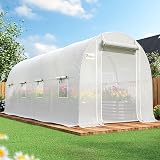 KING BIRD 15x7x7 Walk-in Greenhouse9.8/10View on Amazon
- 3
 Outsunny 20x10x7 Walk-in Greenhouse9.8/10View on Amazon
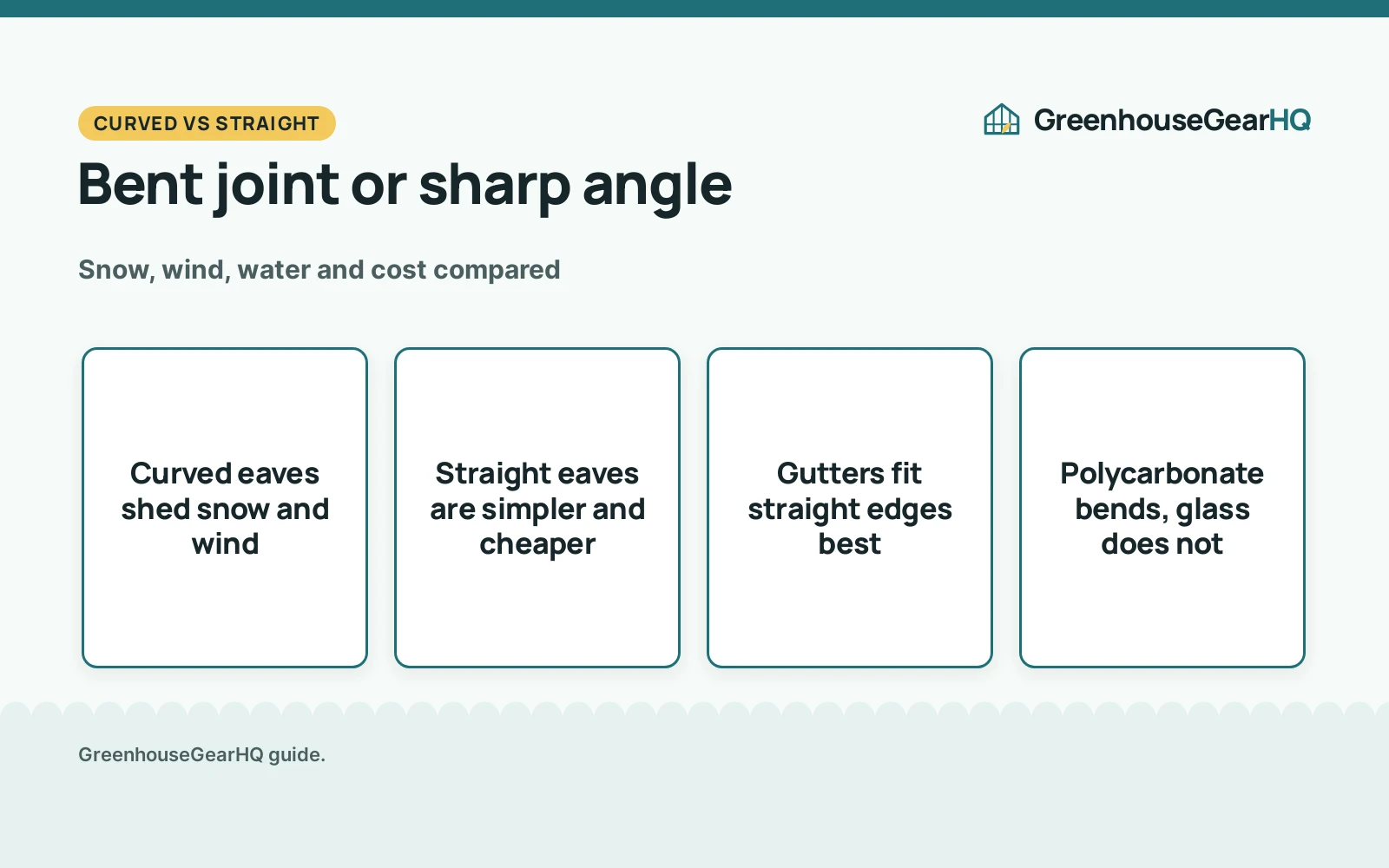
Curved eave vs straight eave greenhouse comes down to the roof-to-wall joint: a curved eave bends smoothly from wall into roof, while a straight eave meets at a hard angle. The listings here are eave accessories rather than greenhouses: rainwater collection kits and half-round PVC gutters in 0.5 to 1.5 m lengths for roof drainage, plus a NOIRDA polycarbonate sheet at 0.50m x 3.0m for cladding. Curved eaves shed snow and wind better; straight eaves are simpler to build and gutter. Choose curved for harsh weather, straight for simplicity.
GreenhouseGearHQ earns a commission when you buy through links on this page, at no extra cost to you. As an Amazon Associate I earn from qualifying purchases. Affiliate disclosure.
What a curved eave is
A curved eave, sometimes called a gothic arch profile, transitions from the vertical wall to the sloped roof in a smooth bend instead of a sharp corner. The curve sheds snow and wind: there is no flat ledge for snow to sit on and no sharp edge for wind to grab. The tradeoff is construction complexity, since glazing a curve needs bendable material. Polycarbonate sheets like the NOIRDA 0.50m x 3.0m 1mm panels in the listings bend where glass cannot, which is why curved eaves are a polycarbonate or film design, not a glass one.
What a straight eave is
A straight eave is the conventional joint: vertical wall, angled roof, meeting at a crisp line. Every part is a straight cut, which makes framing, glazing and repairs simple, and standard gutters fit neatly along the edge. The half-round PVC gutters in the listings, in 0.5 to 1.5 m lengths, are made for exactly this edge: a straight eave gives rainwater a clean line to fall from into the gutter. Straight eaves dominate kit greenhouses because they are cheap to manufacture.
Snow, wind and water
Weather is where the two diverge. Curved eaves shed snow by geometry, and their smooth profile spills wind rather than catching it. Straight eaves hold snow at the joint until it slides or melts, and the sharp edge is a wind catch point, which is why anchoring and bracing matter more. For water, the straight eave wins on simplicity: gutters and rainwater collectors, like the many eave-mounted kits in the listings, mount cleanly to a straight edge. A curved eave needs custom flashing to catch its runoff.
Build cost and repair
Straight eaves are cheaper to build and far easier to repair: straight cuts, standard parts, and any damaged panel is a rectangle you can replace. Curved eaves need bent or custom-formed parts, which cost more and are harder to source as spares. Over the life of the house, the straight eave’s simplicity usually beats the curved eave’s weather advantage on total cost, unless your site sees the kind of snow that punishes flat joints.
Curved eave vs straight eave greenhouse: which suits you
Match the eave to your weather. Heavy snow and exposed windy sites: the curved eave earns its keep by shedding both. Sheltered sites, tight budgets and DIY builds: the straight eave is simpler, cheaper and easier to gutter, with the 0.5 to 1.5 m PVC gutters in the listings fitting right on. Most kit buyers get a straight eave by default; curved is the upgrade you choose deliberately.
Glazing choice follows the eave. Curved eaves need flexible cladding: polycarbonate sheets like the NOIRDA 0.50m x 3.0m panels bend to the curve, and film stretches over it naturally. Glass cannot bend, so a curved eave rules out glass entirely. Straight eaves take anything: glass, polycarbonate or film, all in straight cuts. If you have your heart set on glass, the eave decision is already made.
FAQ for growers
What is a curved eave greenhouse?
One where the wall bends smoothly into the roof instead of meeting at a sharp angle. The curve sheds snow and wind better than a straight joint.
Can I put gutters on a curved eave?
It is harder: standard gutters like the half-round PVC lengths in the listings are made for straight edges. Curved eaves need custom flashing for runoff.
Which eave is stronger in snow?
The curved eave, by geometry: snow slides off the bend instead of loading the joint. Straight eaves need the joint built for the local snow load.
One more consideration is resale and insurance: unusual profiles can complicate both, while a conventional straight-eave house is the shape every buyer and every insurer recognizes. Boring is an asset when paperwork is involved.
Do curved eaves cost more?
Yes, generally: bent or custom-formed parts cost more than straight cuts, and spares are harder to find. Straight eaves are the budget choice.
Keep reading
See every greenhouse guide and all light and heat guides.
More picks: attached vs detached greenhouse, clear vs diffused greenhouse plastic and geodesic dome vs A frame greenhouse.