On this page
Top picks at a glance
As an Amazon Associate I earn from qualifying purchases.
- 1
 VEVOR Garden Dome Tent 9.5 x 5.7 ft Clear Bubble Tent for 2-49.6/10View on Amazon
- 2
 VEVOR 9.6x6.4x6.2 ft Walk-In Tunnel Greenhouse with9.6/10View on Amazon
- 3
 VEVOR Garden Dome Tent 12 x 7.2 ft Clear Bubble Tent HouseView on Amazon
- 4
 VEVOR Garden Dome Tent 15 x 9.5 ft Clear Bubble Tent HouseView on Amazon
- 5
 Build A Geodesic Dome Greenhouse: Under $3.50/Sq Ft. by PruView on Amazon
- 6
 Propagator Tray with Vented DomeView on Amazon
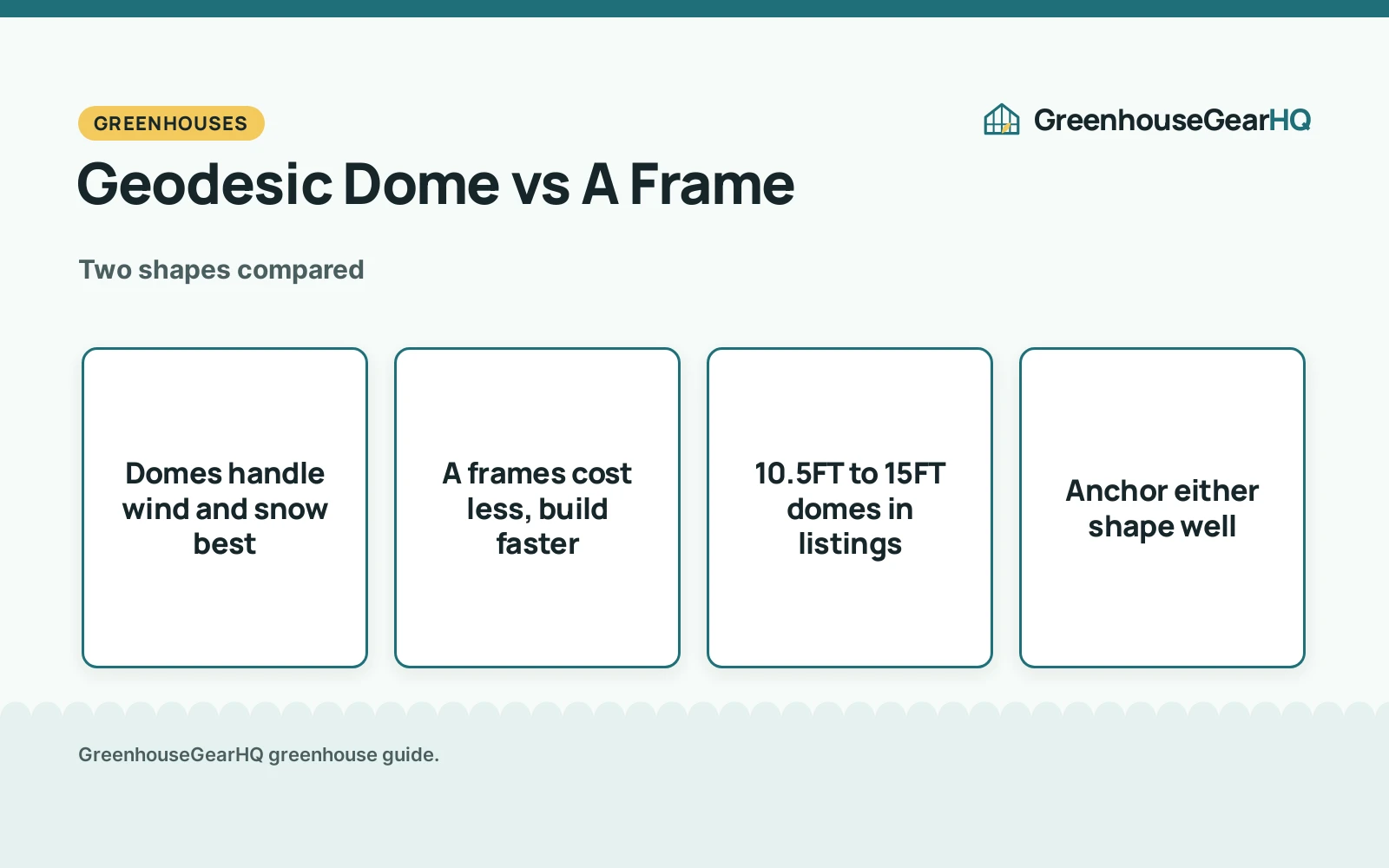
Geodesic dome vs A frame greenhouse comes down to shape: a dome is a sphere of triangles that sheds wind and snow in every direction, while an A frame is a simple peaked tent shape that is cheaper and easier to build. Domes suit exposed, windy sites and year-round use; A frames suit sheltered spots and seasonal growing on a budget. All of the listings here are geodesic domes, from 10.5FT to 15FT, so the dome figures below come from those listings and the A frame side is described in general terms.
Other options worth a look
 VEVOR Garden Dome Tent 12 x 7.2 ft Clear Bubble Tent HouseCheck price on Amazon
 VEVOR Garden Dome Tent 15 x 9.5 ft Clear Bubble Tent HouseCheck price on Amazon
- Build A Geodesic Dome Greenhouse: Under $3.50/Sq Ft. by PruCheck price on Amazon
 VEVOR Garden Dome Tent 9.5 x 5.7 ft Clear Bubble Tent HouseCheck price on Amazon
 Propagator Tray with Vented DomeCheck price on Amazon
GreenhouseGearHQ earns a commission when you buy through links on this page, at no extra cost to you. As an Amazon Associate I earn from qualifying purchases. Affiliate disclosure.
What a geodesic dome greenhouse is
A geodesic dome greenhouse is a half-sphere built from triangular struts, with a transparent cover stretched over the frame. The MAPONEEN listings state 10.5FT, 12.5FT and 15FT geodesic dome greenhouses with TPU clear covers, the CZGBRO listing states a 12FT garden dome house, and the VEVOR listings state 12 x 7.2 ft and 15 x 9.5 ft garden dome tents for 4 to 7 and 12 to 14 people. The triangle structure distributes loads across the whole shell, which is why domes handle wind and snow better than flat-sided designs.
What an A frame greenhouse is
An A frame greenhouse is two sloped sides meeting at a ridge, like a tent. It is the simplest rigid shape to build: straight cuts, simple joints and a cover draped over the peak. That simplicity makes it the cheapest way to get plants under cover, and the steep sides shed rain well. The tradeoff is structural: the flat-ish sides catch wind, and snow loads concentrate on the long slopes. No listing here states an A frame, so compare A frame kits on their own stated dimensions.
Wind, snow and exposure
This is the dome’s home turf. The spherical shape lets wind flow around it with no flat wall to push against, and the triangulated shell carries snow loads evenly. An A frame’s broad sloped sides act like sails in a crosswind and need solid anchoring in exposed sites. If your site is open, coastal or snowy, the dome’s shape is worth the premium; in a sheltered backyard, the A frame’s simpler structure is plenty.
Usable space and layout
The shapes use space differently. A dome’s curved walls mean the edges are too low for tall plants or benches, though the center is tall and open; the VEVOR 15 x 9.5 ft dome for 12 to 14 people shows the gathering scale these reach. An A frame’s straight sides give more usable wall height for shelving along the edges, and its rectangular footprint fits standard benches and beds with no wasted corners. For growing in rows, the A frame lays out more efficiently; for a statement garden room, the dome wins.
Cost and assembly
A frames cost less and go up faster: fewer unique parts, simple joints and no specialized connectors. Domes need hub connectors and many struts cut to exact lengths, which is why the listings sell them as complete kits: the MAPONEEN and CZGBRO listings are all-in kits with covers. Assembly takes longer on a dome, but you get a structure that needs no internal posts. If budget and speed matter most, the A frame is the answer.
Geodesic dome vs A frame greenhouse: which to buy
Buy the dome for exposed sites, snow country and year-round structures where strength matters: the 12.5FT and 15FT MAPONEEN listings show the sizes available as kits. Buy the A frame for sheltered seasonal growing on a budget, where simple construction and efficient bench layout beat ultimate strength. Either way, anchor the structure as the maker directs: even a dome becomes a kite in a real storm if it is not tied down.
What this guide does not cover
This guide covers the two shapes only, not glazing materials or heating. For structure materials, our aluminum vs galvanized steel greenhouse guide compares them, and our attached vs detached greenhouse guide covers placement.
FAQ for growers
Are geodesic domes stronger than A frames?
Yes, for wind and snow. The triangulated shell spreads loads in every direction, while an A frame’s flat sides catch wind and concentrate snow on the slopes.
Which shape is cheaper?
The A frame. Straight cuts and simple joints make it the cheapest rigid greenhouse to build, while domes need hubs, many struts and kit packaging.
What sizes do dome kits come in?
The listings state 10.5FT, 12FT, 12.5FT and 15FT domes, plus the VEVOR 12 x 7.2 ft and 15 x 9.5 ft models. Match the diameter to your site and the plants inside.
Can I use a dome year-round?
The shape suits year-round use in wind and snow, which is the dome’s main advantage. Heating and ventilation still decide winter growing success.
Keep reading
See every greenhouse guide and all light and heat guides.
More picks: aluminum vs galvanized steel greenhouse, attached vs detached greenhouse and best floor for a small greenhouse.