On this page
Top picks at a glance
As an Amazon Associate I earn from qualifying purchases.
- 1
 Quictent 20x10x6.6 FT Tunnel Greenhouse with Dual Hinged Doors9.8/10View on Amazon
- 2
 VEVOR Garden Dome Tent 15 x 9.5 ft Clear Bubble Tent HouseView on Amazon
- 3
 VEVOR Garden Dome Tent 12 x 7.2 ft Clear Bubble Tent HouseView on Amazon
- 4
 VEVOR Garden Dome Tent 9.5 x 5.7 ft Clear Bubble Tent HouseView on Amazon
- 5
 Build A Geodesic Dome Greenhouse: Under $3.50/Sq Ft. by PruView on Amazon
- 6
 Propagator Tray with Vented DomeView on Amazon
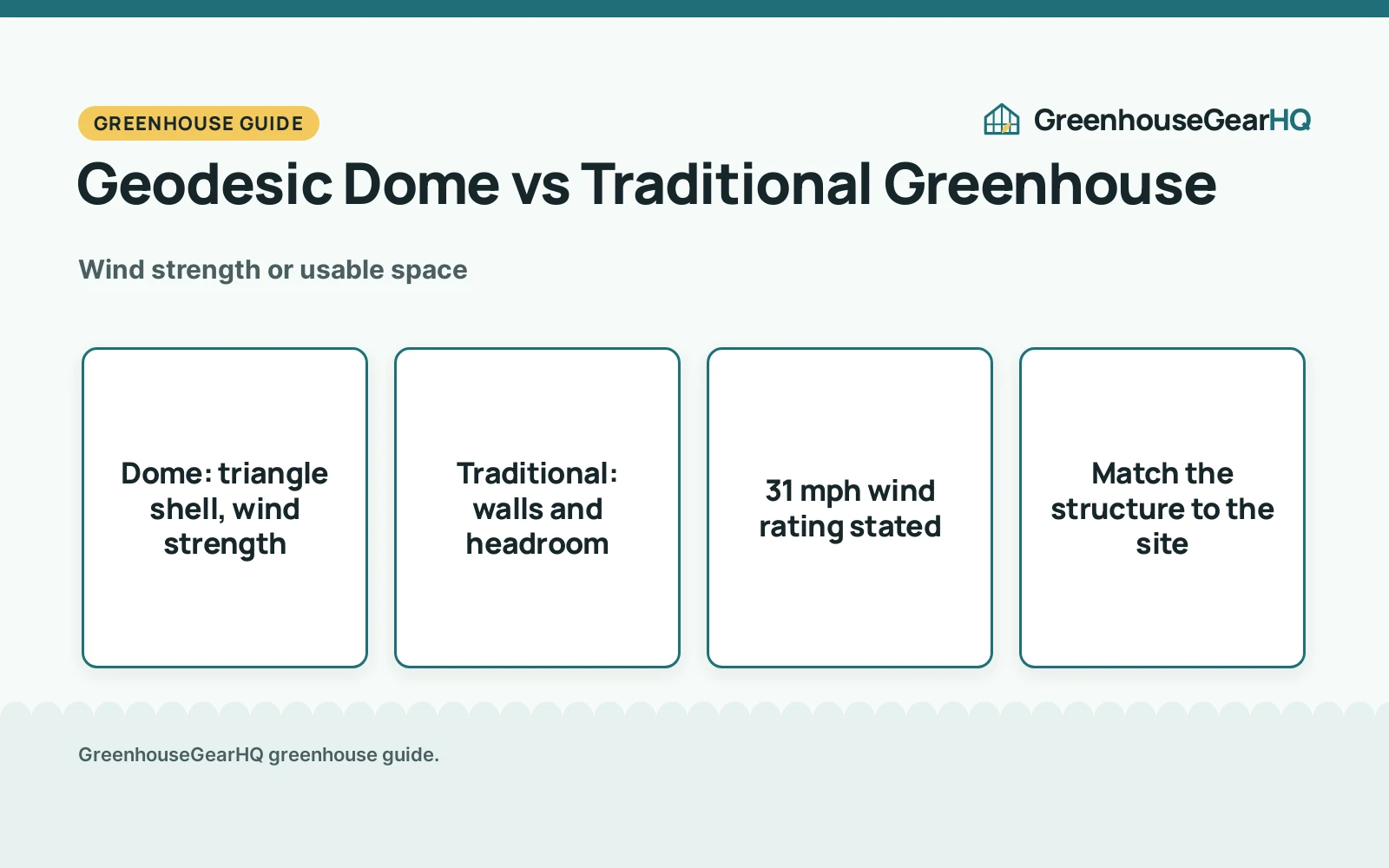
Geodesic dome vs traditional greenhouse: the short answer is that a geodesic dome’s triangle frame spreads wind and snow loads across its whole shell, while a traditional greenhouse gives vertical walls and headroom with simpler construction. One is a structural marvel; the other is the practical default. The reference listings give concrete figures for the dome side; the traditional side is explained without figures where none are stated.
Other options worth a look
 VEVOR Garden Dome Tent 15 x 9.5 ft Clear Bubble Tent HouseCheck price on Amazon
 VEVOR Garden Dome Tent 12 x 7.2 ft Clear Bubble Tent HouseCheck price on Amazon
 VEVOR Garden Dome Tent 9.5 x 5.7 ft Clear Bubble Tent HouseCheck price on Amazon
- Build A Geodesic Dome Greenhouse: Under $3.50/Sq Ft. by PruCheck price on Amazon
 Propagator Tray with Vented DomeCheck price on Amazon
GreenhouseGearHQ earns a commission when you buy through links on this page, at no extra cost to you. As an Amazon Associate I earn from qualifying purchases. Affiliate disclosure.
Geodesic dome vs traditional greenhouse: how they differ
The difference is how the frame carries loads. A geodesic dome is a network of triangles forming a sphere: every strut shares the wind and snow load, and the curved shell sheds weather. A traditional greenhouse is posts and walls with a peaked or curved roof: simpler to frame and glaze, with vertical walls that keep every square foot usable.
Geodesic dome: triangles against the wind
Domes suit exposed sites where wind is the enemy. The listings show the type: the VEVOR garden dome tent listings come at 15 x 9.5 ft for 12 to 14 people, 12 x 7.2 ft for 4 to 7 people, and 9.5 x 5.7 ft for 2 to 4 people, with 0.3mm clear panels and a 31 mph wind rating. The CZGBRO 12-foot garden dome listing states room for 5 to 7 people at 45 lbs, and the Jinrrenyi geodesic dome greenhouse listing states a 12-foot dome at 44 lbs. The triangle frame needs no internal posts, so the whole floor stays open; the tradeoffs are curved walls that waste edge space and glazing that is harder to replace panel by panel.
Choose a dome when wind or snow is the main threat, when you want the strongest frame per pound, and when open floor space matters more than straight walls.
Traditional greenhouse: walls, headroom and simplicity
Traditional suits growers who want usable space and simple builds. Vertical walls keep benches and tall plants right at the edges, the peaked roof takes ridge vents where hot air collects, and flat or curved glazing comes in standard panels that are easy to replace. Construction is straightforward framing rather than a network of custom struts. No traditional greenhouse kits with stated figures appear in these listings, so check each listing for the frame material, glazing and wind rating before buying.
Choose traditional when usable space and headroom matter most, when you want standard replaceable glazing, and when the site is reasonably sheltered.
How to decide: site, plants and build
Start with the site. Exposed, windy ground favors the dome: the VEVOR listings state a 31 mph wind rating across three sizes, and the triangle shell has no flat faces for the wind to catch. Sheltered backyards favor the traditional house for its space. Then check the plants: tall crops and benches want the traditional’s vertical walls, while the dome’s open floor suits beds and gatherings, with the 15 x 9.5-foot listing fitting 12 to 14 people. Finally, weigh the build: a dome’s strut network is a bigger assembly project than a traditional frame.
Which one should you buy?
| Type | Frame | Example figure | Suits |
|---|---|---|---|
| Geodesic dome | Triangle shell | 31 mph wind rating | Exposed, windy sites |
| Geodesic dome | Triangle shell | 15 x 9.5 ft, 12 to 14 people | Open floor space |
| Traditional | Posts and walls | Not stated | Usable space, simple build |
Match the structure to the site. Windy and exposed leans dome: see our budget greenhouses for kit examples. Space and simplicity lean traditional; browse every walk-in greenhouse guide for more.
FAQ for growers
What wind can a garden dome take?
The VEVOR garden dome tent listings state a 31 mph wind rating across the 15 x 9.5-foot, 12 x 7.2-foot and 9.5 x 5.7-foot sizes. Anchor the dome per the listing for the rating to hold.
How big is a 15-foot garden dome?
The VEVOR 15 x 9.5-foot garden dome tent listing states room for 12 to 14 people, the largest dome here. The 12-foot CZGBRO dome fits 5 to 7 people, and the 9.5 x 5.7-foot VEVOR fits 2 to 4.
Which is easier to ventilate?
Traditional: peaked roofs take ridge vents where hot air collects. Domes need top or side vents fitted to the curved shell, which is a harder retrofit.
Which wastes less space?
Traditional. Vertical walls keep the full footprint usable to the edges, while a dome’s curved walls lose headroom around the perimeter.
Keep reading
See every walk-in greenhouse guide and all greenhouse guides.
More picks: budget greenhouses, greenhouse plastic for cold climates, greenhouse fans.