On this page
Top picks at a glance
As an Amazon Associate I earn from qualifying purchases.
- 1
 VEVOR Garden Dome Tent 9.5 x 5.7 ft Clear Bubble Tent for 2-49.6/10View on Amazon
- 2
 KING BIRD 15x6.6x6.6FT Walk-In Tunnel Hoop House with9.8/10View on Amazon
- 3
 VEVOR Garden Dome Tent 15 x 9.5 ft Clear Bubble Tent HouseView on Amazon
- 4
 VEVOR Garden Dome Tent 12 x 7.2 ft Clear Bubble Tent HouseView on Amazon
- 5
 Build A Geodesic Dome Greenhouse: Under $3.50/Sq Ft. by PruView on Amazon
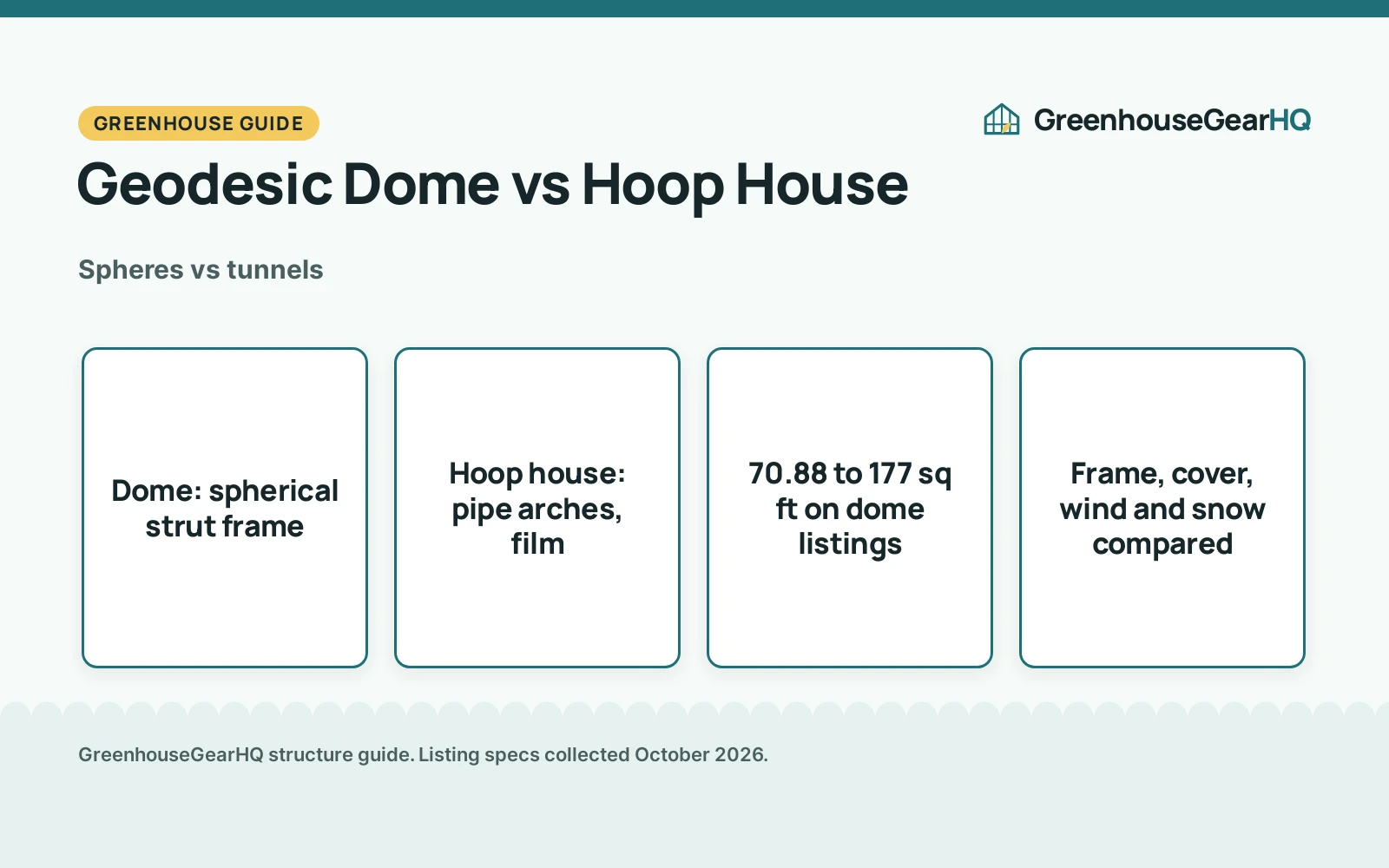
On the first cold snap of autumn, the question is whether your tender plants sit under a sphere or a tunnel. The geodesic dome vs hoop house choice comes down to this: a geodesic dome is a round room of triangular panels that sheds wind and snow from every side, while a hoop house is a row of pipe arches under film that stretches long over beds. We compared geodesic dome listings and set them against how a hoop house is built, to show which grower each suits. Every number below comes from a product listing, and where a listing gives no figure we say so.
Other options worth a look
 VEVOR Garden Dome Tent 15 x 9.5 ft Clear Bubble Tent HouseCheck price on Amazon
 VEVOR Garden Dome Tent 12 x 7.2 ft Clear Bubble Tent HouseCheck price on Amazon
 VEVOR Garden Dome Tent 9.5 x 5.7 ft Clear Bubble Tent HouseCheck price on Amazon
- Build A Geodesic Dome Greenhouse: Under $3.50/Sq Ft. by PruCheck price on Amazon
GreenhouseGearHQ earns a commission when you buy through links on this page, at no extra cost to you. As an Amazon Associate I earn from qualifying purchases. Affiliate disclosure.
Geodesic dome vs hoop house: the short answer
Choose a geodesic dome if you want one round, enclosed room on a backyard pad, with a door and windows built in. The VEVOR 15 by 9.5 foot dome lists 177 square feet of floor area. Choose a hoop house if you want length: arches and film that cover a run of garden rows, sized by the bed rather than the room. If you want a taller walk-in structure, our walk-in greenhouses guide compares those.
What a geodesic dome is
A geodesic dome is a spherical frame of struts joined at hubs, wrapped in a cover. The VEVOR 15 by 9.5 foot listing states a 15-foot diameter, 9.5 feet of height and a 70-pound weight. Smaller VEVOR sizes list 113.1 square feet at 50.5 pounds (12 foot) and 70.88 square feet at 38.7 pounds (9.5 foot). Domes are sold by diameter, so the floor is a circle and the room is one open space.
What a hoop house is
A hoop house is a series of pipe or tube arches set into the ground and covered with greenhouse film. It is long and low, and you add length by adding arches. We found no hoop house listing with published figures to compare, so we give no hoop house size, rating or weight here. The points below describe the design in general terms: a simple pipe frame, a film cover, and ventilation usually handled by rolling up or opening the ends and sides.
Geodesic dome vs hoop house at a glance
| Feature | Geodesic dome (VEVOR listings) | Hoop house |
|---|---|---|
| Size and floor area | 177 sq ft at 15 ft; 113.1 sq ft at 12 ft; 70.88 sq ft at 9.5 ft | Sized by the row; no figure stated |
| Frame material | PC poles with PBT connectors | Pipe or tube arches; material not stated |
| Cover | 0.3mm PVC; the listings state no UV protection | Greenhouse film; thickness not stated |
| Wind and snow | Maker lists 31 mph wind and 90 pounds of snow | Not stated |
| Door and ventilation | Door plus side triangle windows (6.8 ft door on the 15 ft model) | Open or roll up the ends and sides |
| Assembly | Not stated; stakes, clamps and sandbags included | Arches pushed or driven into the ground, film pulled over |
Which should you buy?
Choose a dome if you have a round backyard pad and want a single enclosed room with a door, windows and a clear cover. The 15-foot VEVOR suits a patio room or a seed-starting corner, and the 12-foot and 9.5-foot sizes suit tighter spots.
Choose a hoop house if you grow in long rows and want the cover to follow the beds. It is a frame and film, so the shape stretches where a dome cannot. Expect to work out your own sizing and check the maker’s ratings for any model you consider, since no hoop house figures are stated here.
One dome detail to weigh: the 12 by 7.2 foot listing title says 12 feet while its size field says 11.8 by 7.2 feet, and the VEVOR listings state no UV protection on the PVC cover. For the growing side, see our greenhouse guides.
FAQ for growers
How big are the listed geodesic domes?
The VEVOR domes run from 9.5 to 15 feet across, with floor areas from 70.88 to 177 square feet and weights from 38.7 to 70 pounds.
Can a geodesic dome handle snow and wind?
The maker lists each VEVOR dome for winds up to 31 mph and 90 pounds of snow. Stakes, clamps and sandbags come in the box for anchoring, and these are the maker’s figures, not a guarantee for your site.
Do dome covers block UV?
The VEVOR listings state no UV protection on the 0.3mm PVC cover. Check the product details before you buy if sun protection matters to you.
Can a hoop house be a permanent greenhouse?
A hoop house is a pipe frame under film, set into the ground, so it suits seasonal row cover. No hoop house ratings are stated here, so check the maker’s figures for any model you consider.
Keep reading
See every walk-in greenhouse guide and all greenhouse guides.
More picks: dome vs traditional, mini greenhouses and light and heat.