On this page
Top picks at a glance
As an Amazon Associate I earn from qualifying purchases.
- 1
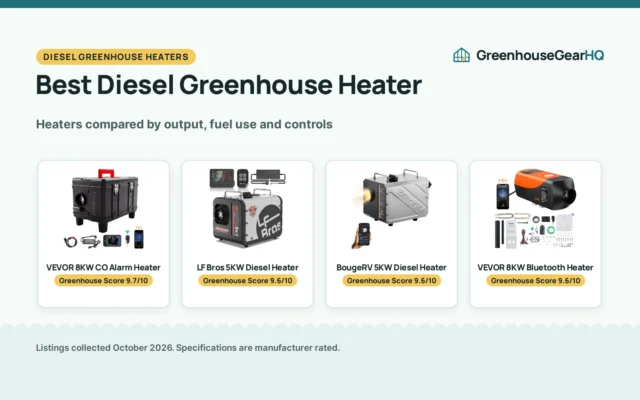
 VEVOR 8KW Diesel Heater with Bluetooth App Control9.7/10View on Amazon
- 2
 BioGreen Electric Greenhouse Heater and Fan with Digital9.7/10View on Amazon
- 3
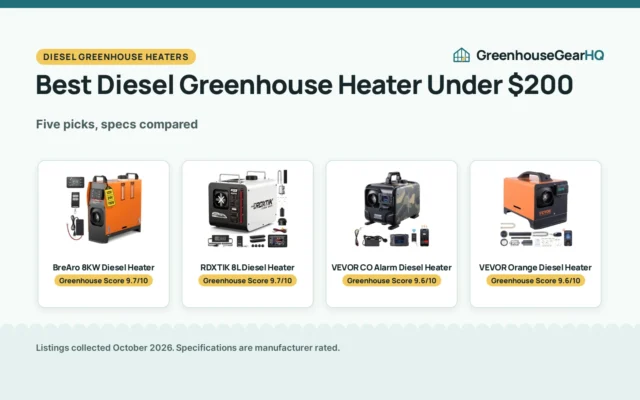
 BreAro 8KW Diesel Heater9.7/10View on Amazon
- 4
 VEVOR 8KW Diesel Heater with Bluetooth App Control ForView on Amazon
- 5
 VEVOR Diesel HeaterView on Amazon
- 6
 BougeRV 5KW Diesel HeaterView on Amazon
- 7
 VEVOR Diesel Heater 8KWView on Amazon
- 8
 8L Diesel HeaterView on Amazon
A diesel vs kerosene greenhouse heater choice comes down to the fuel system: diesel air heaters blow forced hot air and route exhaust out through a pipe, while kerosene heaters are usually self-contained radiant or convection units that burn fuel from a refillable tank. Both run without grid power, which makes them options for greenhouses far from an outlet, but they differ in venting, runtime and controls. This guide compares the two styles using only what current listings state, so you can match a fuel type to how you heat your greenhouse.
Other options worth a look
 VEVOR 8KW Diesel Heater with Bluetooth App Control ForCheck price on Amazon
 VEVOR Diesel HeaterCheck price on Amazon
 VEVOR 8KW Diesel HeaterCheck price on Amazon
 BougeRV 5KW Diesel HeaterCheck price on Amazon
 VEVOR Diesel Heater 8KWCheck price on Amazon
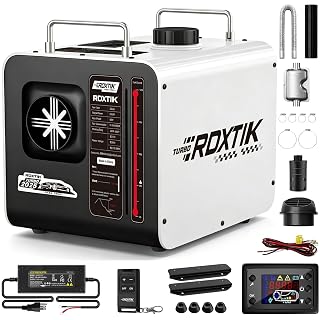 8L Diesel HeaterCheck price on Amazon
GreenhouseGearHQ earns a commission when you buy through links on this page, at no extra cost to you. As an Amazon Associate I earn from qualifying purchases. Affiliate disclosure.
How diesel air heaters work
A diesel air heater is an 8kW forced-air unit that runs on DC 12V to 24V and burns diesel from an onboard tank. The VEVOR all-in-one listings describe a ceramic igniter for cold-weather starts, a precision fuel pump and a heat exchanger that transfers warmth into blown air. Several listings state an applicable range of 161 to 215 ft2, while others state 215 to 269 ft2, and temperature control is listed between 32 and 104 F on some models and 46.4 to 96.8 F on others.
Fuel use is the headline figure in these listings. The VEVOR listings state consumption of 0.18 to 0.36 L/h, or about 1 gallon per night, from a 5 L (1.3 gal) tank; a 10 L (2.6 gal) tank model lists up to 16 hours of continuous heat. On controls, the listings offer a remote control with up to 98 ft range, Bluetooth app control on some models and an LCD display. Safety features stated include a heat-insulated exhaust pipe shield, a leak-proof fuel cap, overheat protection at 518 F and 270 C, and a built-in CO alarm on one model. Our diesel vs propane greenhouse heater comparison covers a related fuel matchup.
How kerosene heaters work
A kerosene heater burns kerosene from a tank in a portable cabinet, usually with radiant or convection heat and no fan. The HeatMate HMN-110 lists 10,000 BTU, heating up to 400 sq ft, from a 1.2 gallon tank with up to 14 hours of burn time, push-button start, an automatic safety shut-off and a tip-over switch. The listing states the unit needs no electricity, with battery-powered ignition.
The Kero World KW-24J lists a larger output: 23,800 BTUs, heating up to 1,000 sq ft, running up to 12 hours on a 1.9 gallon tank, with a tip-over emergency shut-off and a 2 year manufacturer’s warranty. Both listings describe their heaters as portable and usable indoors or outdoors, with protective grills around the burner. See also our best greenhouse heater picks for more heating styles compared side by side.
Diesel vs kerosene greenhouse heater: the key differences
| Feature | Diesel air heater | Kerosene heater |
|---|---|---|
| Heat style | Forced hot air from a fan | Radiant or convection heat, usually no fan |
| Power source | DC 12V to 24V plus diesel | Kerosene only, no electricity needed |
| Stated coverage | 161 to 269 ft2 across the listings | 400 to 1,000 sq ft across the listings |
| Stated runtime | Up to 16 hours from a 10 L tank | Up to 14 hours from a 1.2 gal tank |
| Fuel use stated | 0.18 to 0.36 L/h, about 1 gallon per night | Tank refills, no hourly figure stated |
| Stated safety features | Exhaust pipe shield, overheat protection, CO alarm on one model | Automatic shut-off, tip-over switch |
What the listings state about safety and venting
Fuel-burning heaters need fresh air and careful placement, and the listings give only part of the picture. The VEVOR diesel listings describe a heat-insulated exhaust pipe shield, which routes hot exhaust away from the unit, and one model lists a built-in CO alarm that alerts or shuts the heater off. The kerosene listings state tip-over switches and automatic safety shut-off. No listing in the data claims a heater is safe to leave running unattended, so follow the maker’s manual for any model you buy.
A practical difference is power: diesel air heaters need a 12V or 24V DC source, such as a vehicle battery or power station, while kerosene heaters need no electricity at all, with battery-powered ignition. If the greenhouse has no power, that decides the question quickly. Our gas vs electric greenhouse heater comparison covers another fuel-versus-grid choice.
How to choose the right fuel for your greenhouse
Heat delivery
Diesel air heaters push warmed air out with a fan, so the heat reaches the corners of the space sooner. Kerosene models like the HeatMate and Kero World listings give off radiant or convection heat, which suits a grower who wants steady warmth without a blower. Match the stated coverage to the greenhouse: the VEVOR listings state 161 to 269 ft2, while the kerosene listings state 400 to 1,000 sq ft.
Runtime and refills
Look at how long a full tank lasts. The VEVOR 10 L tank model lists up to 16 hours of continuous heat at 0.18 to 0.36 L/h, and the HeatMate HMN-110 lists up to 14 hours from its 1.2 gallon tank. Longer runtime means fewer refills on cold nights, but both fuels need safe storage away from the growing area, following the maker’s guidance.
Controls and extras
Diesel listings carry more controls: remote control up to 98 ft, Bluetooth app control and LCD displays with temperature adjustment. Kerosene listings are simpler, with push-button start and a flame adjuster. If you like to preheat the greenhouse before a morning visit, the remote and app features of the diesel units are worth comparing; see our natural gas vs propane greenhouse heater comparison for yet another fuel option.
FAQ for growers
Can I run a diesel air heater in a greenhouse?
The listings describe these units for vehicles, RVs and garages, and they run on DC 12V to 24V, so the greenhouse needs a battery or power station. Route the exhaust pipe outside the growing space as the listing shows, and follow the maker’s manual.
Do kerosene heaters need electricity?
No. The HeatMate listing states the heater needs no electricity, with battery-powered ignition and push-button start. That makes kerosene units usable in a greenhouse with no power at all.
Which fuel type runs longer on a fill?
It depends on the tank. The VEVOR 10 L diesel model lists up to 16 hours of continuous heat, and the HeatMate kerosene heater lists up to 14 hours from a 1.2 gallon tank. Compare the stated runtime against how long your cold nights last.
Keep reading
See every greenhouse heaters guide and all greenhouse climate guides. Also see our diesel vs propane greenhouse heater comparison. Also see our gas vs electric greenhouse heater comparison. Also see our natural gas vs propane greenhouse heater comparison.
More picks: greenhouse heaters.